
After more than a decade of deciding its NASCAR Cup Series based on an often-maligned playoff system that featured 16 drivers, whittled down over multiple rounds, with the title ultimately decided by the top-finishing driver in a single race, NASCAR took a step back in time for the 2026 season.
While the sanctioning body did not go to a full-season system that had been building support in recent years, it returned to its first attempt at a regular season and postseason format, the Chase.

Chase 2.0 features 16 drivers, more than the 12 it last showcased, seeded based on the points they earned throughout the first 26 races. NASCAR padded the points for winning a race significantly this year as well and kept the points earned for finishing in the top 10 in the first two stages of each race. It’s a system that rewards running at the front of the field all day and winning races but does not completely negate consistency and running inside the top 10 or 15 week in and week out.
The original Chase underwent several changes over the years, perhaps the most notable being the shift from the Latford points system, which awarded more points for top-five and top-10 finishes, to the current tally, which separates finishing positions by a single point.
The Chase format was a major shift from the full-season format used in the Winston Cup years and prior. Teams had to plan their seasons, as well as individual races, differently. Instead of simply maximizing points every week, teams had to balance that with qualifying for the title race and then preparing for the Chase points reset and the 10 remaining races.
Not every team did that well. But one in particular did: the No. 48 team of Hall of Famer Jimmie Johnson. Johnson won six of 10 Chase titles in its first run. And while, yes, Johnson racked up the wins during that time, his team had a formula for Chase success. Johnson aggressively pursued every point early in the season, but when the dog days of summer rolled around, his performance often dropped off just a bit.
Then, when September and the Chase arrived, Johnson inevitably busted out of his summer slump and rampaged through the Chase as if it was his own personal playground. He won twice as many Chase races during its first iteration as the second driver on the Chase race wins list. Even with the playoff system races through 2025 factored in, Johnson’s 29 postseason wins top the all-time list by double digits, and he hasn’t raced full time since 2020.
As much as Johnson and his team would brush off the summer slump to bad luck or other circumstances, it’s much more likely that the No. 48 team was treating certain races as competitive test sessions, sacrificing a few finishes for data they could use in a title run. If that was the case, it worked.
But will it work in 2026?
If the cars are competitive, it could. Looking at Tyler Reddick’s resurgence at Darlington Raceway after a difficult summer, it’s possible teams are even working that angle. But a few significant changes to the Chase will make the “make sure you get in, test during the summer and go wild for 10 races” strategy less likely to work the way it did for the No. 48 team two decades ago.
One is that seeding is based on regular-season points, which have a hefty bonus for winning. If Reddick and the No. 45 team were playing the long game, they would have hurt themselves in the short term by seeding in third with 35 points to make up before the first Chase race even started. Under the current points system, that’s not a full race, but it’s close.
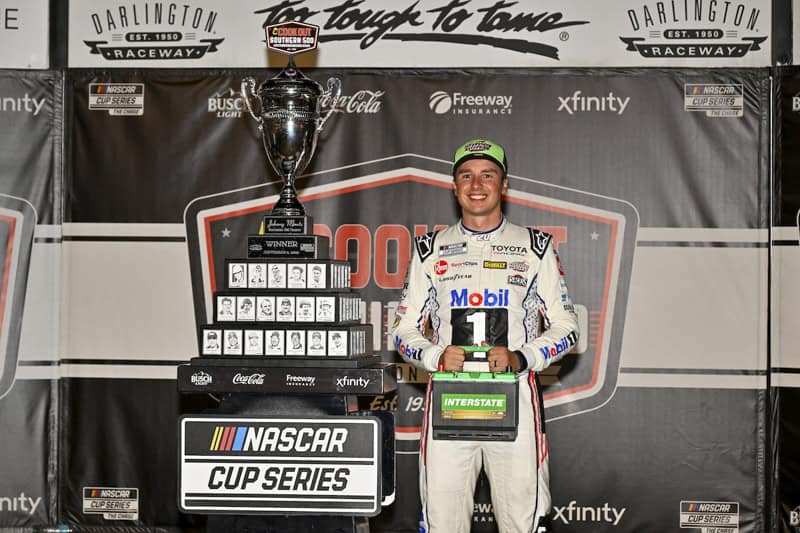
At Darlington, Denny Hamlin, who entered as the top seed, suffered damage and finished 18th. Reddick, who finished third, gained a few points on Hamlin but lost ground overall as Christopher Bell capitalized on the 55-point win payout.
Hamlin, despite his poor finish, placed third in the opening stages, gaining 16 additional points beyond race points alone. Stage points make a real difference. Even with the bonus for winning, if the second-place driver wins both stages and the winner scores no stage points, he’ll take home the same number of points as the winner. If he also has the fastest lap, he’ll come away with more.
Finally, the Next Gen car has been harder for teams to figure out weekly. Consistency is as important as ever but harder to achieve with this racecar. A team can go on a tear only to struggle for a few weeks before bouncing back. It’s not as pronounced as it was a couple of years ago, but a quick look at season statistics shows a trend with the Next Gen: The top drivers in points are putting up fewer top-five and top-10 finishes in a season than before the Next Gen.
So how will this year’s champion approach this final stretch of races?
The obvious is that they will have to fight for every single stage point, race point and fastest-lap point they can, every single race.

One die has already been cast. The points reset gave Hamlin an advantage that means he can make mistakes the others can’t, at least up to a point. If anyone really used a couple of earlier races as test sessions, unless they win multiple Chase races, it doesn’t appear that it would help the way it did during Johnson’s reign of terror. Most people in the industry agree that an underdog champion is unlikely, and it’s much more probable that the champion will come from the top five in regular season points.
What could a team do to change that? The answer is one of the simplest in racing but one of the most difficult to actually pull off: Make no mistakes. That doesn’t just mean avoiding crashes, though that’s certainly part of it, and running up front where they’re less likely to happen is the best way to avoid them. It means not speeding on pit road, not being off by a single lap in fuel calculations, not a single wheel lug in question, not overshooting their pit box, not jumping a restart and not getting caught sleeping on one either.
It means every tire or fuel gamble has to pay off.
It also means seeing when other teams or drivers make even the slightest slip-up and immediately taking advantage of it. It means doing it for 10 straight weeks, because there are no more resets.
The entire system, including the Next Gen car, schedule shifts and stage points, makes it unlikely that someone will dominate Chase Era 2.0 the way Johnson did the first time around. It’s not that teams had it easier the first time around, exactly, because executing 10 outstanding races at the right time is never easy.
It’s just that the odds are more stacked against teams every week. It’s a whole new game. Whoever learns exactly what it is and then how to play it best will have the upper hand.


Amy is an 20-year veteran NASCAR writer and a six-time National Motorsports Press Association (NMPA) writing award winner, including first place awards for both columns and race coverage. As well as serving as Photo Editor, Amy writes The Big 6 (Mondays) after every NASCAR Cup Series race. She can also be found working on her bi-weekly columns Holding A Pretty Wheel (Tuesdays) and Only Yesterday (Wednesdays). A New Hampshire native whose heart is in North Carolina, Amy’s work credits have extended everywhere from driver Kenny Wallace’s website to Athlon Sports. She can also be heard weekly as a panelist on the Hard Left Turn podcast that can be found on AccessWDUN.com's Around the Track page.
A name and email address are required to post a comment. The email address is not publicly visible or shared. Please keep in mind that comments are moderated according to our comment policy.
Comments are listed in order from oldest to newest. Leave a comment