
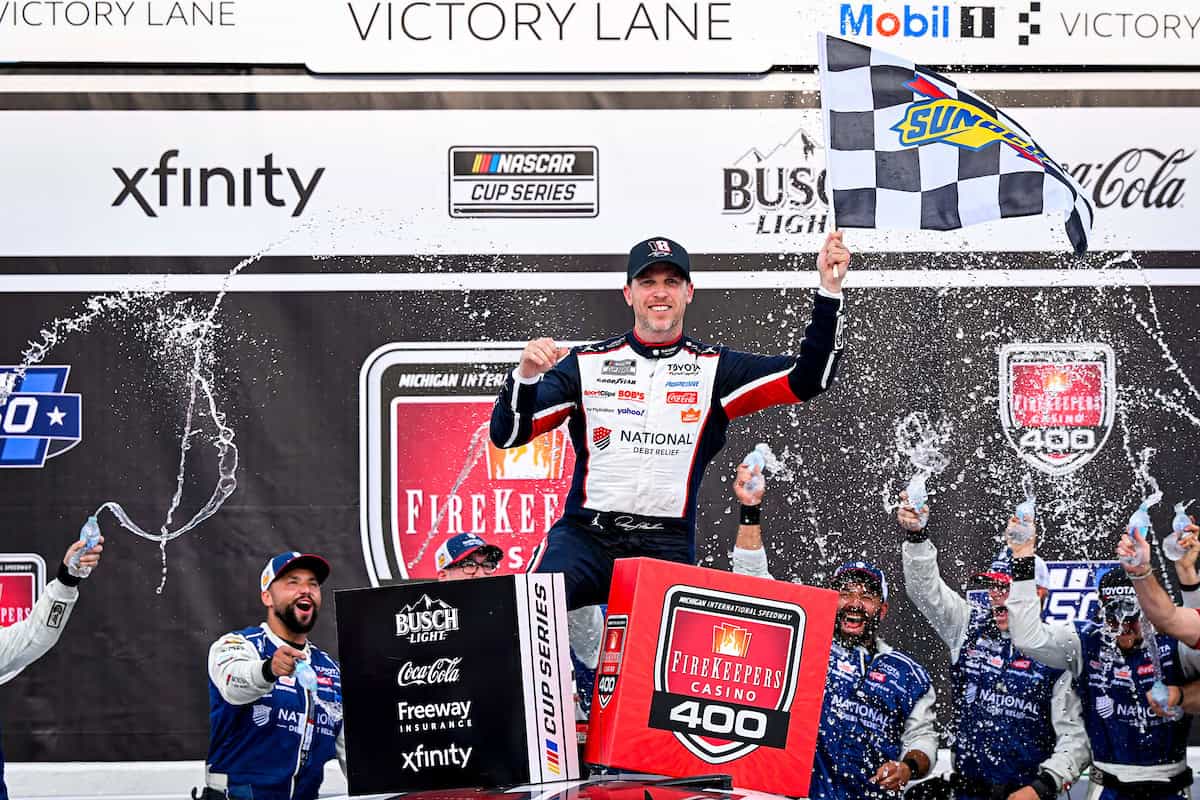
The NASCAR Cup Series season is 20 races in, and so far, fans have seen 10 different winners.
That list includes five multiple race winners: Tyler Reddick (five), Denny Hamlin (four), Ryan Blaney (two), Chase Elliott (two) and Shane van Gisbergen (two). That leaves five single-race winners (Ty Gibbs, Carson Hocevar, Daniel Suarez, Corey Heim and Chase Briscoe).
Gibbs, Hocevar and Heim are all first-time visitors to victory lane, more than we saw in all of 2025, though the total winners are down one from this point last year.

In addition, the NASCAR O’Reilly Auto Parts Series has seen 11 winners in 21 races and the NASCAR Craftsman Truck Series has handed out trophies to eight different drivers in 14 races to date.
While 10 winners is a solid number, two drivers, Reddick and Hamlin, have been responsible for nearly half of the total wins this year.
So, what does all of this say about the health of the sport?
A large number of different winners is unquestionably a good thing. Predictability isn’t really a great thing; fans don’t want to think the outcome is written before the green flag even flies. It’s not just about the drivers, either. A variety of organizations winning races and competing for wins is also a good indicator that the sport is doing well. Seven different owners have seen their cars take the checkers this year.
The resurrected Chase title format may actually work against the number of winners in a season. Without the “win and in” aspect of the playoffs, teams may very well play it safe down the stretch. With six races remaining, even with a substantial points bonus for a win, some teams may elect to play it safe, particularly those who are in the top 16 but towards the back of the field. Risking an incident or mechanical failure may not be worth gambling with when a solid day will keep the status quo.
If there’s a downside to this format over the playoffs, it’s that it may reduce the overall number of winners by a couple over the course of the season. It doesn’t necessarily mean the sport is less competitive, but teams are taking a different approach to the first 26 races.
OK, so different winners are a good indicator that the sport is competitive. There needs to at least be an illusion that anyone can win on Sunday. When one driver dominates, not only does it get repetitive in a hurry, but it shatters that illusion. No fan wants to go to a race and not think their favorite driver can win, even if it’s unlikely. Fans of underdogs know they’re underdogs. But the more competitive the field is as a whole, the more those fans can think anything can happen any given week.
But does that mean a driver can win too much?
Paradoxically, no. At the end of the day, winning is the name of the game, and if one team is doing it, the rest are doing everything they can (and sometimes things they shouldn’t) to catch up. That makes the racing overall more competitive, and if the entire field is racing hard for every position, that’s only good for fans.
Fans of the driver doing all the winning are, of course, not going to complain about it, but the reality is that sometimes a team just hits on something and has a monster season. For fans of other drivers, that creates higher stakes for their guy. If fans bond over racing, fans rooting against the driver doing all the winning really unify in their desire to take him down.
And fans passionate about the outcome is the end goal.
The ideal scenario, one that indicates that the sport’s top series is doing well from a competitive standpoint, is a blend of both: a lot of drivers finding success, especially for the first time or as an underdog, and someone winning just enough to be a hero to his fans and a villain to all the rest.
Thirty-six winners in 36 races is unrealistic, but fans of every driver want to believe that he can win this week, even if the odds are stacked against it. And if he can’t win, the next best thing is to have a villain to fall back on for stealing that chance.
On that front, we’re in a pretty good place. A few more winners, and it’ll only get better.


Amy is an 20-year veteran NASCAR writer and a six-time National Motorsports Press Association (NMPA) writing award winner, including first place awards for both columns and race coverage. As well as serving as Photo Editor, Amy writes The Big 6 (Mondays) after every NASCAR Cup Series race. She can also be found working on her bi-weekly columns Holding A Pretty Wheel (Tuesdays) and Only Yesterday (Wednesdays). A New Hampshire native whose heart is in North Carolina, Amy’s work credits have extended everywhere from driver Kenny Wallace’s website to Athlon Sports. She can also be heard weekly as a panelist on the Hard Left Turn podcast that can be found on AccessWDUN.com's Around the Track page.
Again all the China cars have a little more advantages over the Fords and Chevy maybe a little more fun t watch if Dodge gets back into it again we can only hope.