
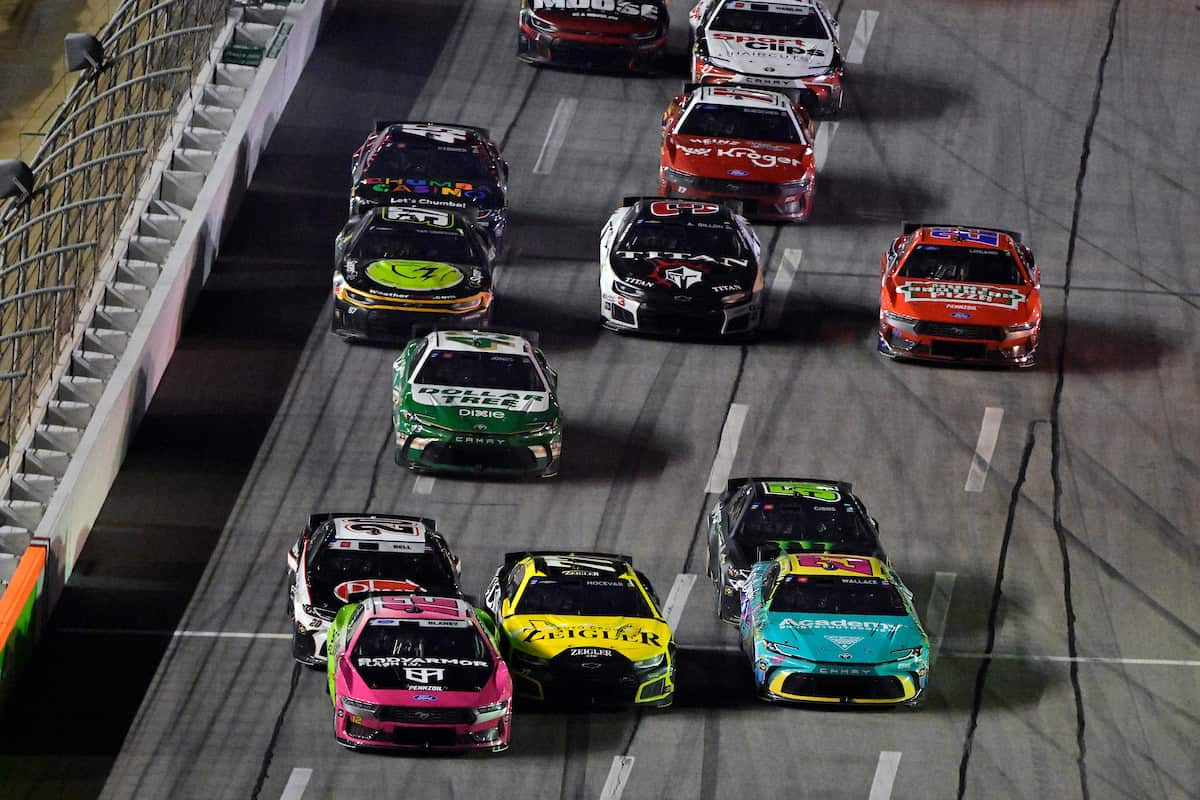
Last Sunday’s (July 12) NASCAR Cup Series race at EchoPark Speedway was yet another Atlanta masterpiece. Time and time again, the track has never failed to deliver in excitement with the Next Gen car ever since the 1.54-mile intermediate was reconfigured to the high-banked drafting track in 2022.
Atlanta has been one of the most highly anticipated weekends on the Cup calendar for quite some time, and with the Next Gen-style racing at Daytona International Speedway and Talladega Superspeedway continuing to falter and polarize fans, Atlanta has usurped them as the marquee drafting track from an entertainment standpoint.
And that’s because the racing at Atlanta is reminiscent of the racing at Daytona and Talladega that captivated fans more than a decade ago. Atlanta is a callback to an era of racing at Daytona and Talladega that no longer exists in the current car.
The Next Gen car has crippled the racing at Daytona and Talladega; no doubt about it. The optimal strategy is to ride around and conserve fuel for half the race in order to achieve the best track position for the home stretch, because once you’re at the back of the pack after the final round of pit stops, your goose is cooked, no matter how good of a car you have. From that point on, it’s two-by-two gridlock all the way to the checkered flag.
Good luck trying to get a run or gain momentum on another driver, and good luck trying to jump out of line in order to improve your position; you’re either stuck where you are, or you’re freefalling to the back of the pack. The only tried-and-true way to make forward progress at the end of these races is by passing all the cars that crash out.
What these races at Daytona and Talladega are missing are variabilities in car handling, which is the most underappreciated aspect of superspeedway racing. The draft serves as the great equalizer that gives every team a chance, but the fastest cars need to be capable of making moves toward the front by leaving ill-handling cars in their wake. The Next Gen car has so much grip that even the best cars can’t make that forward progress when the field is running full throttle, and when the car in incapable of developing runs on the cars in front of them, two-by-two gridlock is the result.
Daytona is shorter, narrower and less banked than Talladega, so some aspects of car handling come into play. The field isn’t entirely stuck running two-by-two, so even if Daytona races are plagued by fuel saving, the end of the races have had some thrilling conclusions like the final lap of this year’s Daytona 500 and the closing laps of last year’s August Daytona race. Talladega, on the other hand? It’s gridlock city.
That’s where Atlanta differs with the Next Gen car compared to its two larger cousins. The track’s narrow width and short length make car handling at a premium, and at Atlanta, the best cars always find their way to the front of the field, and any car with decent speed is capable of developing runs, pulling out of line and making passes with the proper help.
That’s the lost art at Daytona and Talladega today. Those races need that movement throughout the field, and they need some cars to be faster than others.
Speaking of cars being faster than others, look no further than Ryan Blaney, who easily had the most dominant Cup performance at new Atlanta and had a rocket ship reminiscent of Dale Earnhardt Jr., Tony Stewart and Jeff Gordon’s most dominant performances on superspeedways in the 2000s.
Blaney led just under two-thirds of the race and controlled the pace for the majority of the night. The entire field was chasing him, but he wasn’t impossible to pass. Cars in the final stage were capable of working together to take the lead for a few laps by leaving Blaney out to dry, but the No. 12 car was good enough that Blaney could get back to the lead with relative ease. Even at the end of the race, he was able to pull off the win despite being at a tire disadvantage to the rest of the field.
It’s no fun to have one guy untouchable, but Blaney was far from untouchable, and the races at Daytona and Talladega in the Next Gen car have desperately missed those fast cars and skilled superspeedway drivers that the rest of the field are chasing. The superspeedway racing at Daytona and Talladega has been beloved for almost all its history since speeds were first restricted in 1988, and while Daytona and Talladega are capable of pulling off an upset here or there, it was names like Dale Earnhardt, Dale Jr., Gordon, Stewart and Brad Keselowski that made those races legendary.
The list of Cup winners at Atlanta since 2022 — Joey Logano twice, Chase Elliott twice, William Byron twice, Blaney and Tyler Reddick to name a few — roughly coincides with the best superspeedway drivers in the present day, much more so than the Daytona and Talladega races that are more often than not decided by the leaders who aren’t caught up in a crash in the closing laps.
And while the best drivers dominate Atlanta, it is still capable of producing fun, surprise winners like Daniel Suarez, who pulled off a massive Atlanta upset in 2024 in the three-wide finish over Blaney and Kyle Busch in the spring and came one spot short of sweeping both races in the fall.

To sum it all up, the current Atlanta configuration is the perfect mix of entertainment, car handling and driver skill that made Daytona and Talladega must-see TV 10 to 35 years ago. But the problem facing Atlanta at the moment is that this style of racing isn’t going to last forever.
The track’s pavement has aged considerably despite being put down four years ago, and we’re seeing signs that the racing will get more and more strung out as the years go on.
Look no further than the ending to stage one of Sunday’s Cup and the ending to stage two in Saturday’s (July 11) O’Reilly Auto Parts Series race, where the handling differences were so extreme that the top 10 were running multiple seconds apart and the “lead pack” by the end of the stage was down to just two cars. In both cases the racing got spread out under a hot and slick track during the daytime, while nighttime conditions allowed the field to run in the close packs we’ve been accustomed to in the last four years. But if no changes are made to the track, there’s no telling how long the style of racing we’ve come to know and love at Atlanta will last.
The question turns not only to how the racing at Atlanta can be preserved, but also to whether or not it can be replicated at Daytona and Talladega with this car. Pack racing and drafting aren’t going anywhere at NASCAR’s two longest ovals, but the current Cup racing at Daytona and Talladega is a sham compared to what it once was. Perhaps next month’s 400-mile race at Daytona is the first step in getting back to where it should be.


Stephen Stumpf is the NASCAR Content Director for Frontstretch and is a three-year veteran of the site. His weekly column is “Stat Sheet,” and he formerly wrote "4 Burning Questions" for three years. He also writes commentaries, contributes to podcasts, edits articles and is frequently at the track for on-site coverage.
Find Stephen on Twitter @stephen_stumpf