
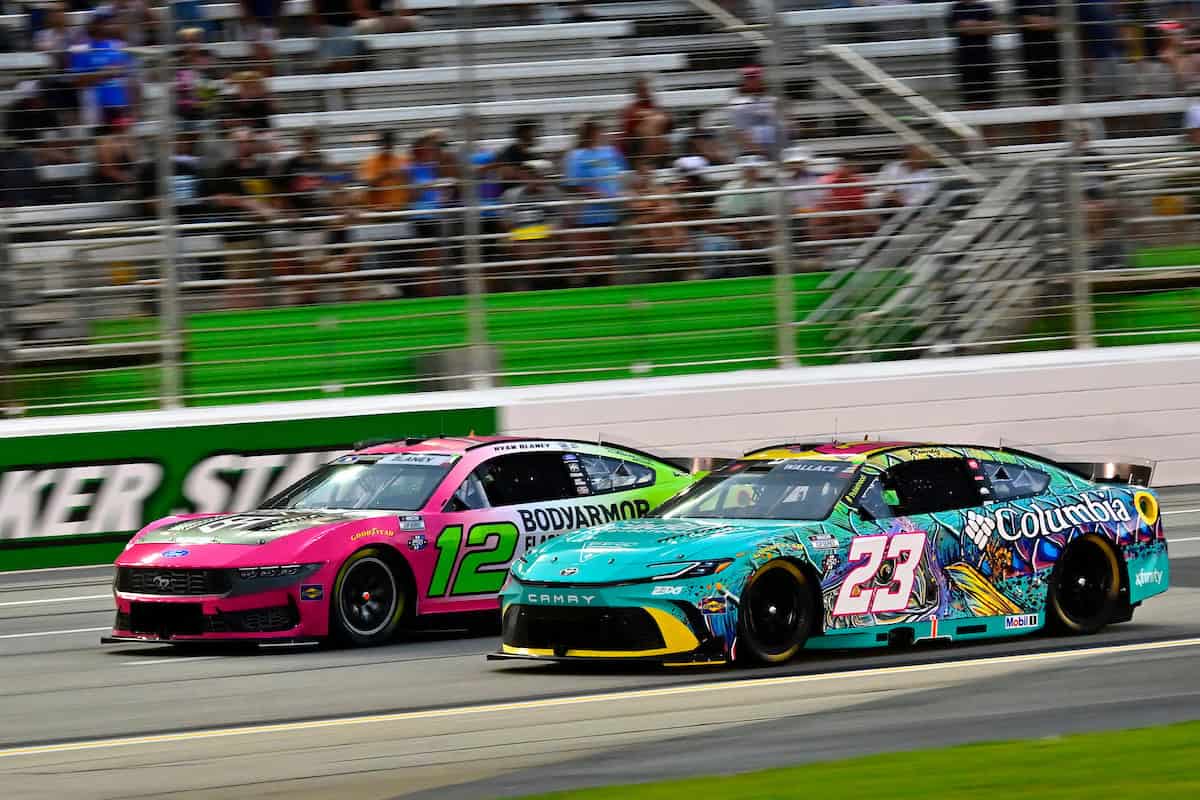
1. What Is It That Makes Racing at Atlanta So Darn Enjoyable to Watch?
If you ask NASCAR fans, especially of the more casual variety, to name the first racetracks that come to mind, Atlanta’s EchoPark Speedway probably won’t be one you hear uttered too often (assuming they even recognize its current name).
Maybe that should change.
The likes of Daytona International Speedway, Talladega Superspeedway, Bristol Motor Speedway and Darlington Raceway may have more cachet, but EchoPark has something none of them have right now: almost universally beloved racing. The Athletic‘s Jeff Gluck laid out the evidence after the late night thriller in this year’s summer race left everyone amazed again.
That kind of love from the fans makes it easy to forget how much skepticism there was over the 2021 repave and reconfiguration that gave us the Atlanta we have today. The consensus among observers and drivers alike was that it was a mistake and would rob the track of the character it once had.
Instead, it produced a completely different phenomenon: a drafting track that isn’t a superspeedway. It sounds bonkers, yet it’s hard to argue with race after race of excitement.
Many people love Daytona and Talladega in theory, but while their current races offer lots of cars running side-by-side at top speed, they also produce soul-crushing fuel saving, reduce the edge for superior cars so that they can’t win without help, and haunt us all with the knowledge that more than half the field will inevitably wreck.
Atlanta somehow avoids all of those drawbacks, especially if you wipe the latest NASCAR O’Reilly Auto Parts Series race out of your mind. It’s both guilt-free and gimmick-free, and maybe that’s why it keeps rising to the top of fan sentiment with each new installment.
2. Does the Yellow Line Rule Need Some Kind of Instant Review Process?
One person who won’t be remembering this Atlanta visit quite as fondly as most is Bubba Wallace, who saw his second-place finish overturned by NASCAR for running afoul of the rule that says you can’t go below the line at the bottom of the track and advance your position.
Never mind that Wallace didn’t really advance his position, or at least it didn’t look that way when the replay showed during his post-race interview. He was credited with a 29th-place finish, and that was that. NASCAR eventually did get around to explaining its logic for the penalty, and deserves credit for doing so.
Still, that explanation didn’t come until today, and that seems unacceptable by current sporting standards. Watching copious amounts of World Cup action over the last few weeks has only reinforced my thoughts on that.
What I mean by that is that NASCAR would surely say that it wants the proper time to address serious penalties, including the post-race appeal period and plenty of hours to formulate responses. But even though not all soccer fans like Video Assistant Referee (VAR), and I’m not quite suggesting that racing needs something similar (it wouldn’t make sense to stop a race, for example, to have officials review video), the fact remains that soccer and other sports have immediate video reviews that give fans the chance to see more replays and hear an explanation of the decisions right away.
Sports happen fast, and NASCAR is the fastest of them all. It’s silly to have race-changing penalties dished out and then disseminated so slowly.
3. Ryan Blaney IS Ford Right Now …
One thing almost no one could have predicted before the 2026 season started is that we’d be 20 races in and one manufacturer would have only one winning Cup Series driver. That is indeed the case, however, as Ford has just two victories, and Ryan Blaney pulled off both of them thanks to his narrow escape at Atlanta.
Pick just about any stat and it will reinforce just how far Blaney is above the rest of the Ford camp. Right this second, only two other Ford drivers are in the Chase field: Chris Buescher and Austin Cindric. Blaney has more top fives and top 10s than both of them combined, and he has led four times as many laps. And those are the next best drivers the Blue Oval has to offer.
There’s one more Ford than Toyota in the Cup garage each week, but it sure doesn’t feel like it given what plays out on the track. What Blaney is doing given the overall struggles of his Ford brethren is almost superhuman, and even if he doesn’t end up winning the championship this season, he and his team will feel like winners under these circumstances.
4. Blaney Has Made the Regular Season Title a 3-Way Dance
One of the more fun aspects of this first “points matter again” season is how the spot atop the standings has felt anything but secure. It seems like we just got finished marveling at how Tyler Reddick and his hot start had him sitting pretty when Denny Hamlin one-upped him to take control of the No. 1 points position.
It remains to be seen if Blaney can put together a multi-race run of his own, but it’s not an exaggeration to say he has muscled his way into the regular season championship discussion. The Atlanta win left him sitting just 65 points behind Hamlin, with Reddick hanging around in second, 24 points out of the lead.
Fourth-place Ty Gibbs is 60-plus points behind Blaney, and Chase Elliott is nearly the same distance back from Gibbs, so their chances of making a charge are virtually nil. Whoever wins the regular season crown is going to come from the top group of three.
For reasons we’ve kind of already touched on, it would probably benefit Blaney the most. He’s dealing with a bit of a speed deficit vs. the Toyotas, and his team has yet to show it can reel off multiple victories in a row.
He’d have to make up double-digit points per race on average over the next six races to do it, and if Hamlin swoons enough to make that possible, Reddick will probably benefit even more. But it’s interesting that it’s even a conversation given how dominant the Toyota duo has been at various times, and it will add some intrigue as we head down the regular season stretch.
5. Toyota Teammates? Not Quite
There isn’t another drafting track race for more than a month, but the two that remain are in key spots on the schedule. The return visit to Daytona ends the regular season and locks in The Chase field, while the fall Talladega race looms large in The Chase itself.
So while there’s time to work things out between cars of the same manufacturer, there’s still some urgency to be on the same page when the time arrives. And it was clear at the end of the Atlanta race that not everything is cool among the Toyota crew.
That was clear from Wallace’s Atlanta post-race comments, where he weighed in on his run-ins with Gibbs with this gem: “That’s Toyota teammates. We don’t race very well together.” The two drivers also had a brief but testy-looking exchange on pit road after the checkered flag.
While a number of people have pointed out that Gibbs may not have been at fault, the bigger issue here is really one of trust. It’s possible that almost half of The Chase contenders will be driving Toyotas, so they, more than anyone, need to be able to feel comfortable with someone from the same manufacturer behind or around them come Talladega time.
I’ve always been fascinated by the idea of teamwork in NASCAR because there are levels to it that don’t exist in any other sport. It’s every driver for themselves, but the consensus is that when possible, you try to help a driver on your own team, and then beyond that, you attempt to assist someone with the same emblem on the grill.
But those bonds of loyalty are weaker with each level, and sometimes they really don’t exist much at all. While Wallace was almost certainly speaking out of frustration in this case, it’s worth wondering if there were some kernels of truth in his words that might sprout at the worst possible time in the months to come.


“Never mind that Wallace didn’t really advance his position, or at least it didn’t look that way when the replay showed during his post-race interview.”
He was behind other cars before he went below the line, and he was next to those cars when he came back up on the track. That’s advancing your position, even if you don’t get ahead of them.
The yellow line rule has been pretty squishy in the past, so I can’t really disagree with Bubba Wallace’s post-race interpretation, or for driving the way he did during the race. In the heat of the moment he had to make a tough decision. Personally I wouldn’t want to back off in front of a field of cars going full throttle, and I’d find it hard to not keep my foot in the gas and just go for the win, penalty be damned.
History lesson! I call the double yellow line the Jeff Gordon rule.At Daytona, Gordon was second behind Rusty Wallace and couldn’t pass him since they were both on the bottom leading everybody. Gordon took to the apron and tried to pass Wallace and if Wallace hadn’t backed off it would have been a really Big One. Gordon won and the rule was developed.