

Talladega Superspeedway.
Just the name evokes a whole plethora of feelings in race fans. Excitement, anticipation, that little thrill of fear—they’re all there. Talladega hosts the ultimate party disguised as a NASCAR race twice a year. Before it was supplanted by the Brickyard 400 at Indianapolis Motor Speedway, the summer race—which has become the fall playoff race—was on the short list of crown jewel races.
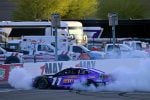
Superspeedway racing in today’s NASCAR means one large thrumming swarm of cars for a lot of the afternoon. Drivers will form alliances, break them and form new ones as the day goes on. One lane will have an advantage, and then another, sometimes two cars wide, sometimes three or (not always successfully) more.
For the history buffs, history is on full display. Dale Earnhardt is the winningest driver at ‘Dega with 10 victories. His son Dale Earnhardt Jr. is tied for second with fellow Hall of Famer Jeff Gordon and Brad Keselowski, who has a chance to surpass Dale Jr. and Gordon on Sunday. Say what you want about Keselowski; he has this place figured out.
Whether you like the current style of superspeedway racing or not, you have to admit it’s exciting, with the cars rolling inches apart for miles on end. All it takes to upset the balance is one car getting a little squirrely, and suddenly there are cars spinning in every direction while one lucky S.O.B. somehow makes it through. When the smoke clears, if your favorite driver isn’t in it, you breathe a sigh of relief. If he is, let’s just say that’s an interesting vocabulary you’ve got there.
Lately, though, the post-race discussion has often faded from enthusiasm to a common theme: a lot of the race is spent by drivers content to ride in line, simply saving their cars and saving fuel. They might temporarily turn it on for stage points, but for the most part, they’re content to stay in line and ride the draft.
As much as fans hate it, though, with the current speedway package, it’s a strategy that gives drivers the best chance of winning, or at least of surviving to the end. We’ve all seen the pileups that result from the cars running so close together, unstable in the swirling air. The slightest mistake, sometimes not even with contact between cars, triggers a spin, and when there are 30 cars running a few inches apart, that spin rarely happens without collateral damage and plenty of it. Double-digit car counts in a single incident are common, even expected.
And the drivers would understandably like to avoid that. The easiest way to make that happen is to stay in line and avoid upsetting the car, or to hang way at the back of the field. To teams, the best way to set up a good finish is to stay out of trouble and play the fuel strategy game.
To fans, if it’s a 500-mile race, drivers should spend 500 miles racing.
Part of the blame—OK, most, but not all of the blame—is on the playoffs. The current format forces drivers to plan for a playoff run from the Daytona 500 until the regular season ends, and then they plan to win the title. Sometimes that means sacrificing a race or two along the way, and Talladega, in particular, fits the bill for that.
Daytona International Speedway somewhat avoids the same fate because teams still care as much about winning the Daytona 500 as the playoff spot it guarantees, and the second race is the postseason cutoff, which guarantees a free-for-all among all the teams not locked in.
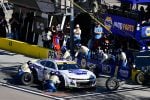
Talladega’s spring race is deep enough in the season that teams are already worried about making the cut, and the fall race is now deep in the playoffs. You’d think that would mean the desperation of the final round of elimination would cause total mayhem, but it won’t. There will be the usual mayhem because someone will make a mistake, but it won’t change the fundamental way teams approach the race. Even teams in a must-win situation won’t take chances before they absolutely have to, and while teams outside the title hunt will certainly race to win, they don’t want to be that one guy who killed (insert playoff driver here)’s championship hopes.
Outside of Denny Hamlin, none of the playoff teams have enough of a points cushion to take unnecessary chances. Simply put, it’s worth more to them to ride all day and race at the end than to race all day.
It’s a two-way street, and both ways lead anywhere but where you want to go. Talladega in the playoffs hurts the credibility of the postseason and the integrity of the championship when it’s not just possible, but likely, that at least one title hopeful will wind up out of the picture after something caused by a backmarker with visions of trophies dancing in his head (and an underdog could certainly win, which might be the race’s saving grace).
The playoffs make Talladega less of a race to be won on its own merits and more just a means to an end. While teams are always going to avoid trouble midrace to try and win later, the playoff teams are going to take that to the extreme and their teammates and even manufacturer teams will play right along.
Will you still see a big crash or two or more on Sunday? Yup, that’s all but inevitable. You’ll see plenty of cars running inches apart. The party will be in full swing.
But expect drivers to settle in and ride for a good chunk of the race. Riding in parade formation is the easiest way to at least delay the big crashes and fuel strategy is a natural consequence of that type of racing. The payoffs just enhance the incentive to play the game.


Amy is an 20-year veteran NASCAR writer and a six-time National Motorsports Press Association (NMPA) writing award winner, including first place awards for both columns and race coverage. As well as serving as Photo Editor, Amy writes The Big 6 (Mondays) after every NASCAR Cup Series race. She can also be found working on her bi-weekly columns Holding A Pretty Wheel (Tuesdays) and Only Yesterday (Wednesdays). A New Hampshire native whose heart is in North Carolina, Amy’s work credits have extended everywhere from driver Kenny Wallace’s website to Athlon Sports. She can also be heard weekly as a panelist on the Hard Left Turn podcast that can be found on AccessWDUN.com's Around the Track page.
“Whether you like the current style of superspeedway racing or not, you have to admit it’s exciting, with the cars rolling inches apart for miles on end”
Sounds like a traffic jam. I guess you enjoy being in one.
i’m in one 5 days a week to and from work here in atlanta. hate it!
When I got my licence in 1966 the 401 was two lanes across the city each way from the airport to the Don Valley. Now it is 6 lanes each way and it takes over 60 minutes when it should take just under 20. Every day!
I would be ecstatic to see the playoffs go away, but I can’t see where they’re really having an impact here. Eventually this may be true, with someone ceding a win to a playoff driver, but if this has happened, I haven’t seen any proof of it yet. Unless the playoffs are scrapped, it probably will happen eventually.
I think the real issue is the current package, and better analytics available to the teams. Their simulations have shown it’s preferable to ride and save fuel until near the end of the race. Also, scheduled cautions mean so long as you stay on the lead lap, only stage three matters from a win standpoint.
Out of a field of 35+ cars, only 4 – 7 of those cars care about points. One is already in the final, and others look to be far enough below the cut line that they may be seeing this as a must win.
If the old Stableford points system were put back in place, where would the motivation be to race harder until near the end of the race? The same logic would likely remain. Stay in the lead pack, save fuel. Being first to pit road matters little if you have to take more fuel.
The teams have figured out the best path to a good points day, or even possibly a win, is to have a conservative, boring race. This is true whether you’re a playoff team or not.
latford was the old system.
i do like how ‘dega could very well have a winner that doesn’t care about the top 4.
Doh!
Thanks for the Latford correction. I was confusing sports there. Stableford is a golf system.
I wonder if the napkin it was written on originally is still around?