
I’m extremely thankful for the extended 20th anniversary re-release of Cars this month. I was in Seattle for nearly a week in early September, which happened to coincide with the film’s release, but the showtimes got extended to where I could still see it — at the same theater I saw it at in 2006 (shoutout Regal Virginia Center).
I wrote about Talladega Nights: The Ballad of Ricky Bobby after revisiting it earlier this summer, but Cars was just as important (and more successful) in the summer that brought racing movies to the masses. Sure, kids gravitated toward it because it was a Pixar movie with talking cars, but there is so much racing ingrained in the fabric of the movie that I have a greater appreciation for it 20 years on.
Cars raked in $480 million at the box office, had multiple promotional schemes in NASCAR Cup Series races and is a critical touchstone for a number of racing fans. I had already been into racing for a few years, so seeing something about motorsports on the big screen was a huge deal.
I get my love of racing from my grandfather Maurice Jones, who raced at an amateur level on dirt tracks up and down the east coast in the 1940s and 1950s (we still have yet to find any photos of his cars, so if anyone knows of anything, let me know), so I’d been into racing for a few years already. Cars was a huge milestone in that; I got to see one of my favorite sports represented on screen. This was one of the earliest times I remember seeing a movie in a theater (the first I remember seeing was the NASCAR IMAX film).
Everyone knows the plot, I hope, but the quick rundown is this: This Pixar world is made up of anthropomorphic vehicles, along with racing divisions of its own. Three championship contenders (the rookie Lightning McQueen, the longtime runner-up Chick Hicks and the veteran Strip “The King” Weathers) go into the final race of the season, at a Bristol Motor Speedway-esque track, and tie for the title, leading to a tiebreaker race across the country in California one week later.
Along the way, some underglow-fitted cars mess with McQueen’s hauler, Mack, eventually causing the tailgate to open and McQueen to roll out the back. He ends up in Radiator Springs, a long-forgotten town in the middle of the desert on Route 66. It’s well past its heyday and made up of a cast of characters, whom he eventually comes to appreciate.
It’s a classic Pixar plot, but from the animation era (mid-1990s to mid-2000s) that really set the blueprint for these films and produced a ton of iconic movies. The movie’s got a ton of heart, a stacked voice cast and some really well-done racing action, and has aged pretty well.
Owen Wilson is our lead as Lightning McQueen, his first mass-appeal kids’ movie right around the height of his popularity; Wilson had already been in three Wes Anderson films by this point and had been in Wedding Crashers the year prior. Bonnie Hunt voices Sally, having already been in Rain Man, Jerry Maguire and The Green Mile before eventually appearing in a ton of Pixar films.
Legendary comedians Cheech Marin and George Carlin voice low-rider Ramone and hippie VW bus Fillmore, respectively, while Larry the Cable Guy voices redneck tow truck Mater. Longtime Pixar voice John Ratzenberger voices a bunch of characters, which is poked fun at during the credits.
Michael Keaton had already been Batman for Tim Burton and acted in Quentin Tarantino’s Jackie Brown, but Cars marked his second racing movie in as many years; he was also in Herbie Fully Loaded in 2005. And the great Paul Newman, an Oscar winner and star of everything from Butch Cassidy and the Sundance Kid and The Color of Money to The Sting and Slap Shot (and racecar driver himself) is the voice of Doc Hudson, a former racer and champion who left the sport when it cast him aside.
And we get tons of cameos. Richard and Lynda Petty have pretty big voice roles as Strip “The King” Weathers and his wife; Bob Costas and Darrell Waltrip serve as commentators Bob Cutlass and Darrell Cartrip; Dale Earnhardt Jr. has a cameo as himself (the car version); Humpy Wheeler portrays Tex Dinoco; and Michael Schumacher plays a Ferrari in a brief cameo at the end (as a patron of Guido’s Casa Della Tires).
I think the racing action is still pretty excellent, even 20 years on, especially in this day and age where a lot of the animation styles still look the same and they crank out film after film year after year. Few feel like they have the same staying power of things like Cars, Monsters, Inc. and Toy Story (even though we all thought the latter was done at three films and they’ve added two more since 2019).
The racing scenes have tons of angles and everything is just slightly tweaked and adapted for the world populated by cars. There are still flashbulbs going off, even if the grandstands are considerably larger to accommodate cars instead of people; the Goodyear blimp is anthropomorphic; cows are tractors; two Miatas “flash” McQueen with their headlights; and grilles serve as mustaches.
It’s so creative and well-done that, rewatching it, I got so much joy out of seeing the inventiveness that went into the production. It’s great.
And, of course, I gotta talk about the schemes that it sponsored, right?
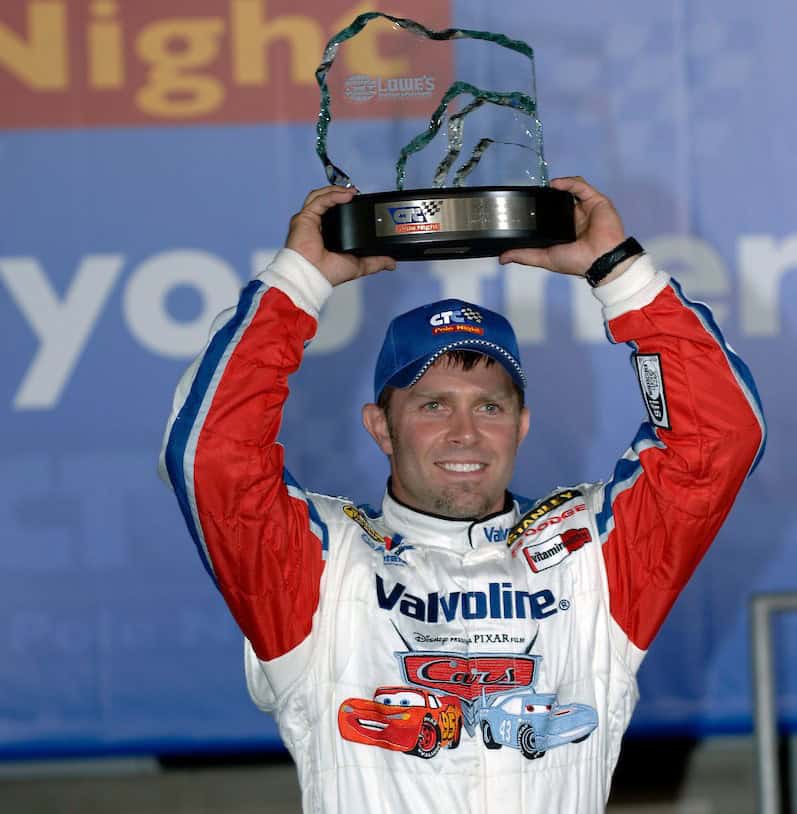
First off, Scott Riggs won the pole for the 2006 Coca-Cola 600 in a Cars scheme (with the firesuit pictured above in this article). I remember talking to Scott at Richmond Raceway a few years ago when his son Layne (named after, he told me, Alice In Chains frontman Layne Staley, one of the greatest singers of all time) was making his second-ever Craftsman Truck Series start about some of the wins that got away from him at the Cup level — he finished 13th in that one.
That same race, Kyle Busch finished 38th after getting caught up in a wreck. Both cars featured their normal schemes for the most part, but each had Lightning McQueen and The King flanking the movie logo on the hood, as well as the characters on the sides.
Also in that race — and unfortunately finishing the worst of the three, with a 40th-place effort — was Tony Raines, in Hall of Fame Racing’s No. 96. He had the best scheme of the three, a red body complete with the McQueen lightning bolts down the side and a close-enough number with No. 96.
Cars has had such a lasting legacy, and I’m glad they put forth the effort to re-release it in theaters. It’s just a shame I didn’t get to it in time to get the collectible popcorn buckets and cups.
Ka-chow.


Adam Cheek joined Frontstretch as a contributing writer in January 2019. A 2020 graduate of Virginia Commonwealth University, he covered sports there and later spent a year and a half as a sports host on 910 the Fan in Richmond, VA. He's freelanced for Richmond Magazine and the Richmond Times-Dispatch and also hosts the Adam Cheek's Sports Week podcast. Adam has followed racing since the age of three, inheriting the passion from his grandfather, who raced in amateur events up and down the East Coast in the 1950s.
A name and email address are required to post a comment. The email address is not publicly visible or shared. Please keep in mind that comments are moderated according to our comment policy.
Comments are listed in order from oldest to newest. Leave a comment