

Next week is a big milestone.
Tuesday, Aug. 4, marks exactly 20 years since Talladega Nights: The Ballad of Ricky Bobby released in 2006. It was the second installment in a NASCAR-movie theater kind of summer, with Cars having come out a couple months before. It hit both crowds: the kids movie with Cars in June, and the teens/adults audience in August.
Talladega Nights was also the second in a four-year run of sports comedies for Ferrell — Kicking & Screaming in 2005, this in 2006, Blades of Glory in 2007 and Semi-Pro in 2008 (and Ferrell teamed up with Reilly again in 2008 for Step Brothers, as well).
I hadn’t rewatched it since the early stages of COVID, which also doesn’t really count, so it felt like I hadn’t seen it in more than a decade. So I figured a revisit was in order.

Maybe it was because I was in the mood for a comedy, but I had a great time rewatching this, laughed out loud a ton and really appreciated just how in the spotlight NASCAR was for film in 2006. I do have my reservations about how Talladega Nights definitely perpetuated a lot of the typical stereotypes about NASCAR, but those are stereotypes that I think will remain no matter what.
The racing scenes aren’t half bad; there are certainly less continuity issues than Days of Thunder (though I still prefer that to this). Both would rank in my top 10 racing films, though, but not within the top five. Talladega Nights does hit a dip in the middle of the movie, when Ricky has to go home, get his mojo back and deal with his wife leaving him. My only complaint is that, at two hours, this movie does feel just a tad long. Cut maybe 15 minutes, down to an hour 45, hour 50, and it’d be perfect.
Such a stacked cast, too. Ferrell and Reilly (who was also in Days of Thunder) are givens, but you look down the list of names, and it’s huge cast member after huge cast member. Sacha Baron Cohen, of course, debuted Borat the same year as Talladega Nights and stands as one of the 21st century’s most prolific comedic personalities (including his role as French driver Jean Girard).
Michael Clarke Duncan’s most recognizable role is as prisoner John Coffey in The Green Mile, but he’s hilarious as Ricky’s crew chief. Gary Cole already had Dodgeball and Office Space under his belt before he took on Reese Bobby, Ricky’s father, and Leslie Bibb — Carley, Ricky’s (and eventually Cal’s blonde bombshell trophy wife) went on to Trick ‘r Treat, Iron Man, Iron Man 2, Confessions of a Shopaholic and more.
Early-career Amy Adams becomes Ricky’s love interest late in the movie. She was coming off an Oscar nomination when this movie came out and has earned five more over the course of her career. It’s a crime she hasn’t won one yet. Comedy legends David Koechner, Jack McBrayer, Rob Riggle and Jane Lynch all have roles of varying degrees, along with Saturday Night Live alum Molly Shannon. Conan O’Brien’s right-hand-man Andy Richter plays Jean Girard’s husband Gregory, and Grayson Russell plays Ricky’s young son Texas Ranger. Russell went on to play Fregley in the Diary of a Wimpy Kid movies a few years later.
Director Adam McKay co-wrote the script with Will Ferrell. They’d already worked on Anchorman: The Legend of Ron Burgundy together, and they ended up making five movies together (Step Brothers, The Other Guys and Anchorman 2: The Legend Continues followed).
McKay went on to move into a satirical drama-comedy sphere in more recent years. The Big Short chronicled the 2008 financial crisis with an all-star cast (Christian Bale, Brad Pitt, Steve Carell and Ryan Gosling) and was nominated for five Oscars, with McKay co-winning for screenplay. Bale re-teamed with McKay to play Dick Cheney in Vice, which got eight Oscar noms, and McKay then directed Don’t Look Up, which got four noms and satirized how the current world would react to a catastrophic asteroid headed toward the planet.
Love or hate later-career McKay, his early stuff cemented itself in the cultural lexicon. Anchorman did in its own way, but Talladega Nights had its share, in a non-exhaustive list, of iconic lines:
- “If you ain’t first, you’re last.”
- “I don’t know what to do with my hands.”
- “Shake and bake!”
- “Help me Jesus! Help me Jewish God! Help me Allah! Help me Tom Cruise! … Help me Oprah!”
- “Don’t you put that evil on me, Ricky Bobby!”
- The infinite versions of their “Dear Lord Baby Jesus” prayers
- “If you don’t chew Big Red, then f**k you.”
Quotes aside, the scenes of Ricky Bobby stabbing himself in the leg to prove he’s paralyzed or not, running around on “invisible fire” after his brutal wreck at Charlotte, the “Long One” at Talladega (extra props for the play on “The Big One”) and everything else just instantly cemented themselves as classic bits and references.
There are some interesting anachronisms, too. When we first meet adult Ricky Bobby, we’re at Talladega, but the cars he’s racing are, bizarrely, early 2000s/late 1990s-looking cars. There’s a No. 30 Pennzoil, Geoff Bodine‘s No. 7 QVC, the old Interstate Batteries scheme on the No. 18, and that’s when Ricky first jumps in the car.
The next extended race scene, it’s suddenly 2005 Gen 4 bodies all over the place. That’s when Ricky has his run-in with Jamie McMurray, who has a vocal and visual cameo in his No. 42 Home123 car as he races Ricky for the win at Texas Motor Speedway. Ricky promptly crashes with McMurray, beats him while going across the start-finish line in reverse and flips him the bird.
This is another reason I appreciate the movie for its authenticity, and I mean that in the sense of so many NASCAR personalities showing up during its runtime. Dale Earnhardt Jr. asks Ricky Bobby for an autograph.
Darrell Waltrip, Mike Joy and Larry McReynolds all appear as themselves commentating several times, along with the Bill Weber/Benny Parsons/Wally Dallenbach Jr. booth later on during the grand finale. Dick Berggren, Bob Jenkins and a host of drivers also show up, and Elvis Costello and Mos Def are guests of Girard late in the movie; McKay even shows up as the driver Ricky replaces.
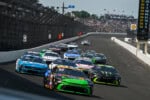
NASCAR nerdiness aside when it comes to the Gen 4 cars, drivers of the era, specific sponsors sponsors and everything, this movie just screams mid-2000s in the most iconic ways possible. Leslie Bibb has the midriff-baring tops and low-rise jeans of the Britney Spears era; Ferrell has the enormous Powerade letterman-style jacket and the flannels … it’s so of its time, and I love it.
I also noticed evidence of “shooting the rodeo” (a term movie YouTubers RedLetterMedia coined when talking about a production filming what’s already happening wherever they’re at). There’s at least one wide shot, included in the sequence where the entire field wrecks in the final race, where we can see Scott Riggs’ demolished No. 10 on the far apron of the track. The damage to the car means it’s obviously a shot taken during the fall 2005 race, where Riggs smashed into the wall and barrel-rolled several times. So a neat little real-life detail there.
I’ll keep the paint scheme thing going a bit, because of course, we have to talk about the movie being promoted on Bill Lester’s No. 22 Craftsman Truck Series ride. But somehow, no Cup cars picked it up, so Lester’s truck ran it at Kentucky Speedway. Huge missed opportunity for a few premier-series rides to run schemes from the movie.
All the paint schemes became instantly iconic. Ricky starts out in the No. 26 Laughing Clown Malt Liquor car before picking up Wonder Bread as a sponsor (paid tribute to multiple times over the years) and eventually hopping in the No. 62 ME Cougar car (which Kurt Busch ran in the No. 51 at Talladega in 2012).
Girard’s Perrier No. 55 is a great-looking car, and Cal Naughton Jr.’s No. 47 Old Spice machine made a great pairing with the Wonder Bread No. 26. Chase Briscoe and Ryan Preece teamed up to run Naughton and Bobby cars, respectively, at Talladega in 2023.
I think the movie has aged well in the fact that it’s very of its time humor-wise, but that humor hasn’t really gone away. Girard is a gay driver, and while it’s definitely the subject of jokes in the movie, said jokes aren’t insulting or at the expense of Girard’s orientation — it’s more at the lack of exposure the racing community he’s entering has to it, and it’s obviously a testament to the open-mindedness we know McKay and Ferrell have. Hell, Ricky and Jean have one of the greatest movie kisses of all time at the end of the film.
There’s other comedies from the time that haven’t aged as well, but I think much of Talladega Nights’ humor holds up. A lot of those quotes and scenes will be referenced endlessly for years to come.
And we can’t forget when Carl Edwards replicated the run to the finish line when he flipped in the Talladega trioval in 2009.
It’s a truly fun watch, and this was my first time checking out the Unrated & Uncut version. Happy 20th, Ricky Bobby.


Adam Cheek joined Frontstretch as a contributing writer in January 2019. A 2020 graduate of Virginia Commonwealth University, he covered sports there and later spent a year and a half as a sports host on 910 the Fan in Richmond, VA. He's freelanced for Richmond Magazine and the Richmond Times-Dispatch and also hosts the Adam Cheek's Sports Week podcast. Adam has followed racing since the age of three, inheriting the passion from his grandfather, who raced in amateur events up and down the East Coast in the 1950s.