
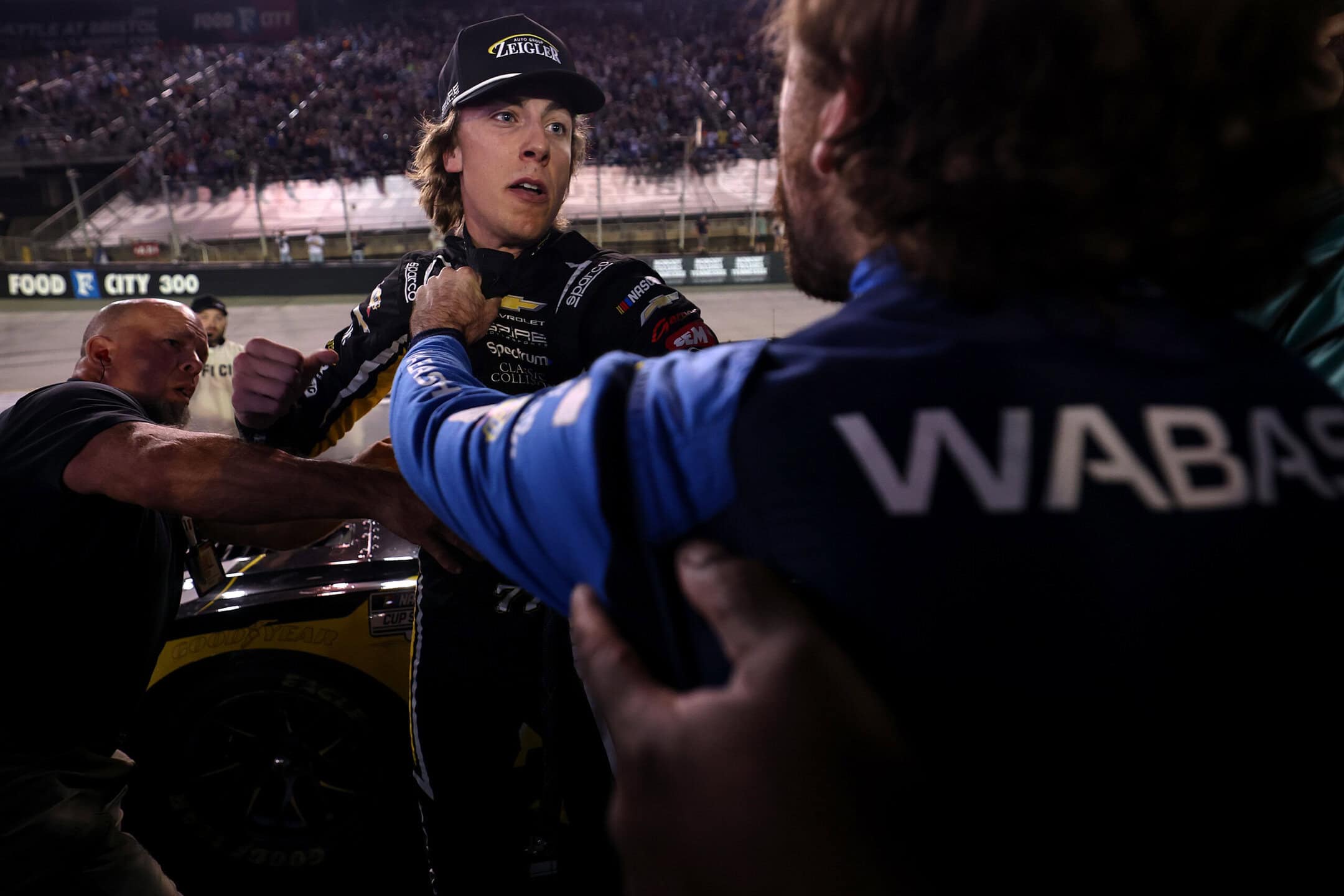
The Ryan Blaney and Carson Hocevar fight after Saturday’s (Sept. 19) Bristol Night Race stands with Hocevar’s unique celebration after scoring his first NASCAR Cup Series win at Talladega Superspeedway in April as one of NASCAR’s most viral moments of the year.
The fight was a perfect storm. Months and months of frustration about Hocevar’s antics behind the wheel, followed by inaction from his peers, finally reached a boiling point after Blaney crashed while racing Hocevar for second with less than 50 laps to go, ending the former’s chances of winning the most prestigious (non-crown jewel) race on the schedule.
What followed post-race was a grab, then some swings, and just like that, NASCAR’s biggest fight and headline-grabbing altercation in more than two years had begun.
And if NASCAR was still using last year’s playoff elimination championship format, none of it ever happens.
For Blaney, the wreck was a one-two punch (no pun intended) of ending his chances of both winning Bristol Motor Speedway, a track where he’s led 977 laps without a win, and significantly altering his championship hopes.
With seven races to go in The Chase, Blaney sits 52 points behind leader Kyle Larson. By finishing 33rd, the wreck cost Blaney 31 points from where he was running in second. If he went on to win (and he certainly had the car to do so), that number would be 51. If Blaney doesn’t crash at Bristol or lose his brakes at World Wide Technology Raceway with a top-five car, he could’ve entered these final seven races in the driver’s seat with a commanding lead. Instead, he sits two-thirds of a race back with three consecutive 1.5-mile tracks, one of Team Penske’s biggest weaknesses this season, up next.
If the playoffs were still in place like last year, Bristol would’ve been the race that weeded the field down from 16 drivers to 12. In this alternate universe, the wreck would’ve done zero damage to Blaney’s championship hopes, as he had accumulated enough stage points, playoff points, and total points that he was in no danger of elimination from the Bristol crash; he would’ve entered next week’s race at Kansas Speedway with a clean slate.
Instead, no reset is coming to save Blaney. He and the No. 12 team have to deal with the fact that back-to-back DNFs with race-winning cars have cost them anywhere from 50 to 100 points, points they will never get back. During his appearance on Monday’s (Sept. 21) Actions Detrimental podcast, Blaney admitted that “frustration has been building the last few weeks,” and while wondering what else could go wrong, he said that that frustration “had to started to boil a little bit in me.” Frustration that likely contributed to his ire and decision to approach Hocevar after the crash.
It shouldn’t be lost on how unexpected it was for Blaney, of all drivers, to be the one to fight Hocevar, either. Blaney is a notorious swearer on the radio in the car and might get a reputation as a hothead because of it, but he’s almost always calm, cool and collected outside of the car. Before Bristol, when was the last time Blaney had a confrontation or an exchange of words with any driver after a race? Exactly.
That’s what the pressure of winning a championship looks like, especially when a team looks to be in store for a win or a monster points day, only for it to be completely squandered. A playoff reset would’ve taken away a ton of the pressure, the anger and the emotion that culminated in the fight after the race.
And let’s be real, the removal of elimination objectively made Bristol a better race as a whole. If Bristol was run using the playoff elimination format in the alternate reality listed above, the bulk of Bristol’s coverage would’ve been dedicated to Chase Elliott, Shane van Gisbergen, Chris Buescher and Daniel Suarez: total nonfactors who all finished off the lead lap and ran in the teens and 20s all day. In other words, a playoff elimination broadcast would’ve focused on walking mediocrity and drivers who have no chance at winning this year’s championship given how they’ve run in recent months.
The drivers that The Chase broadcast focused on at Bristol? The drivers at the top of the standings that ran well and have a chance to win it all like Larson, Blaney, eventual race winner Joey Logano, Denny Hamlin, Christopher Bell and Ty Gibbs, as well as drivers like Hocevar who are behind in the championship fight but became contenders as the race drew closer to its conclusion. Gibbs was driving the special M&M’s Kyle Busch tribute paint scheme, an important storyline in its own right, and even though he became a contender for the win in the second half, the broadcast also made sure to focus on him when he wasn’t a contender in the first.
Bristol is evidence that The Chase is putting the focus back on success and NASCAR’s biggest stars. It shows that playoff eliminations weren’t needed to manufacture drama and storylines when the 10-race Chase is perfectly capable of producing storylines, drama and intensity on its own. And if Bristol had eliminations and resets last weekend, there’d be no dramatic and viral fight that everyone is talking about today.


Stephen Stumpf is the NASCAR Content Director for Frontstretch and is a three-year veteran of the site. His weekly column is “Stat Sheet,” and he formerly wrote "4 Burning Questions" for three years. He also writes commentaries, contributes to podcasts, edits articles and is frequently at the track for on-site coverage.
Find Stephen on Twitter @stephen_stumpf
A name and email address are required to post a comment. The email address is not publicly visible or shared. Please keep in mind that comments are moderated according to our comment policy.
Comments are listed in order from oldest to newest. Leave a comment