
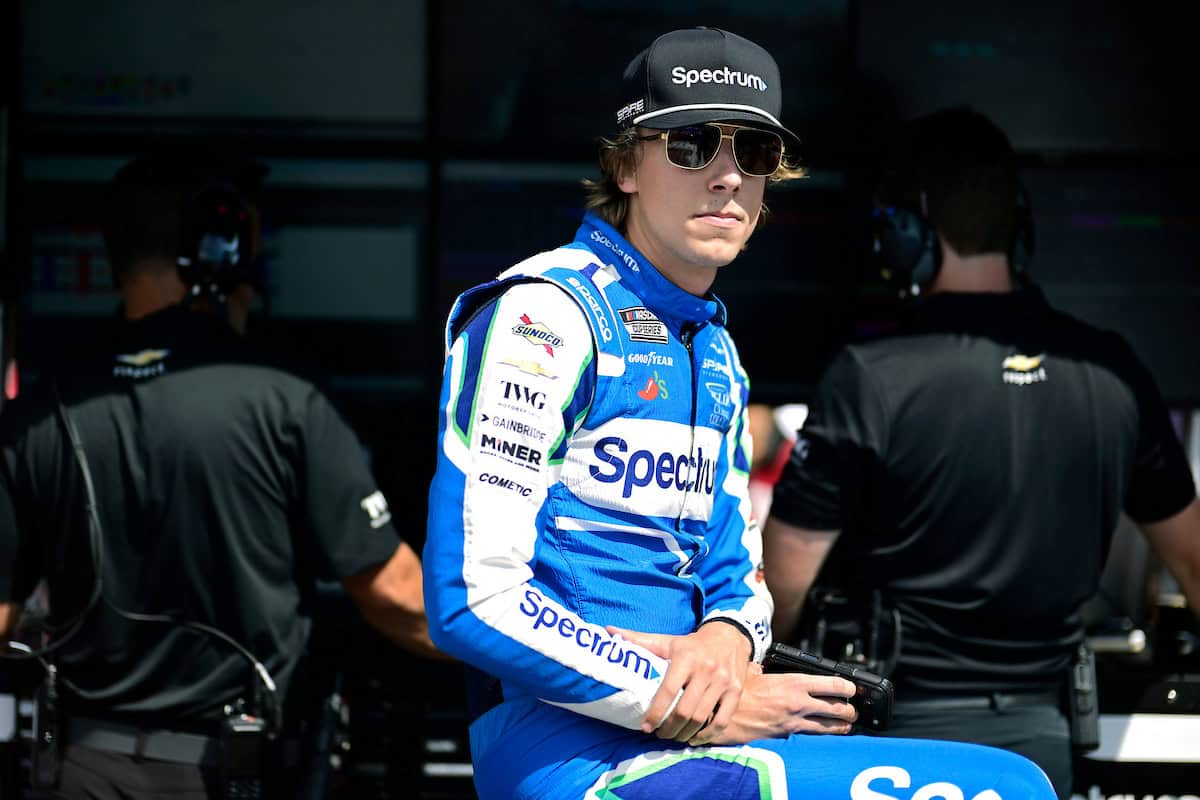
NASCAR 2026 is, among other things, the Year of Carson Hocevar. Hocevar got his first NASCAR Cup Series win this year, in the spring race at Talladega Superspeedway. He celebrated with a wildly risky ride up the track while sitting on the windowsill of his No.77 Chevrolet. His fans loved it.
The rest of the field and their fans, though? The honeymoon is over. Hocevar has a reputation for being too aggressive, often at the expense of his fellow competitors. At this point in the season, if someone on the track spins or crashes, the default is to look to see if Hocevar was in the vicinity.
It seems as if the garage and the fanbase are taking sides; they’re either for Hocevar and his driving style or sick of the same old incidents every week. Hocevar defends his on-track aggression, sometimes citing the oft-maligned but also widely popular style of Hall of Famer Dale Earnhardt as a driver he emulates.

Watching from the sidelines, the whole situation is both frustrating and puzzling. Because here’s the thing: To some degree, both the defenders and the detractors are right. And it’s hard to watch it continue week after week, because Hocevar has a lot of potential to not only win races but to be an asset to the sport as a whole.
But for that to happen, he needs to learn when to back off.
Aggression in a racecar driver is not an inherently bad thing. It takes a good measure of it to compete on a track with at least 35 other drivers in massive machines that are hard to make passes with. Winners are aggressive. Champions are more aggressive still. But what makes them winners and champions is knowing how aggressive to be and when. It’s not a matter of being 100% every lap, never letting off the throttle. It’s not about driving through the competition.
The most recent incident with Hocevar happened Saturday night at Bristol Motor Speedway, when he tangled with Ryan Blaney, and it’s a perfect example of the bigger picture here.
Blaney passed and cleared Hocevar, who immediately went for a crossover move. So far, so good; that’s exactly what he should have done. Then Blaney turned down to try and protect against the move, but Hocevar was already there. That’s where things could have gone differently. Blaney had raced Hocevar cleanly, per usual. Blaney’s excitable on the radio but generally respectful of the competition.
And Hocevar didn’t lift. In that situation, he should have. There were enough laps left to work on passing Blaney, who had raced him cleanly. Hocevar could have returned the favor and changed the entire narrative.
Hocevar ran a good race. Yes, he rubbed fenders with Ty Gibbs on a restart with nine laps to go in the race, but he didn’t cross a line for that point in the race. He didn’t turn Gibbs, and at that point, there weren’t enough laps left to regroup and try again.
If he’d given Blaney the respect that Blaney gave him, fans would still be talking about him afterward because he’s a talented young driver. Instead, his fans are defending a move that could have been avoided and other fans are angry at his choices.
Look at it this way: Blaney was at least as much at fault for the crash as Hocevar was. He had the faster car and the preferred line. He threw a late block. And after the race, he went up to Hocevar and aggressively shoved him and then grabbed his uniform. Even he admits that when Hocevar then swung at him, it was, “Rightfully so.”
But the next day, Blaney owned up to his part in the post-race scuffle, and more importantly, realized it wasn’t his finest hour.
But in the eyes of much of the NASCAR fanbase, Hocevar is entirely at fault. Why? Because that’s the reputation he’s chosen to cultivate. The Earnhardt persona.
Early in his career, Earnhardt drove a lot like Hocevar. But he learned to drive smarter. To pick his battles. He didn’t hesitate to use a bumper, but he didn’t drive through the field like he was bowling for racecars every lap of every race.
Once he learned that lesson, he won more. Other drivers, and even their fans, respected him, albeit often begrudgingly. The wins racked up, and the titles too.
Hocevar is holding himself back.
Sometimes winning means backing out of a situation, regrouping and making a better move. The driver code is well-known: race others the way they race you. Other drivers, especially veterans, know when a younger, less experienced driver makes a mistake, and they will give him a little grace, but they also don’t forget. The next time Blaney has the chance to pass Hocevar, he’s not going to back out if Hocevar needs room to gather in his car. Neither is most of the field.
That’s not saying they should go out and wreck him. That’s dangerous and isn’t good for anyone. But there are enough drivers out there that Hocevar has driven with no respect or thought who are now in the position to show him no grace.
In the long term, that will only hurt Hocevar’s chances at winning races and it’s not the kind of driving that wins titles. Drivers like Joey Logano, Kevin Harvick and Kyle Busch were overaggressive early in their careers, and they paid for it. They gave no quarter and were given no quarter. They raced wide open, but they didn’t always race smart.
But they all learned, and once they did, the wins came more often. Then came the titles. Harvick will enter the Hall of Fame this year. Busch will soon follow, and when he’s eligible, so will Logano.

That’s what Hocevar should be emulating. Not a driver who has become almost a mythical figure and who the sport sometimes sees through rose-colored glasses. Hocevar is no Earnhardt, and trying to pretend otherwise is silly.
But he could be a driver in the vein of Logano. Logano is still aggressive, and yes, sometimes too much so. But he’s learned to temper that to a large degree, and that earns him more respect on the track, which in turn buys him a chance to make better decisions. That’s what has made him a three-time champion. Had he never grown as a driver and learned that sometimes backing off is the best move toward the end goal, he would not have had the success he has.
Hocevar could be a bright spot for the sport if he understood that backing out is not a bad thing when the situation warrants. If he learns to channel his talent and his emotion, he’ll become a weekly threat — to win, not to cause a crash and make the list of drivers who want to make every race miserable longer every week.
It also means owning up to the moments where he could have made better decisions. Sometimes that goes as far with fans as not doing the thing you own up to in the first place, at least if it didn’t cause a crash.
NASCAR needs talented, brash young drivers with personalities that aren’t sterile and who make the racing interesting. And that’s Hocevar to a T. Unfortunately, he’s also overaggressive, disrespectful, and unrepentant.
It’s too bad that he seems so unwilling to change, because in many ways, he’s exactly the driver NASCAR needs. He just needs to take a deep breath, admit he needs to make a few changes, and show respect for his competitors, the fans (not just his, but all of them) and the sport itself. He’d find he’d most likely enjoy more on-track success. He has the talent to do so much in his career.
He just needs to learn the best way to use it.


Amy is an 20-year veteran NASCAR writer and a six-time National Motorsports Press Association (NMPA) writing award winner, including first place awards for both columns and race coverage. As well as serving as Photo Editor, Amy writes The Big 6 (Mondays) after every NASCAR Cup Series race. She can also be found working on her bi-weekly columns Holding A Pretty Wheel (Tuesdays) and Only Yesterday (Wednesdays). A New Hampshire native whose heart is in North Carolina, Amy’s work credits have extended everywhere from driver Kenny Wallace’s website to Athlon Sports. She can also be heard weekly as a panelist on the Hard Left Turn podcast that can be found on AccessWDUN.com's Around the Track page.
A name and email address are required to post a comment. The email address is not publicly visible or shared. Please keep in mind that comments are moderated according to our comment policy.
Comments are listed in order from oldest to newest. Leave a comment