
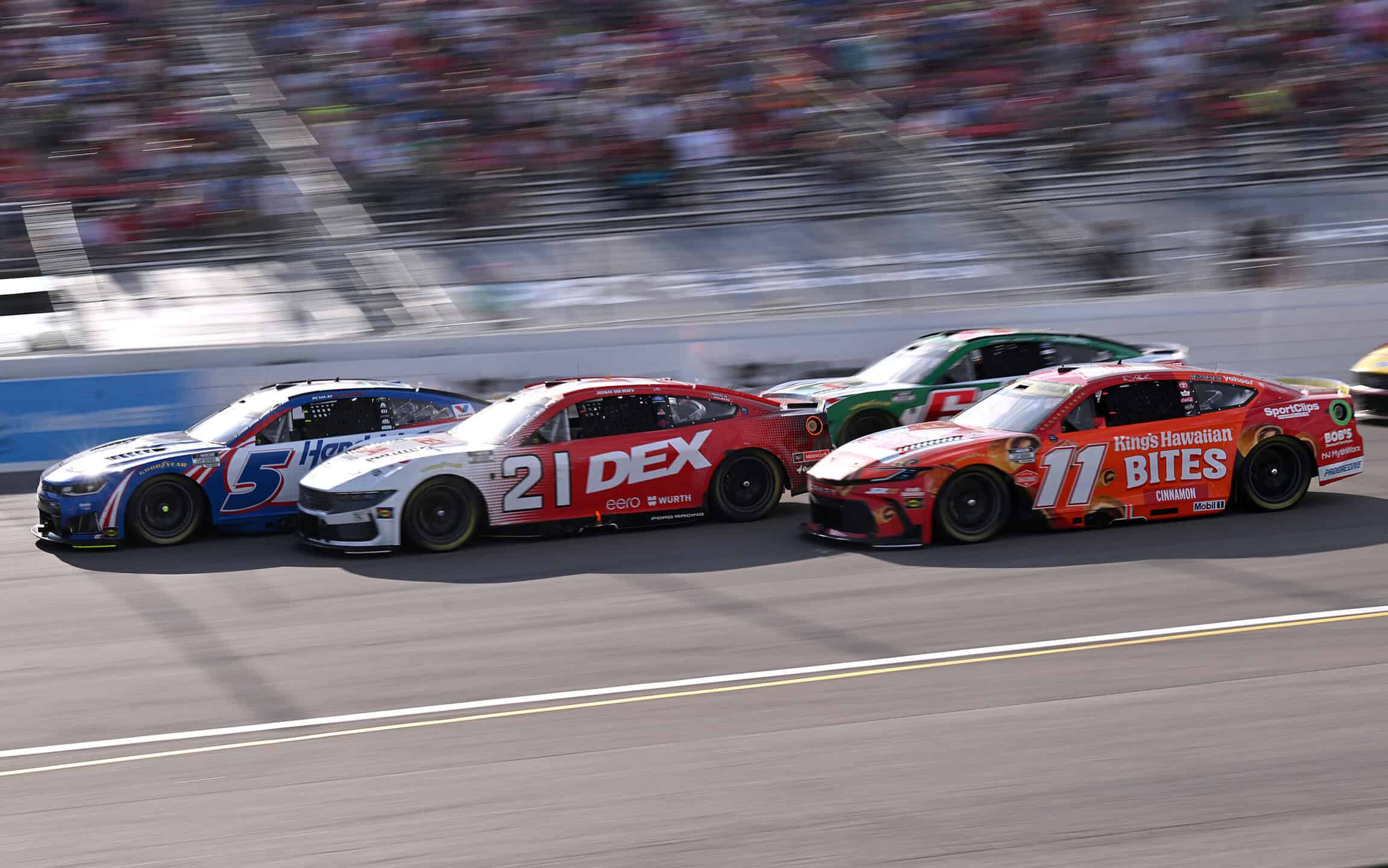
Sunday’s Enjoy Illinois 400 at World Wide Technology Raceway was a largely forgettable NASCAR Cup Series race, filled with cautions, restarts, and more cautions.
Not all of the incidents happened because of overly aggressive driving, though. Several brake rotor failures brought out yellow flags, including one that resulted in a brutal hit for Zane Smith and one especially dramatic instance in which the rotor exploded through the hood of Ryan Blaney’s No. 12 Ford before shooting across the track as he hit the outside wall.
At a time when mechanical failures have become a rarity, what caused a rash of brake problems all at once? It seems to be a perfect storm of changes to the racecar and rules that don’t give teams a lot of options.
Teams knew entering the weekend that brakes could be a concern. The high-horsepower/low downforce package means that drivers will have to brake more getting into the corners than they did with the underpowered package from a year ago. That was a part of the plan; with less power, drivers were able to stay in the throttle longer and, at many tracks, could run through the corners with little, if any, braking.
Braking zones are, in essence, passing zones, so NASCAR worked to find a package that gave drivers more overall power to pass but also force them to brake more entering corners. For fans, it means more opportunities for passing and a race that’s more in the hands of the drivers.
Teams knew going into the weekend at Gateway that brake management would be important. Turns 1 and 2, in particular, are tight and require more braking than the opposite end of the track. Still, nobody anticipated multiple failures.
What else contributed? Race-winning crew chief Cliff Daniels has a theory: extra practice.
“I wonder as we get towards more practice, having two sets of tires, which in my view is really good for the sport, good for the fans, that is also a lot more duty cycle on the brakes,” Daniels said after the race on Sunday.
Daniels went on to clarify, “Just from the perspective of lap count, which is that much more brake pad wear and overall cycles. When you have the extended practice with two sets of tires—which we all want, we all love, are grateful to have it the way we have it now—when you come in to put on your second set of sticker tires, you’re going to be sitting for a minute. That’s another rapid cooling cycle from where you go from being really hot on track. You come in, sitting, making your change, putting on sticker tires to go back out. This is a bit different than what a pit stop scenario would be during a race.”
Why does it matter? Heat is the reason brake rotors fail. High heat causes metal to expand and warp, and when it cools down, those areas contract, which can cause cracks where warping occurred. With its multiple cautions, Sunday’s race put the brakes through multiple cycles, and because of the longer practice session on Saturday, they were already more stressed than earlier this year on race day.
Hendrick Motorsports Vice Chairman Jeff Gordon added that teams have very little choice in the parts and pieces they use on the Next Gen car.
“I feel like the reason we’re in this position is because we’re so limited… We need more options and more ability. If we want to cool more, cool more. If we want a different pad…I mean, I was glad to see them at least look at rotors and things. But this track is really extreme on brakes. I would just like to see NASCAR and the teams work a little bit more together with the brake manufacturers to try to find a solution for here. I mean, our cars are notorious(ly) hard on brakes in general, then hard on them here. I feel like with the right amount of effort, they can come up with a solution.”
This is where it all comes to a bit of a crossroads, and one with many different origins and directions.
NASCAR, to its credit, has worked hard to improve the racing with the Next Gen, particularly on the flat and short tracks. The higher horsepower package, combined with lower downforce, gives drivers the power to get off the corners and sometimes out of trouble, but it also forces them to slow down more, creating passing zones.
It has also attempted to level the playing field by making the cars more uniform and keeping spending down by mandating specific components and often adding a specific manufacturer for many of them. That’s good from a financial standpoint in an expensive sport, but it means teams can’t make many changes to compensate for different tracks or weather conditions. Sunday’s weather was extremely hot, only adding to the issues.
Tighter racing for the fans and less expense for the teams sounds great for the sport, and there are absolutely positives. NASCAR is working to make the racing better. Sunday’s event was just a dud.
But at some point, faster cars with mandated parts that can fail with more miles and heat cycles, combined with more practice time, form an ugly intersection with safety. Teams’ inability to choose parts based on the needs of the driver, the weekend weather and specific track conditions is a compromise when it comes to durability.
Smith’s crash was a reality check. He walked away relatively unscathed, a testament to how safe the cars and tracks have become. Considering the angle and speed of impact, it certainly could have been much worse.
What we don’t need to hear from anyone is, “but it wasn’t.” That’s complacency, something that has no place in racing when it comes to safety.
That said, given time and maybe a little more room to work, teams will figure out how to better manage brakes under the current rules. Remember the tire wear issues at Bristol Motor Speedway a year ago? By the next race, teams more or less had them figured out. In fact, they may have figured them out too well, as there was little effect on the racing from tire wear in the spring race.
That’ll happen with the brakes. Teams will adjust setups and work on ways to improve them until they’re much less of a concern.
Daniels said NASCAR can also help minimize issues going forward as well without reducing practice. There’s a pretty simple solution, he says.
“Part of the conversation might be to consider in the future after we have these longer practice sessions at the Nashvilles, Loudons, Gateways, Phoenix, tracks that are notorious heavy brake-demand tracks,” Daniels said. “Do we allow the teams to put like-for-like changes, brake rotors and pads, on the cars going into the race? I’m sure that would be a topic that could be kicked around.”
NASCAR should absolutely consider letting teams replace brake components after practice if they wish to. If all teams can opt to do it, or not, it doesn’t give anyone a competitive advantage. While it would have an added cost for teams, if there’s any safety benefit, it’s hard to argue against it.
NASCAR needs to take a closer look at the factors that contributed to the brake failures at Gateway and what might prevent them. At the same time, there’s no reason for a knee-jerk reaction. Brake issues have not been a major problem this year with the exception of Gateway, and the only real change was the extended practice, which may have contributed but was not the singular cause.
If NASCAR can make small changes to lessen the risk, it absolutely should. But no need to throw the baby out with the bathwater. At least not yet.


Amy is an 20-year veteran NASCAR writer and a six-time National Motorsports Press Association (NMPA) writing award winner, including first place awards for both columns and race coverage. As well as serving as Photo Editor, Amy writes The Big 6 (Mondays) after every NASCAR Cup Series race. She can also be found working on her bi-weekly columns Holding A Pretty Wheel (Tuesdays) and Only Yesterday (Wednesdays). A New Hampshire native whose heart is in North Carolina, Amy’s work credits have extended everywhere from driver Kenny Wallace’s website to Athlon Sports. She can also be heard weekly as a panelist on the Hard Left Turn podcast that can be found on AccessWDUN.com's Around the Track page.
A name and email address are required to post a comment. The email address is not publicly visible or shared. Please keep in mind that comments are moderated according to our comment policy.
Comments are listed in order from oldest to newest. Leave a comment