
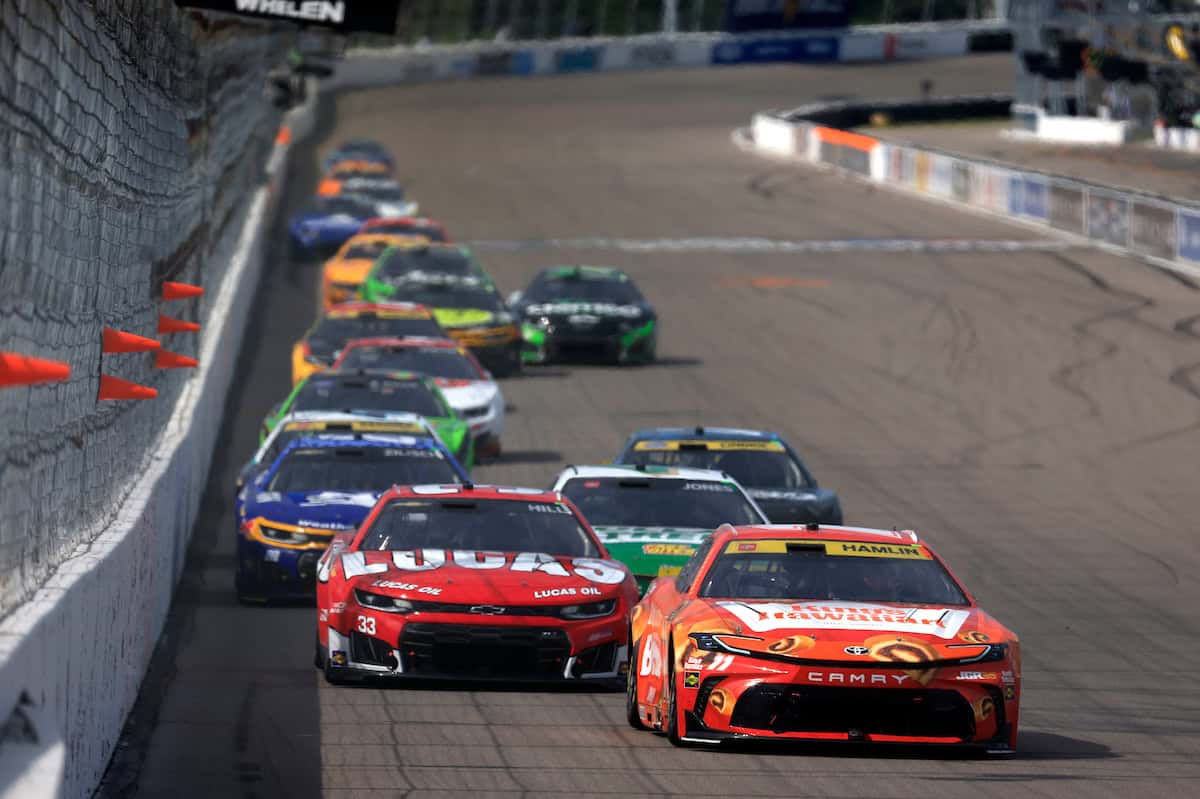
If anyone was under the illusion that the eventual 2026 NASCAR Cup Series champion would need to run 10 perfect races in the Chase, Sunday’s (Sept. 13) 18-caution, four-hour marathon at World Wide Technology Raceway threw that notion right out the window.
A whopping 11 of the 16 Chase drivers were involved in at least one of the race’s never-ending wrecks. Three of them (Chris Buescher, Chase Elliott and Ryan Blaney) suffered brake rotor failure, while two more (Chase Briscoe and Daniel Suarez) watched the finish from the garage with terminal crash damage. Other championship favorites like Christopher Bell, Ty Gibbs and Tyler Reddick were involved in late wrecks that cost them double-digit points by the time the checkered flag waved.

Winning matters. Stage points matter. But Gateway served as a cautionary reminder that avoiding trouble and sheer luck will play just as important a role in crowning this year’s champion.
To that point, Joey Logano and Kyle Larson are the only Chase drivers who have scored top 10s in the last two races. They are also the only drivers who can say they’ve left nothing on the table. Everyone else has run into a problem in some form or fashion.
This comes as no surprise to anyone who has closely followed the Next Gen era, where average finish among elite drivers has taken a sharp nosedive. From 2017 to 2021, the final five years of the Gen 6 car, 11 drivers recorded an average finish of 10.0 or better in a season.
| Driver | Year | Average Finish |
| Kevin Harvick | 2020 | 7.3 |
| Kyle Busch | 2018 | 8.3 |
| Denny Hamlin | 2021 | 8.4 |
| Kevin Harvick | 2018 | 8.8 |
| Kyle Busch | 2019 | 8.9 |
| Kyle Larson | 2021 | 9.1 |
| Denny Hamlin | 2020 | 9.3 |
| Martin Truex Jr. | 2017 | 9.4 |
| Denny Hamlin | 2019 | 9.5 |
| Martin Truex Jr. | 2019 | 9.8 |
| Kevin Harvick | 2019 | 10.0 |
Since the start of the Next Gen era, no one has completed a full season with an average finish better than 11.0.
| Driver | Year | Average Finish |
| William Byron | 2023 | 11.0 |
| Christopher Bell | 2025 | 11.2 |
| Chase Elliott | 2024 | 11.7 |
| Chris Buescher | 2023 | 12.1 |
| Denny Hamlin | 2023 | 12.4 |
| Chase Elliott | 2022 | 12.5 |
In that regard, Denny Hamlin‘s average finish of 8.6 through 28 races of 2026 is a massive anomaly — so much so that he would need to have an average finish worse than 19th in the final eight races of the year to not set a new Next Gen record.
Even in the smaller-sample-size postseason, drivers in the Next Gen car have struggled to keep up with their Gen 6 counterparts in consistency. In 2017, Martin Truex Jr. set a postseason record with an utterly ridiculous average finish of 4.3 in the final 10 races, and that included a crash at Talladega Superspeedway. In the original Chase era, Carl Edwards set the gold standard with an average finish of 4.9 in the final 10 races of 2011, a year when he didn’t even win it.
In the Next Gen era, William Byron in 2023 (6.1) is the only Next Gen driver to have an average finish under 7.0 in the final 10 races. Whether it’s because of accidents or missed setups, the margin for error in a Next Gen era is significantly larger than it was in the Gen 4, Car of Tomorrow and Gen 6 eras. The introduction of stage points in 2017 and a beefed-up point total for wins in 2026 also make it easier for drivers to make up lost ground than the previous iterations of this format.
Make no mistake, however; those bad finishes take a toll. Blaney looked poised for a top five at worst when a brake failure relegated him to 35th at Gateway, costing him 30 or so points he won’t ever get back. And unlike last year (or the 11 years before that), there are no resets coming to save anyone.

But is a singular bad day an absolute heartbreaker when everyone has a bad day?
Let’s take Hamlin, for example, whose Chase is off to a rocky start. An 18th-place finish in the Southern 500 after sustaining damage and a ho-hum ninth-place finish after a Gateway race where the No. 11 team didn’t show much speed give some cause for concern, but when factoring in trouble everyone has faced, Hamlin has actually the fourth-most points in the last two races among Chase drivers. Only Larson, Logano and Bell have scored more, and two of the three have scored a win that (rightfully) inflated their totals.
Wins and stage points will do wonders for a driver in the final 10 races. An 18th-place finish at Darlington Raceway was costly for Hamlin, but stage points gave him 35 points for the night; Gibbs, who finished second that race, only earned 36. Larson’s Gateway win and 18 stage points gave him a monster 73-point day, a day so impactful that he gained 40 points — more than half a race — on Hamlin, who still finished that race inside the top 10.
Bad finishes hurt, but the Next Gen car has made elite drivers far more prone to bad days and bad finishes than the cars of the past. A perfect Chase is improbable, if not impossible. Deficits can easily be made up with winning speed, and with the high value that wins and stage points provide, drivers have more tools at their disposal to recover from bad days than ever before.


Stephen Stumpf is the NASCAR Content Director for Frontstretch and is a three-year veteran of the site. His weekly column is “Stat Sheet,” and he formerly wrote "4 Burning Questions" for three years. He also writes commentaries, contributes to podcasts, edits articles and is frequently at the track for on-site coverage.
Find Stephen on Twitter @stephen_stumpf
A name and email address are required to post a comment. The email address is not publicly visible or shared. Please keep in mind that comments are moderated according to our comment policy.
Comments are listed in order from oldest to newest. Leave a comment