
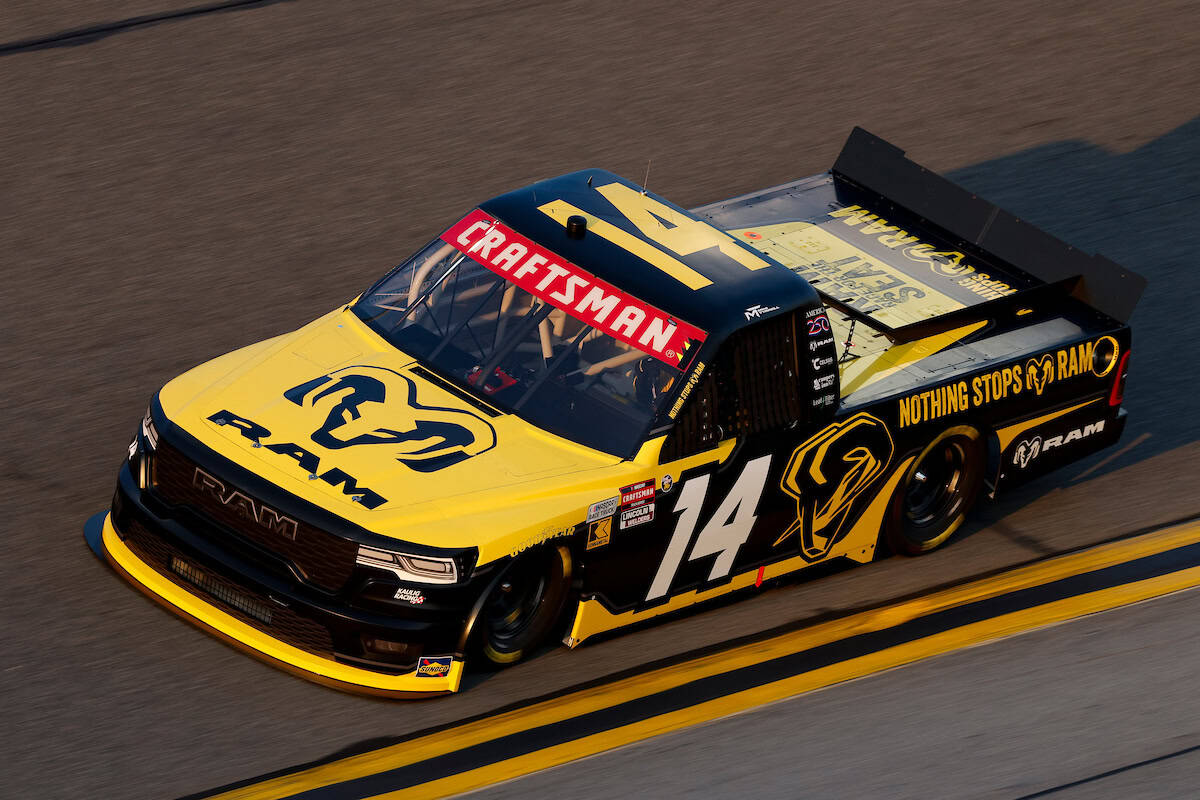
On Monday while perusing Instagram, I came across a cryptic post from the Roush Performance account, alluding to a forthcoming partnership with RAM Trucks.
This caught my attention for a number of reasons, the least of which was it being the first public pronouncement of Roush partnering with a direct competitor to its Ford offerings, specifically ones they will be in direct competition with on the track, in the showroom and on the street.
Roush Industries as long been a fixture among the Big Three as a Tier 1 supplier providing services such as engineering, fabrication, prototype and emissions work. But when you mention Roush Performance, you immediately think of its serialized Roush Mustangs, F-150s, superchargers, intake, exhaust, and suspension packages for Ford products that it has produced and promoted for over 30 years.
When you think of Roush and NASCAR, think back to why Roush came south to begin with: a request from Ford to get its teams to begin working with each other, sharing information and technology, and taking an engineering approach to racing development to help fight back against Chevrolet and the emergence of multi-car teams like Hendrick Motorsports. Could RFK Racing play a similar role with the advent of a new manufacturer returning to the Cup Series after what would be a 15-year absence?
Last month, Bozi Tatarevic noted a Kaulig Racing hauler at the Aerodyn wind tunnel. While it was likely one of their RAM trucks, the image naturally raised the question of what else could be in the trailer under the Mopar umbrella.
Last week during an interview with SiriusXM NASCAR Radio, RFK President Chip Bowers was addressing the re-signing of Chris Buescher and the future of the company, including plans for 2027. Bowers, who also recently replaced team principal Jack Roush on the Race Team Alliance board of directors last week, stated that the organization has two non-negotiables:
- Nothing less than being a Tier 1 Cup Series racing program.
- Fielding more than two cars to do so.
The cost of a charter is already prohibitive these days — expected to be in excess of the $46 million charter that Legacy Motor Club purchased from Rick Ware Racing — and with the continued uptick in ratings and attendance, they aren’t going to get cheaper anytime soon. That said, what would be the path of least resistance to help gain a third charter?
Bringing in a new manufacturer.
It also would also make sense from a legacy perspective. The K in RFK has long had deep ties to Dodge and Mopar Performance, now known as Direct Connection. Bob Keselowski lead the return of Chrysler to the ARCA Series in the 1990s and Dodge trucks in the late 1990s. Couple that with his uncle Ron campaigning Dodges during the late 1960s and 1970s in NASCAR, and Brad’s own championships in the now-NOAPS Series in 2010 and the Cup Series in 2012, which then prompted a mic drop walk-off with a title as the lone Dodge program with Team Penske.
Obviously, this is assembling the Charlie Day string board meme in real time and making quick work of the jump to conclusions mat, from an IG post about hot rodding some pickup trucks.
But it did raise my particularly lustrous eyebrow when you consider that Ford hasn’t done much to promote its NASCAR participation, vanishing from what is arguably the best series in the O’Reilly Series, while the Truck Series has essentially two competitive operations. This year seems far removed from Ford’s championship outcomes in 2022 and 2024 with Joey Logano and 2023 with Ryan Blaney (albeit in the one-race format at a track Penske over-performs at). It’s been struggling to be a top-10 presence in the Cup Series the last few months.
Considering what the response was from Chevrolet to Kaulig Racing fielding RAM Trucks, there’s some crossover conflict here that could understandably cause some friction.
While this is not necessarily something being fielded on the racetrack, it’s going to be a very public-facing offering of trucks retailing for near six figures and making the same or more horsepower than what is actually on the racetrack. In performance circles, the supercharged 5.0L regular cab shortbox F-150 is currently the vehicle of choice, even becoming more favorable to purchase and upgrade than the flagship Mustang. A quick glance at the Roush Performance website shows a Roush F-150 in its lineup, but even it no longers offer a specific Roush Mustang, and hasn’t since 2023.
It’s quite a balancing act to offer two manufacturer vehicles in direct competition with each other; this isn’t remotely the same as Roush offering some dress-up parts for a Nissan Frontier.
NASCAR has quickly become Stellantis and RAM’s most visible marketing tool at the moment, and they aren’t going away. NHRA has even taken a backseat to the TV presence and free agent driver program that they have been investing in to raise awareness of their return to circle track racing. That said, it should be noted that RFK, along with Team Penske and Front Row Motorsports, are actively involved in working on a new body for the Mustang — a must considering the visibly wide chasm that exists on pure speed between the Toyotas and frankly anything that is not a Toyota at this point.
While I doubt this is all an elaborate ruse, the announcement that was made Monday still feels remarkably odd. This wasn’t something that just came about; being the premier OEM supplier they are, these Roush RAM Trucks being hinted at have no doubt been in testing and in development for months.
Perhaps it’s nothing, but I can’t help but feel it is something, and we haven’t quite heard it yet. 2027 would be a bridge too far to expect a Dodge announcement for a return to racing. The Charger is getting a Hellcat revival again next year, and the two-door version would make a great addition to the Cup Series field once again.
Again, it’s probably nothing … but time will tell.

Are We Headed for a 1992 Championship Fight?
A funny thing happened after the NASCAR lawsuit was settled during the 2025 off-season, when it was announced that the playoff system was being scrapped for a system similar to The Chase that replaced full-season points following the 2024 season. A compromise plan that was championed by Mark Martin and Dale Earnhardt Jr., seemed to strike a balance of a traditional championship format and some sort of postseason reset to crown a champion.
So what happened? Naturally, Tyler Reddick rattled off three wins in a row and five of the first nine races. This elicited the kind of knee-jerk response you’d expect from the “everything sucks” crowd.
“Oh he’s already got an insurmountable lead, he’s going to cruise to the title, this is going to be boring, waaaahhhhh …”
A quick check of the standings with nine races to go before the regular season ends at Daytona on August 29 will reflect a whole 8 points separate Reddick from second-place challenger (and car owner) Denny Hamlin. Fourth through sixth in points are separated by two points.
Two. Both of them.
Tenth through 13th in the standings? 10 points.
But what about the scramble to make the 16-team cutoff? While we might not have a driver who’s 32nd in points suddenly championship eligible this year, or trigger Austin Dillon to go Predator self-destruct mode again, Erik Jones in 14th and Zane Smith in 23rd (and becoming a regular visitor to the top 10) are separated by only 56 points.
| Rank | Driver | Points | Behind First | Behind 14th |
| 14 | Erik Jones | 372 | -344 | – |
| 15 | Austin Cindric | 370 | -346 | -2 |
| 16 | Ryan Preece | 367 | -349 | -3 |
| 17 | Shane Van Gisbergen | 362 | -354 | -8 |
| 18 | Joey Logano | 357 | -359 | -13 |
| 19 | Brad Keselowski | 354 | -362 | -16 |
| 20 | A.J. Allmendinger | 346 | -370 | -24 |
| 21 | Michael McDowell | 333 | -383 | -37 |
| 22 | Ross Chastain | 327 | -389 | -43 |
| 23 | Zane Smith | 316 | -400 | -54 |
There is a lot of racing left to do, and the jockeying for position throughout the points is just now starting to take shape. In years past, we’d be waiting for Daytona or a road course to potentially provide a surprise winner and lock a driver into the playoffs. Now they’re forced to race for every point and not just bank on one epic run to put them over the top and into the title fight.
The Toyotas clearly have the field covered on speed, but Chevrolet teams are starting to get a handle on the balance of their new body. The Mustang is older in comparison and Ford hasn’t won since March 8 at a short track, but they have two drivers solidly in the top seven in points at the moment. Do Penske or Roush have any 11th-hour engineering tricks left in their old war horse?
Six of the next nine tracks shape up well for them; two drafting tracks and four short tracks, and past champions like Joey Logano and Brad Keselowski who desperately need a win to have any shot at qualifying for the championship chase.
When the season started, the consensus was a driver would need to be in the top five or six to have a legitimate title shot. While that might ultimately be what it comes down to (and mirror the legendary 1992 finale), there’s a lot of shuffling left to be had leading up to the postseason, and the actual championship battle may end up looking a bit different by the time we’re a few races in.
In short, the plan is working.


Vito is one of the longest-tenured writers at Frontstretch, joining the staff in 2007. He’s been a contributor to several other outlets, including Athlon Sports and Popular Speed in addition to making radio appearances and podcast appearnces here on Stock Car Scoop and Happy Hour. He forever has a soft-spot in his heart for old Mopars, late model Fords, and is generally a warehouse of useless automotive information.
I sure hope RFK doesn’t partner with RAM. I like all the RFK drivers, and I can stomach many things, but I cannot handle RAM making a verified wife beater the face of advertising their brand. I get wanting to have a tough outlaw image, to sell big trucks and muscle cars.
Battering your wife is not tough. It’s what a coward does, when they know they’re in a position to assert dominance over someone who is physically weaker.
Huh?
What you said.
Ram’s primary spokesperson is Dana White. He appears in all their ads. He also is on video beating his wife, an is a terrible human being by pretty much any measurable standard.
I don’t really see how “the plan” is working. There’s a really big hitch in the plan still to come, namely the massive influx of free points a bunch of drivers are going to receive at the end of the regular season to put them back within striking distance of a championship. We have no idea what the final picture of the 2026 season is going to look like, just that there will be slightly less chaos than there has been in recent seasons. The chase format resulted in fewer undeserving champions than the playoff format, but that doesn’t make it good.
RFK posted on Facebook that they’re not switching to RAM or Dodge, they are sticking with Ford. Of course, your mileage may vary.