
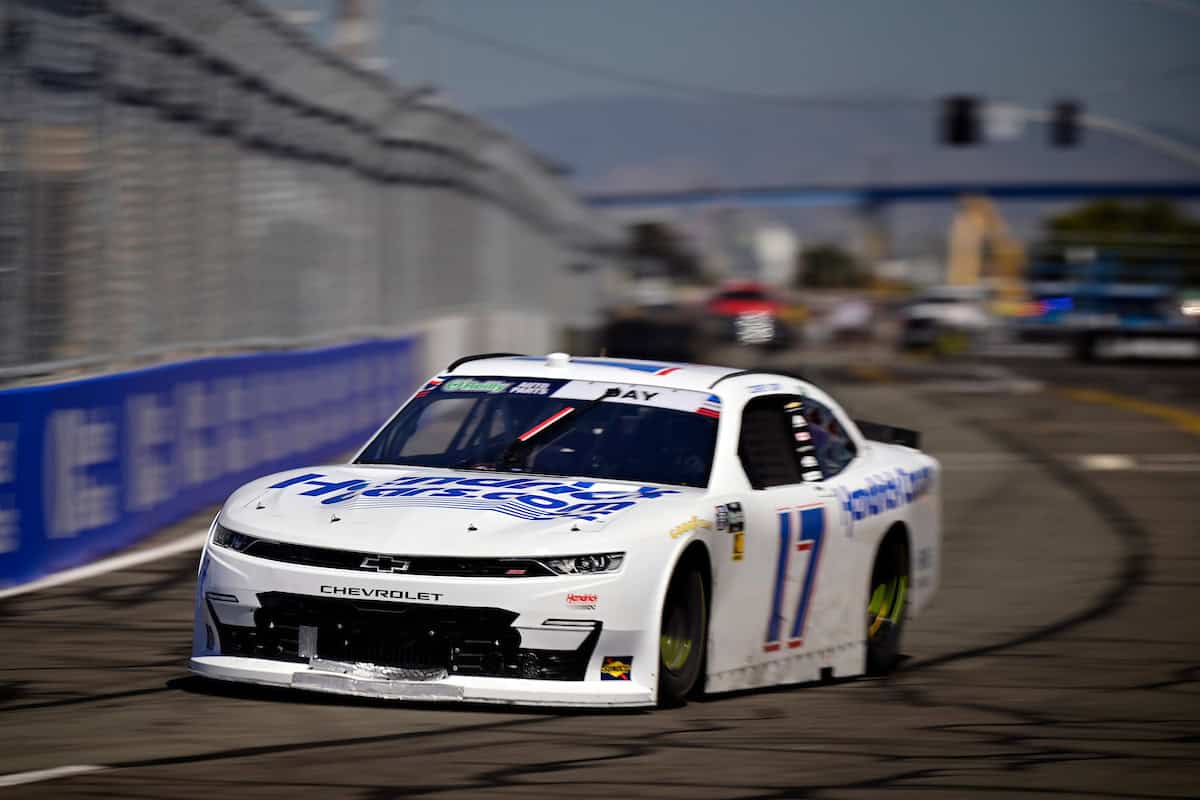
One of the under-the-radar storylines amidst a full weekend of them took place on lap one of the NASCAR O’Reilly Auto Parts Series race at Naval Base Coronado.
Corey Day, already sitting in a backup car that got stripped down to a basic white paint scheme, was rolling from the back and hit a moving manhole cover that was supposed to be welded into the track around turn 5. NASCAR, in a decision we rarely, if ever, see, allowed Hendrick Motorsports to repair the damaged No. 17 under red. And when Day returned to the track four laps down, NASCAR allowed him to get all his laps back under caution.
Spending the rest of the race on the lead lap, Day brought the No. 17 home 10th.
Was that the correct decision to make? Logan Kendall and Thomas Dunn attempt to surmise that on this week’s 2-Headed Monster.

Corey Deserved Respite for His Day
In contract law, there is a clause known as “force majeure,” which in a legal context means “superior force” in French. This clause absolves parties from liability when an extraordinary event beyond their control prevents them from fulfilling their obligations.
Day hitting a manhole cover during Saturday’s (June 20) NASCAR O’Reilly Auto Parts Series race fits that description perfectly. It was an extraordinary event outside of his control, and NASCAR made the correct decision by allowing the No. 17 team to repair the car under the red flag and receive its laps back.
Day hit the manhole cover through no fault of his own. He didn’t spin, miss a turn, or make contact with another driver. The incident took place on a surface that was never designed to function as a racetrack, which only adds to how extraordinary the circumstances were. Day was just unlucky and fell victim to an event that NASCAR rarely has to address. And if the sanctioning body established a new precedent by allowing the No. 17 team to repair the car and receive its laps back, that’s perfectly acceptable.
Critics of NASCAR’s decision have pointed to past incidents in which drivers were also unlucky enough to fall victim to a track malfunction. The most notable example came at Martinsville Speedway in 2004, when Jeff Gordon struck a piece of concrete from the racing surface. He was unable to get his car repaired under red-flag conditions, thus forcing the No. 24 team to wait until after the red flag and repair under green flag conditions, ruining any chance of a race win.
That may have been the precedent NASCAR established 22 years ago, but precedents can and should change. Just because NASCAR once showed little grace to a driver who received damage because of a track failure does not mean it should continue doing so indefinitely.
Bear with me as I take us back to high school government class for another legal analogy. Think of the United States Supreme Court, an institution that has a long history of overturning its own precedents when a future court determines that a previous ruling was unjust or incorrectly decided.
That is essentially what NASCAR race control did on Saturday, and good on them for doing so. As long as NASCAR applies the same standard in any future incident of this nature, there should be little room for controversy.
Now, setting aside the fairness of the ruling and the precedent it may have created, the business realities of the NASCAR O’Reilly Series also deserve consideration.
Even for Hendrick Motorsports — the powerhouse organization that Day drives for — hauling two cars (a primary and a backup) from North Carolina to San Diego, California, along with the necessary equipment and personnel, is not cheap. That’s before considering the cost of transporting its four-car NASCAR Cup Series operation to the event weekend.
And Day was already in the No. 17 team’s backup car after the primary car was damaged during practice. The expenses were already mounting before the race even began.
Now put yourself in the shoes of a team owner, even one with substantial financial resources. Imagine hauling your team across the country only to have your car damaged on the opening lap by a piece of the racetrack. Then imagine being told that your team cannot repair the car and your car will not be put back on the lead lap even after the red flag, which halted the race, is lifted.
Most people would be livid, and rightfully so.
NASCAR recognized an extraordinary circumstance and responded accordingly, ensuring the unforeseen event did not unfairly impact Day or Hendrick Motorsports any more than it already had. And for that, NASCAR race control should be commended. There have been fair criticisms of NASCAR race control in the past, but on this occasion, they got it right. –Logan Kendall

NASCAR Creates a Slippery Slope
As a fan, I’d definitely understand the gripe that comes with your driver having the day ruined with something not of their own doing. Even more so when it’s on a street course that’s not fitted for racing and where natural adverse circumstances can arise like this past weekend.
But I can’t help but shake the potential precedent that was set here.
Things happen in racing. The 2010 Daytona 500 got delayed when the track came up in turn 1. Sonoma Raceway battled its first repave in some time back in 2024. Jamie McMurray got belted into the wall when Dover Motor Speedway came apart in 2014.
McMurray had to wait through the red flag and somehow brought his wounded car home to 13th place. Those victims were “told” things along the lines of “tough luck” because those situations can occur. I’m not the one to call balls and strikes, but to me, that’s a part of the equation at any racetrack, whether it should or shouldn’t take place to begin with.
I personally don’t believe NASCAR should’ve granted the exception but understand why it did so.
If this occurred on lap 20, then what? The race is already well under way by that point, and you can’t just reset the equation depending on what type of repair was required. Could you ask to let them fix it while acknowledging the laps down are lost? Sure, but then you are looking for more carve outs, and if we know anything about NASCAR teams, they will push the limits when there’s a little give.
Matt Weaver of Motorsport.com gauged the pulse of the NOAPS garage in the aftermath, and opinions leaned in the direction of liking the choice, with one notable thought from Sam Hunt, owner of Sam Hunt Racing.
“I’ve never seen that before,” Hunt told Weaver. “I hated it for them. I would have hated that for anyone. Again, it’s a bad situation, but I’ll spare you all the comments from our box and just tell you I’ve never seen anything like that before.”
We just don’t know how NASCAR will react to something like this in the future. To be clear, I don’t even necessarily see this as a “bad” decision from race control like any number of situations the past few seasons. But what if Chicagoland Speedway isn’t prepared well enough and a NASCAR Craftsman Truck Series team in the back hits something?
There would almost assuredly be a callback to the precedent of this past weekend in that they weren’t in control. But will the sanctioning body make the same choice given that its a regular racing facility as opposed to the city streets?
Your guess is as good as mine, and that’s ultimately part of the can of worms that were opened this past Saturday in Southern California. And it’s why Day’s day, while unfortunate, should’ve ended there. – Thomas Dunn


Logan Kendall joined the Frontstretch team in 2025 as the Tuesday news writer and eventually branched out into assisting with Frontstretch's social media and video team operations as well. Outside of motorsports, he has an interest in history, meteorology, and government.
Thomas is in his second year covering NASCAR at Frontstretch. A Bay Area NASCAR fan for over 15+ years, he found his love for the sport through Jeff Gordon. He helps manage the 2-Headed Monster Column.
Thomas has enjoyed several trips to Sonoma Raceway in his time and currently covers college athletics in the Bay Area, writing about the California Golden Bears and doing play by play broadcasting.
I was surprised when they announced that he would not lose his laps but I think it was the right call. It was the first time we were there and a manhole cover in the grill was probably not on their list of things to contemplate. I do not think they agreed to this because it was a Hendrick car. So lets not go there.
The fact it was a Mr. H car certainly had a bearing on the decision. Same if it was a Reverend Joe Toy. If it was a Ford… no way!
Your spot on.
I guess the closest incident I can remember was that time when a TV camera wire fell on the track during the Coke 600 in 2013. NASCAR gave the teams 15 minutes to repair the damaged caused by the cable. There was some talk afterward that the situation wasn’t really controlled more than that, and teams might have been doing work beyond that scope that was hard to police. I get the argument that it’s unfair to the driver that track conditions caused damage and that’s out of their control, but there are a lot of things that are out of the driver’s control that can cause damage. Running over a small piece of debris and cutting a tire, puncturing a radiator, or breaking an oil line is out of their control. Another driver making a mistake, blowing a tire, or dropping fluid on the track right in front of them is out of their control. A sudden rainstorm is out of their control. Should NASCAR have given teams time to repair their cars under the 3-hour red flag that happened during the 2022 Coke 400 at Daytona?