
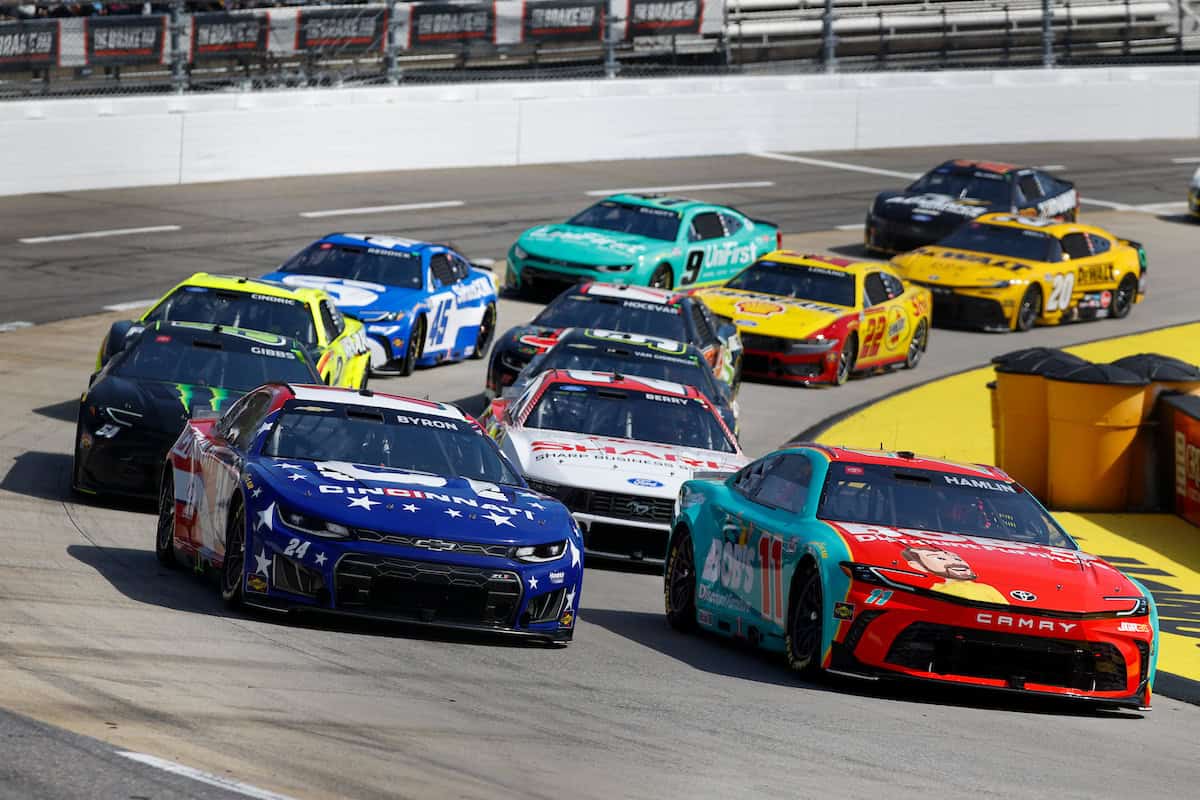
Denny Hamlin saw victory slip away in the closing laps at Martinsville Speedway on Sunday (March 29) as Chase Elliott used pit strategy and a great late restart to snatch the win away.
But Hamlin hit a home run on his assessment of how a portion of NASCAR Cup Series races play out.
Hamlin nailed this one. While NASCAR has cut down on questionable debris cautions in recent years, it hasn’t solved anything. There are still too many laps being run under yellow.

To NASCAR’s credit, in addition to fewer debris cautions, officials have been a little less heavy-handed with the yellow flag recently, giving drivers who spin or scrape the wall a chance to drive away if it’s safe to do so. The calls are a little quicker at the Cup level, but overall, there’s been an improvement.
But none of that addresses the length of the caution periods. Let’s talk about those.
Cautions fall into two categories: stage breaks and competition yellows, which are pre-planned, and cautions for cause, which sometimes happen frequently in a race and sometimes very little. Cautions for cause include crashes, engine failures where fluid gets on the racing surface, rain and yes, the dreaded debris on track (which can be a real thing). Occasionally, there’s something really weird, like a wild animal on the track, a large hole in the pavement, a drunken fan on the catch fence or the racetrack actually on fire (yes, all of these have happened).
Sometimes this type of caution can be lengthy if there’s excessive cleanup or if a SAFER barrier or the track surface needs to be repaired. That’s understandable and generally necessary for the safety of competitors and fans. To be clear, NASCAR should never compromise on safety.
In situations that do require an especially lengthy fix or the track needs to be dried, NASCAR will generally display the red flag, halting the action and resuming when the track is ready. That’s the correct move to not only ensure the race resumes safely, but also to keep from wasting laps.
In any case, cautions for incidents can still be stretched, but in general, fans are willing to accept that track cleanup is needed. The broadcast networks use the opportunity for as many commercials as possible, but that’s better than commercial breaks under green.
Stage cautions, created for the networks as a planned commercial window, are another story. They’re dragged out, and as Hamlin said, the networks have a hand in that by insisting on showing pit stops.
Sunday’s race at Martinsville featured five caution periods for a total of 54 laps, an average of just under 11 laps per caution.
Three were solely for cause, one was a stage break at the scheduled lap, and the other one was for cause but rolled into the first stage break.
That last one was actually the first yellow flag of the day, and it flew about three laps before the stage break. It lasted a total of 16 laps. How much of that was due to cleanup and how much was just the stage end isn’t noted by NASCAR, but the caution was for contact between John Hunter Nemechek and Cody Ware, and while Ware did spin, he drove away with minimal damage, so cleanup should not have been extensive.
A two-car incident during stage two, in which Noah Gragson sustained a bit more damage than Ware had, lasted six laps.
The third caution was the end of stage two and lasted 11 laps.
The longest caution solely for cause was a 10-lap delay while crews located and picked up pieces of a shattered brake rotor. Was that excessive? It depends on how long it took to find all the pieces because leaving pieces where they could be run over is a safety issue, even at Martinsville where speeds are low.
The final caution was for a 12-car pileup on the restart from the previous one and lasted six laps.
Final tally: almost half of the total caution laps of the day were used on stage breaks, one of which required no track cleanup from an incident and one of which required very little.
Addressing Hamlin’s observation that showing pit stops sandwiched by the inevitable commercials extends the cautions, there’s an obvious fix: don’t show the stops live if it’s going to reduce the number of laps of live racing. Green-flag racing should be prioritized over yellow-flag pit stops 100% of the time. Unless something absolutely newsworthy happens during stops, a recap by the pit reporters and the booth is plenty to inform fans of what happened in the pits.
If something happens that needs to be addressed, such as major issues for a contender or an injury to a crew member, yellow-flag stops aren’t a story. Fans will see who got off pit road first when NASCAR sets the running order behind the pace car before the choose cone.
And, yes, in an ideal world, they’d show all of it, but in reality, the commercials pay for the broadcast and the networks have to fit them in somewhere. We’re talking lesser evil here.

Stage cautions do nothing to enhance races. Drivers will race for the points, sure, but they’d do that without the caution. If anything, the planned cautions hurt the final product. They take away the pit strategy for the first half of the race, particularly on road courses. They can put an end to a compelling on-track battle. Not only do they take up too much of the races (and that’s even more true in the NASCAR O’Reilly Auto Parts and Craftsman Truck Series), but they actively damage the on-track product that fans see.
Competition cautions for things like weather the night before a race or potential issues are their own animal. They’re generally a safety measure and early in the run, so less detrimental to strategy and not simply for the benefit of TV. They’re just a part of the game.
The problems are obvious, but what to do about them?
It’s been suggested not to count caution laps at all like some short-track events don’t, but for long races, that’s not feasible. Another 54 laps at Martinsville would have been fine but remember that the Clash at Bowman Gray Stadium took three hours to complete—some races at Daytona International Speedway would end up rivaling the Rolex 24.
In the same vein, a better idea would be not to count the stage caution laps. That would provide fans with more actual racing but doesn’t actually solve anything in terms of the effect the breaks have on strategy or on-track action.
The best solution for fans would be to eliminate the stage cautions altogether. Points could still be awarded without stopping the race. Teams would have to make green-flag stops and decisions that could actually alter races and give fans an unexpected finish. Not stopping the race might still produce a couple of natural cautions due to mechanical or tire issues because teams would have to push their equipment more, but natural cautions are, as noted above, not the same level of disruption for fans.
Television wouldn’t allow that, of course, as they love their full-screen commercial time, or if they allowed it, we’d wind up with even more commercials during green-flag racing. Still, the stage breaks have run their course. The cautions drag on for way too many laps for what could actually be a quickie yellow where all cars pit together and get right back to the action.
Natural cautions will always exist in motorsports, but the cultivated ones have worn out any welcome they might have had. Teams deserve to control their own destiny and make daring calls. Fans deserve to see as many laps under green as possible—that’s why they buy tickets and tune in from home. In the scheme of things, it’s one of the easiest issues NASCAR has in terms of a viable fix. It’s just one unlikely to happen anytime soon.


Amy is an 20-year veteran NASCAR writer and a six-time National Motorsports Press Association (NMPA) writing award winner, including first place awards for both columns and race coverage. As well as serving as Photo Editor, Amy writes The Big 6 (Mondays) after every NASCAR Cup Series race. She can also be found working on her bi-weekly columns Holding A Pretty Wheel (Tuesdays) and Only Yesterday (Wednesdays). A New Hampshire native whose heart is in North Carolina, Amy’s work credits have extended everywhere from driver Kenny Wallace’s website to Athlon Sports. She can also be heard weekly as a panelist on the Hard Left Turn podcast that can be found on AccessWDUN.com's Around the Track page.
How can they not show the pit stops?
At some races that’s the only place passing takes place.
The more pit stops the greater the chance for a mistake to cost a driver.
On Saturday the red flag came out with 16 laps left. When the green flag came out there were FIVE laps left! I have always maintained that when there is a red flag, laps don’t count until the green flag restart. But there were a lot of laps for commercials.
Saturday had 14 cautions for 167 laps out of 250.
The trucks had 9 for 56 in 200 laps.
I find it hilarious that NA$CAR counts the lap that the caution flies as a green flag lap. Makes sense only to NA$CAR brain trust.
The stages & stage points not only need to go, they should never have been created in the first place. As far as showing any of the cautions live, to me, that’s actually the perfect time for commercials.
Brian France & the NASCAR “brain trust” screwed things up worse that a football bat or a soup sandwich when they started tinkering with the points format. Yes, the points system Bob Latford designed way back in the ’70s needed tweaking, Latford himself said that, but obviously Brian had to make his own mark on the sport. Too bad it was a giant brown skidmark. And yeah, while I love live broadcasts of the races, TV has gotten too much control over how things are done in the sport.
Stages and stage points are fine, they give the drivers more reason to race the whole race, and not just cruise until the last 25 miles. It also gives drivers who have trouble in the last part of the race some consolation points, rather than just last place points.
The compromise would be to not count the stage caution laps.
The best case would be to remove the stage caution completely, just award the points and keep going green. But we know the TV wants their ad time.
“The best case would be to remove the stage caution completely, just award the points and keep going green. But we know the TV wants their ad time.”
This is the way.
Back in the golden era, there was a points/$ bonus for leading at half the race distance. It was never a problem, and even with only one car getting points, there were often drivers who would intentionally stay out a bit longer than others to get this bonus. With stages awarding to the top ten in points, many would likely strategize a bit to earn the points.
What I’d love for the TV and/or ad execs to explain is why they feel the scheduled cautions are better for them. When I still bother with a NASCAR race, I usually watch on delay, just to FF through these breaks. If the ad break comes during green, I’m more apt to continue watching, especially if it’s a side by side break. For those watching live, even a regular break seems more likely to be watched if under green, to avoid missing anything when the broadcast returns.
There are plenty of lulls in NASCAR races, even with the contrived drama of stage cautions. Go to break when the field is strung out. Sure, once in a while something meaningful will be missed, but that’s no different than the days when NASCAR first rose to national attention.
If I recall correctly, wasn’t 2 points awarded for leading a lap, and 3 extra (5 total) points for leading the most laps? I think they modified that to 5 for leading and +5 for most laps led later on. Leading at the halfway point was always cash bonus. I think that’s all correct.
The stage racing idea came about because the TV telecast I guess wasn’t exciting enough during the first 2/3 of the race when guys were feeling out their cars, trying to stay clean, and adjust/save their car for a hard run at the end. There was demand from somewhere to “make them race hard the whole 500 miles”, and here we are. I agree with many others here, it would be much better to keep the stages, award the points, but keep the track green to let every other aspect of the race/strategy play out naturally.
You’re probably correct. I’m old and busted. I definitely remember people staying out for the halfway bonus, but entirety possible I’m misremembering the points for it.
I also recall the “carrots” for leading a lap as well as most laps led.
I may be old school but I prefer Nascar just leave pit road open all the time and let the teams pit when they want. With technology the way it is today, timing and scoring should be able to adapt to that. As it is now, opening pit road 1 lap for lead lapped cars and then another lap for lapped cars just drags out the cautions. We should not be holding up going back to green for pit stops and for the sweeper trucks to go out there an clean the track. Cautions were supposed to be for cleanup of incidents only then right back to racing. That’s what they need to get back to.
Another issue i have is the caution being flown for a 1 car spin when they don’t hit anything and the other competitors clears the scene. They still need to drive evasive to avoid being caught up in it whether the caution comes out or not. At worse, hold the flag until the leaders come back around to allow for the car to get going. If the car hasn’t moved when the leaders approach the car, then throw the caution. It gives the driver time to get going and the longer they sit there, the higher the risk of going a lap down. Some common sense could be used here. If the drivers know that the caution will not come out so quick, they will do everything to get going again after a spin, which allows for more green flag racing and less cautions.
14 laps under caution for no incident at Martinsville should not be a thing.