
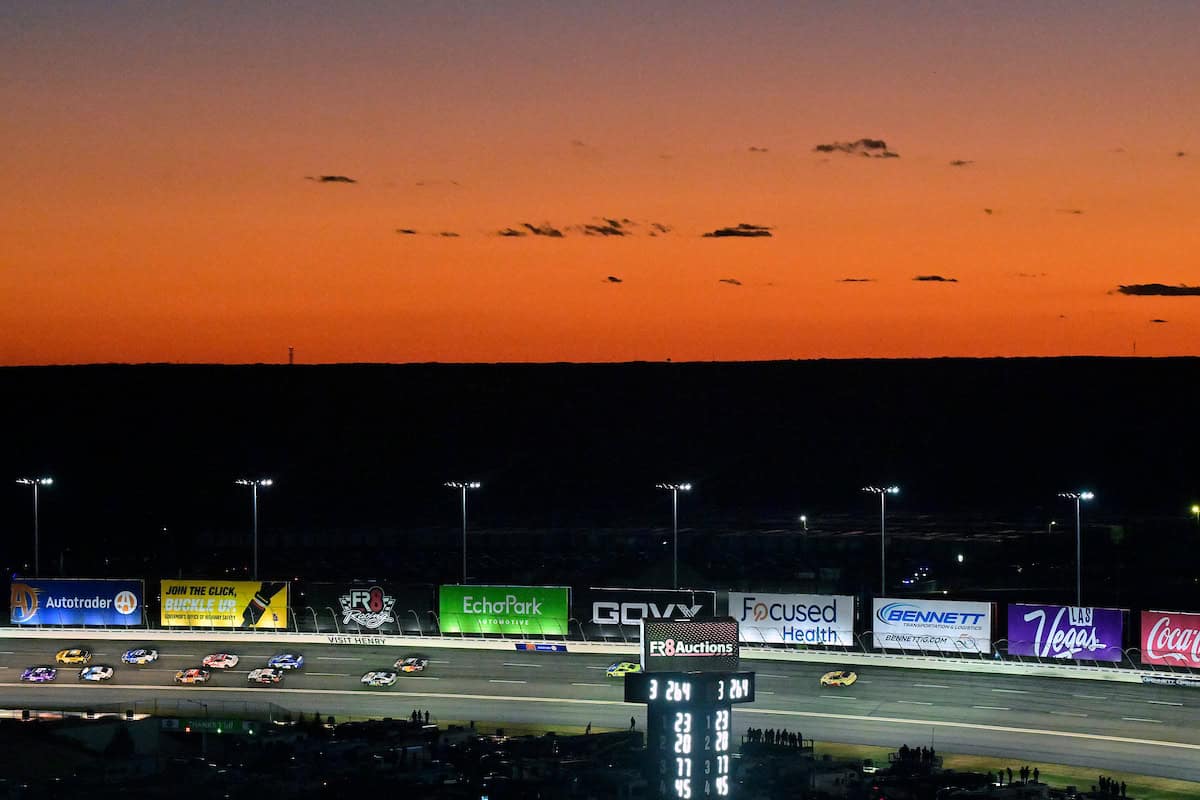
Would the powers that be ever deem EchoPark Speedway as a worthy championship-hosting site?
With as much hype as each EchoPark Speedway race gets in the Next Gen era, some have asked in recent years whether it could ever be considered as one of the newly rotating championship host sites.
While I do believe it’s smart to keep the championship somewhere in the South, I hate to burst your bubble. Atlanta is never going to host a NASCAR Cup Series championship, and that’s OK.
The racing at Atlanta is better than it’s ever been. It’s like the track itself was designed with the Next Gen car in mind (because it was), and the racing there is among the best any race fan could watch. In fact, if you were going to show a new fan the NASCAR product anytime soon, this weekend would be an ideal race.
Despite all that, it still shouldn’t host a championship. Because while I’m all for being adventurous, in this new format, the racing in The Chase has to be as pure as possible, and placing any sort of drafting track, such as Atlanta, Daytona International Speedway or Talladega Superspeedway, leaves the result entirely to chance.
That’s precisely why Atlanta is so fun to watch. It’s unpredictable, not just a one-lane track, and the cars actually have the room and capability to move around through all three lanes. It’s an amazing circuit, and we should be thankful we get to watch it twice.
But it shouldn’t be more than that. Fans should and will enjoy this weekend of racing, but if anyone suggests that Atlanta should host the championship anytime soon, just know that it’s probably never going to happen.
Are we back to the “Boys, have at it” era of NASCAR?
When Steve O’Donnell took the helm at NASCAR, nobody knew what to expect. The buzz around the garage suggested that O’Donnell was a racer’s kind of guy and that he believed in some of the sport’s older methodologies that gave rise to its early-2000s superstardom.
So far, that’s been evident, and it reared its head again last weekend as the series returned to Chicagoland Speedway for the first time since 2019.
On two distinct occasions, a driver straight-up turned someone on the track under green, and one even came back to collide with the other under caution.
The result from NASCAR yesterday? Crickets.
Neither Austin Hill and Shane van Gisbergen nor Zane Smith and Carson Hocevar were penalized following their on-track incidents, even after clear video evidence of Hill colliding with van Gisbergen under caution surfaced via the latter’s in-car camera. SMT data even showed that van Gisbergen didn’t lift when turning Hill. And still, no penalty.
Just five years ago, that was unheard of. At one point in the not-so-distant past, penalty Wednesday was treated like Black Monday. It’s the reason that so many PR teams had to put clamps over their drivers’ mouths, and it played no small part in the dehumanization of NASCAR that led to its decline in the late 2000s and early 2010s.
Now, though, it seems we’re back, as long as drivers don’t say anything about retaliation on the radio, which is understandable, especially given that stricter FCC regulations now apply since the races are back on cable.
To that, I say, “hell yeah.”
Why does Prime Video want more races?
Because it’s damn good at broadcasting them.
On July 8, Sports Business Journal‘s Adam Stern reported that Prime would like to broadcast more NASCAR races, but that any change to the schedule is unlikely before 2031 due to the current media rights deal, according to O’Donnell, NASCAR’s CEO.
As discussed at length in this column, Prime could be a huge player in the next media rights negotiations and could even lobby for either half of the season or the full season if the right pieces are put in place. That’s due in part to the fact that in 2026, media rights negotiations are a big-time addition for streamers as much as for cable providers.
For instance, Netflix is spending $150 million over three years with the MLB and is expected to make a much more lucrative offer when its negotiations reopen in a few years. Why or how can it make that offer? Take a company considered to be a broadcast giant, like FOX, for instance. At this current point, FOX’s market cap is around $22 billion. If that sounds like a lot, it’s because it certainly is.
But Amazon’s market cap? Try nearly $2.7 trillion. Tech giants and streamers have the money to spend on things like mini movies and other value adds that mean a lot to the fan base, as we saw with Amazon this year, whereas the more traditional cable companies simply can’t keep up with that level of capital.
Prime will be the name to watch come the next media rights negotiation. The question now, though, is how much NASCAR can convince them to put on the table.
Should the In-Season Challenge return next year?
This is a hard no from me.
While the idea of in-season tournaments has worked for the NBA and pro golf, to an extent, racing simply doesn’t lend itself to a format like this, especially not in a seeded NCAA Tournament-style bracket. I was in Chicagoland last weekend, and I don’t think I even heard a single fan mention the In-Season Challenge.
It’s simply not something the fanbase can or has gotten behind. That begs the question, though: what could replace it?
$1 million to a Cup driver, depending on what team they race for, can mean nothing or a lot. Conversely, though, if that kind of cash were available to the NASCAR O’Reilly Auto Parts Series or NASCAR Craftsman Truck Series, drivers would be dooring each other left and right for a chance at a purse that large. The first option would be to move it down to a lower series, then, but that won’t draw the same eyes as a Cup event.
If it has to stay at the Cup level, it needs to have prestige behind it, not just a dollar amount, and I fondly remember another in-season event that had all the prestige in the world: The Winston Million.

From 1985 to 1997, if a driver won three of the four crown-jewel races, they received a $1 million bonus from NASCAR’s premier series sponsor, RJ Reynolds Tobacco Company, which manufactured Winston cigarettes. Today, that fund could simply be covered by the money used for the In-Season Challenge, and it also wouldn’t be guaranteed to come out of the expense account each season.
Jeff Gordon and Bill Elliott were the only two drivers ever to win the million, but several others came close. If it were to be rinsed and repeated today, it would add another level of prestige to NASCAR’s crown-jewel races and warrant the type of pomp and circumstance necessary to make an in-season event of this nature mean something not just to the drivers but to the fans as well.


Tanner Marlar is a staff writer for Sports Illustrated’s OnSI Network, a contributor for multiple automotive news outlets, an award-winning sports columnist and talk show host, and a PhD. student at a premier college of media and mass communication. Tanner began working with Frontstretch in 2022, covering the O'Reilly Auto Parts Series.
Thanks for choosing to comment on this article. A name and email address are required to post a comment. The email address is not publicly visible or shared. Please keep in mind that comments are moderated according to our comment policy.