
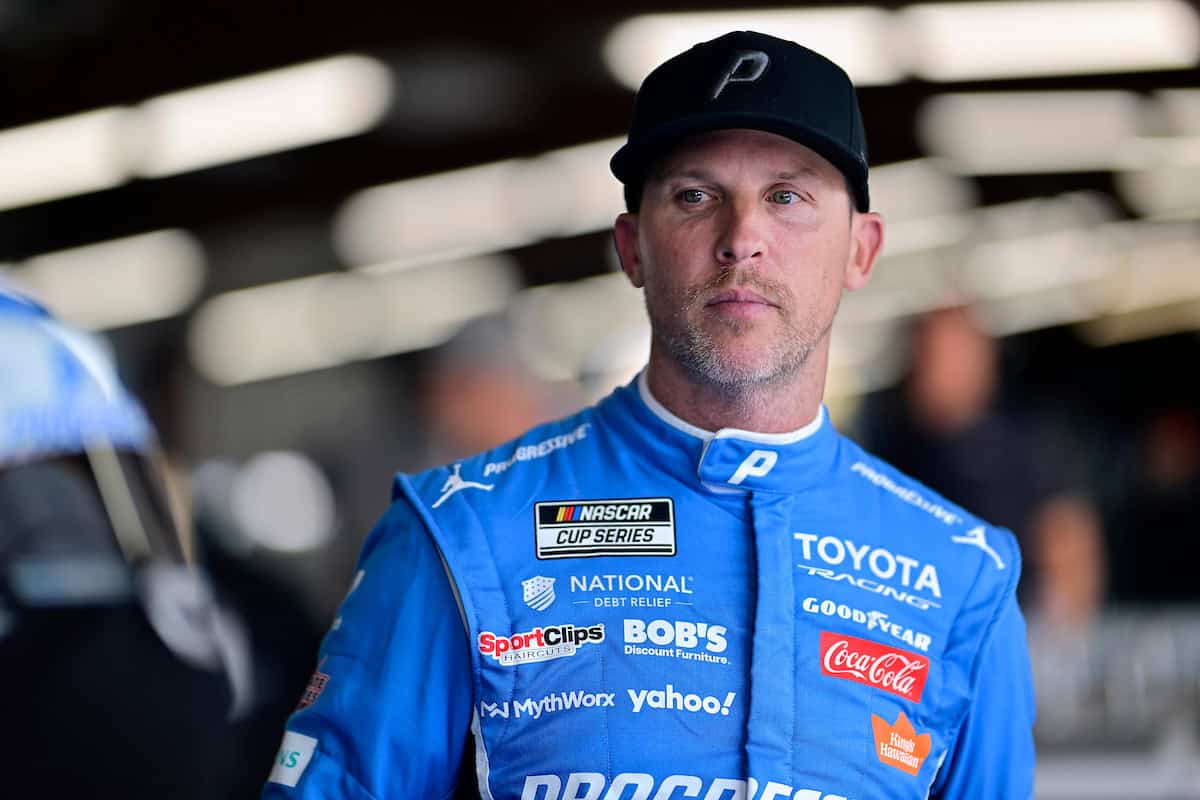
Did You Notice? … Not one of NASCAR’s regular season champions in its top three series are leading the points halfway through The Chase? Denny Hamlin (NASCAR Cup Series), Justin Allgaier (NASCAR O’Reilly Auto Parts Series) and Layne Riggs (NASCAR Craftsman Truck Series) each find themselves trailing by at least 30 points with just a handful of races left to close the gap.
That’s a surprise considering how that trio thoroughly dominated most of the spring and summer. Without a playoff, each of them would still hold a commanding lead, cruising toward all-but-certain titles. In the case of Allgaier, the gap would still be well over 175 points, over two full races’ worth of cushion (he won the regular season by a whopping 229 over Carson Kvapil).
Instead, the top seeds are bonded together for all the wrong reasons. A long list of pit road problems, wrecks and self-inflicted mistakes have dug them holes that feel impossible to crawl out of based on recent momentum.

Their combined slump is impressive for all the wrong reasons: the trio has failed to win a race this postseason in 11 combined starts. They’ve notched just two top-five finishes compared to six results of 16th or worse. It seems like everything that can go wrong has gone wrong, including…
- Hamlin spinning out from fourth at Las Vegas Motor Speedway after leading much of the race’s first stage. He went from putting championship rival Kyle Larson a lap down to watching him blow past on his way to second place; Hamlin floundered and limped to 16th.
- Allgaier getting involved in a crash with Brandon Jones that same weekend, posting his worst finish of the year (34th) at the worst possible time. It was just the third DNF of Allgaier’s season and his first for a crash since the February race at EchoPark Speedway outside Atlanta.
- Riggs fighting for the win at Kansas Speedway two weeks ago only to push too hard, hitting the outside wall with two laps remaining. Rival Kaden Honeycutt took the win unchallenged and virtually doubled his lead with the mistake.
It’s some cruel irony considering this revamped format was designed to give regular season champions a better chance. But what people may not realize is that during the original run of this 10-race format, from 2004-13, the driver who scored the most points in the first 26 races almost never maintained that momentum into the postseason.
Only once did the driver with the most points at the end of the regular season go on to win the championship (Tony Stewart, 2005). There were far more drivers known for the faceplants Hamlin et al. are doing right now, like Kyle Busch’s disastrous 2008 Chase where he went from a dominant, eight-win regular season to 10th in the final standings.
Here’s a closer look at the list — keep in mind only Cup ran the 10-race Chase format the first decade it was used.
| Year | Regular Season Champion | Playoff Finish |
| 2004 | Jeff Gordon | 3rd |
| 2005 | Tony Stewart | 1st |
| 2006 | Matt Kenseth | 2nd |
| 2007 | Jeff Gordon | 2nd |
| 2008 | Kyle Busch | 10th |
| 2009 | Tony Stewart | 6th |
| 2010 | Kevin Harvick | 3rd |
| 2011 | Kyle Busch | 12th |
| 2012 | Greg Biffle | 5th |
| 2013 | Carl Edwards | 13th |
As you can see, as the Chase system aged a bit, the title contenders wised up, learning how to peak at the right time. That meant the regular season champion was often a placeholder, earning the spot through consistency but often showing all their cards in July and August while others behind them were fiddling with the right setups to carry them through the postseason.
Jimmie Johnson and company were experts at playing that game, and they would often spend much of the summer floundering during their run of five straight titles (2006-10). In 2006, the year of Johnson’s first championship, he didn’t have a finish better than 10th during the final five races of the regular season.
But when The Chase started, the No. 48 team was always on the top of their game. All it took was a win or two to close the gap and then Johnson was off and running.
To be fair, the second rollout of this system was designed to give the regular season champion more of a cushion. A 25-point lead over second place, so we thought, and 35 over third would make it difficult for anyone outside the top three to make a run.
That gap turned out to be smaller than we thought. The bonus for winning has become so strong under this system that sweeping the stages, plus earning the fastest lap bonus, gives you a minimum 23-point gap over the second-place finisher in just one race. And that’s if your closest rival finishes second in each of the stages you win.
It means even the third seed in this system could close within 12 points of the lead, minimum, if not take the overall point lead with a dominant win in The Chase opener. And we’ve seen how much winning pays off already: Larson has charged to the point lead in Cup on the heels of four straight top-two finishes (including two wins).

What the difference is now compared to 2004-13 is that the bonus for winning minimizes the argument a lower seed is an undeserving champion. If Larson wins a few more times in the final five races, finishing with four wins, is anyone going to argue he’s an unworthy champion the same way they did last November?
No. Hamlin was given a 10-race runway plus some cushion to prove he’s worthy of the top seed and (at least so far) he’s on his way to falling flat. Compare that to a one-race, winner-take-all event where Hamlin lost on a pit call after controlling most of the race and you can see why everyone likes this format better.
Winning the NASCAR regular season title is back to giving you an edge over everyone else. But it doesn’t hand you the championship.
If we’re going to have a Chase system, that’s how it should be.
Follow Tom Bowles on X at @RacingBowles


The author of Did You Notice? (Wednesdays) Tom spends his time overseeing Frontstretch’s 50+ staff members as its majority owner and Editor-in-Chief. Based outside Philadelphia, Bowles is a two-time Emmy winner in NASCAR television and has worked in racing production with FOX, TNT, and ESPN while appearing on-air for SIRIUS XM Radio and FOX Sports 1's former show, the Crowd Goes Wild. He most recently consulted with SRX Racing, helping manage cutting-edge technology and graphics that appeared on their CBS broadcasts during 2021 and 2022.
You can find Tom’s writing here, at CBSSports.com and Athlonsports.com, where he’s been an editorial consultant for the annual racing magazine for 15 years.
A name and email address are required to post a comment. The email address is not publicly visible or shared. Please keep in mind that comments are moderated according to our comment policy.
Comments are listed in order from oldest to newest. Leave a comment