
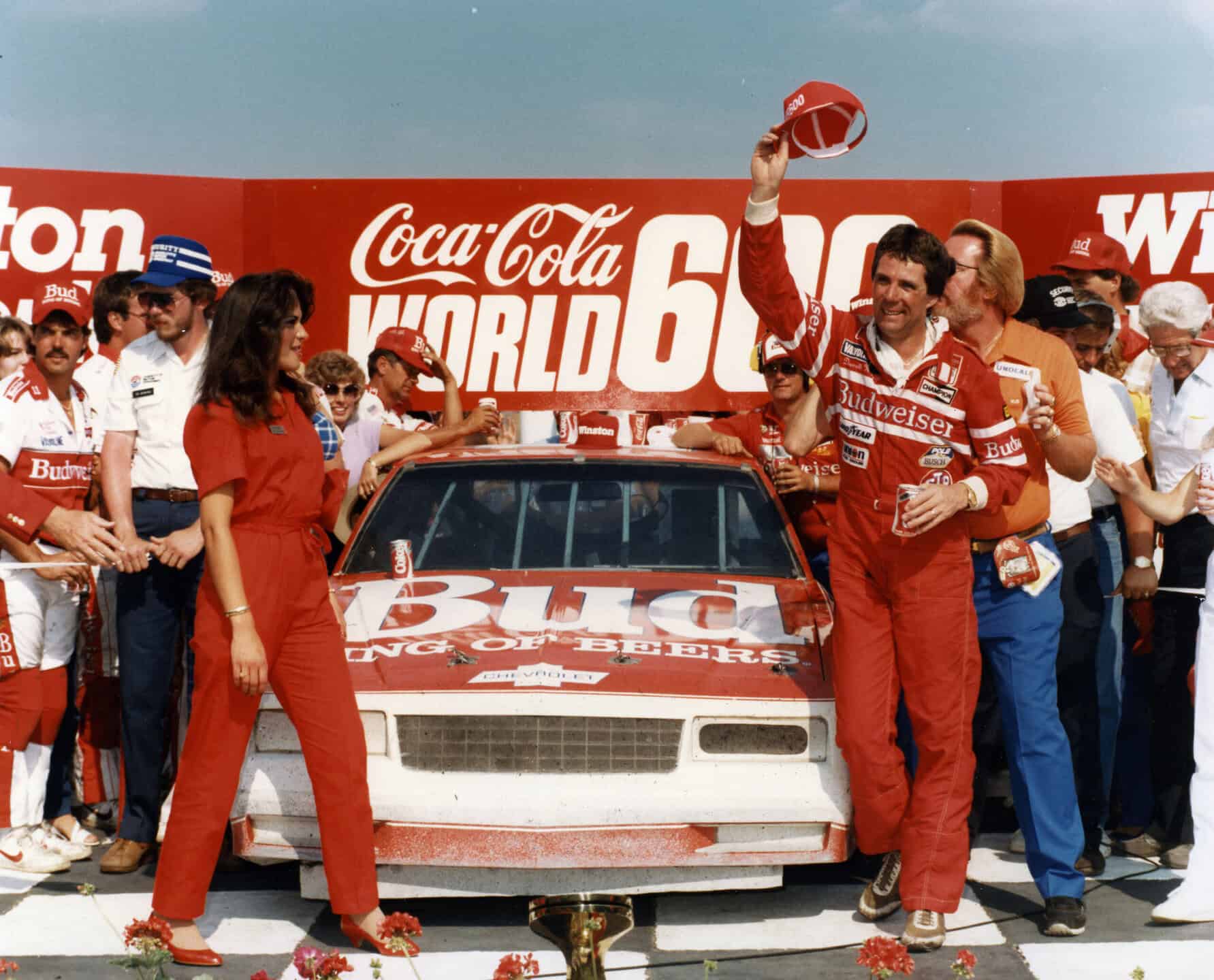
Too many people think of Darrell Waltrip today as a commentary booth blowhard, or a hated driver.
But his championship comebacks in the 1980s are the stuff of legends. And as the current NASCAR Cup Series season starts to wind down and more drivers seem to be out of the running for the title, some of them may well point to these efforts to prove they’re not really out of the running yet.
I recently picked up and read Waltrip’s book he wrote with Jade Gurss back in 2004 (DW: A Lifetime Going Around in Circles). There’s some good tidbits and stories in there. I don’t think it’s the best racing autobiography, but it was immensely helpful in writing this column.

The story of Waltrip’s three legendary comebacks really begins in 1979, a year where he dominated and led Richard Petty by 229 points with 11 races left.
But Waltrip struggled in the fall months and Petty closed the gap. Just two points separated them entering the final race, and Petty edged Waltrip by just three positions and 11 points to take his record seventh championship.
In 1980, Waltrip’s form regressed. His DiGard Racing team wasn’t motivated anymore, still stung by how close they were the previous year. Waltrip spent most of the year trying everything to get out of his contract, eventually paying team owner Bill Gardner $300,000 to walk away and join Junior Johnson’s team.
The 1979 defeat still played heavily in Waltrip’s mind entering 1981. Johnson had won three championships from 1976 to 1978 as a car owner with sworn Waltrip rival Cale Yarborough. He’d eventually get three championships out of Waltrip as well, but it was an adventure compared to the relatively smooth sailing Yarborough had in his campaigns.
1981
Waltrip was very excited to join Johnson’s team.
The very first time he visited the shop as its new driver, Waltrip asked Johnson what he could do to help, just to show he was a team player. Johnson motioned over to a stack of tires and told him to “bounce” them.
Waltrip bounced the tires all over the shop’s outside. The tires were here, there and everywhere. Eventually, Johnson came out and yelled that he had said to balance the tires.
Waltrip’s first 14 races with the team were go-or-blow. He won four races but also had four costly DNFs. A cylinder head that went bad at Texas World Speedway ended his day in the 14th race of the season after 33 laps.
Third in points and 341 points off leader Bobby Allison, Waltrip was written off. He was almost two full races behind Allison now, and it looked to be all over.
He then went on the greatest 17-race run in the history of NASCAR.
In an era with only a handful of cars finishing on the lead lap, Waltrip finished on the lead lap in 15 of the last 17 races. He never finished outside of the top 10 and only had three finishes out of the top five.
His eight wins in the final 17 races were highlighted by a four-race win streak late in the season in which he won all four from the pole. He ended it in the penultimate race of the season by finishing second at what’s now EchoPark Speedway in Atlanta for his 13th consecutive top-three finish; he was 83 points ahead of Allison and easily clinched the championship by finishing sixth in the finale.
1982
Post-championship, a number of key contributors were poached out of Johnson’s shop, including crew chief Tim Brewer.
Jeff Hammond stepped onto the pit box, and the new pairing had speed but also reliability issues. In the first 16 races of the season, Waltrip had five mechanical issues, usually blown engines.
This time, the gap was 183 points from Allison. The comeback was slightly less impressive this time, as he’d have another blown engine in the Southern 500 and would finish 14th at the fall race at Charlotte Motor Speedway.
Allison also put up a much tougher fight. Waltrip won half the races in this 14-race span, but Allison had three wins in that span and only one finish outside of the top 20.
Entering the finale, Waltrip had only a 22-point lead on Allison. It was almost academic either way, though. Riverside International Raceway had been a great track for Waltrip even back in the DiGard days, and he finished third. Meanwhile, Allison blew multiple tires through the day before blowing his engine with eight laps to go.
Allison claimed, probably half-jokingly, that Johnson had hired a sharpshooter to shoot out his tires. When Johnson was asked about this, he quipped that had he done so, they wouldn’t have been aiming for Allison’s tires.
1985
After off seasons in 1983, where Allison finally prevailed over Waltrip, and 1984, where Waltrip didn’t come close to the title, he returned with a vengeance in 1985.
This time, Bill Elliott had one of the biggest seasons ever, winning 11 of 28 races and $1 million for winning the Daytona 500, Winston 500 and Southern 500 in the same year.
With eight races to go after his million-dollar payday at Darlington, Elliott held a 206-point lead over Waltrip.
The late, great Steve Waid wrote a column a few years ago that went into far more depth then I ever could on how Elliott lost the championship.

What I will put here, from the autobiography, is that Waltrip’s championship changed in large part because of the change in dynamics the team went through in the run-up to that season.
Johnson loved for his drivers to charge as fast as they could drive, all the time. By this time, though, reliability had clearly become the key to winning the title. Why? Because so many more cars were fast enough to win races now than they were in Yarborough’s day, or even in the early ’80s when Waltrip dominated.
The wins were nice, but staying in the race as long as it took would win the championship most years. It’s how Terry Labonte won it in 1984, and it’s how Waltrip won in 1985.
Interestingly, Johnson’s approach in part was also similar to the modern approach of Hendrick Motorsports, a team Johnson hated. It was simple: test things out in the first half of a season and throw things that weren’t working away for the second half.
The Johnson team spent weeks building a new car. Waltrip took it out for a race, and Johnson asked him how it ran. If he didn’t like it, Johnson would just throw it into the bin instead of trying to work around it or improving it.
This sink-or-swim mentality seems wild today. But Johnson also won six of the 10 championships from 1976 to 1985.
The lesson here is that nobody is truly out of the championship, no matter what, until the curtains fall and the math says they are.


Michael has watched NASCAR for over 25 years and has covered it on-and-off for 14.
In addition to Frontstretch he also writes sporadically for his own websites GrandPrixFocus.com and StockCarFocus.com.
A name and email address are required to post a comment. The email address is not publicly visible or shared. Please keep in mind that comments are moderated according to our comment policy.
Comments are listed in order from oldest to newest. Leave a comment