
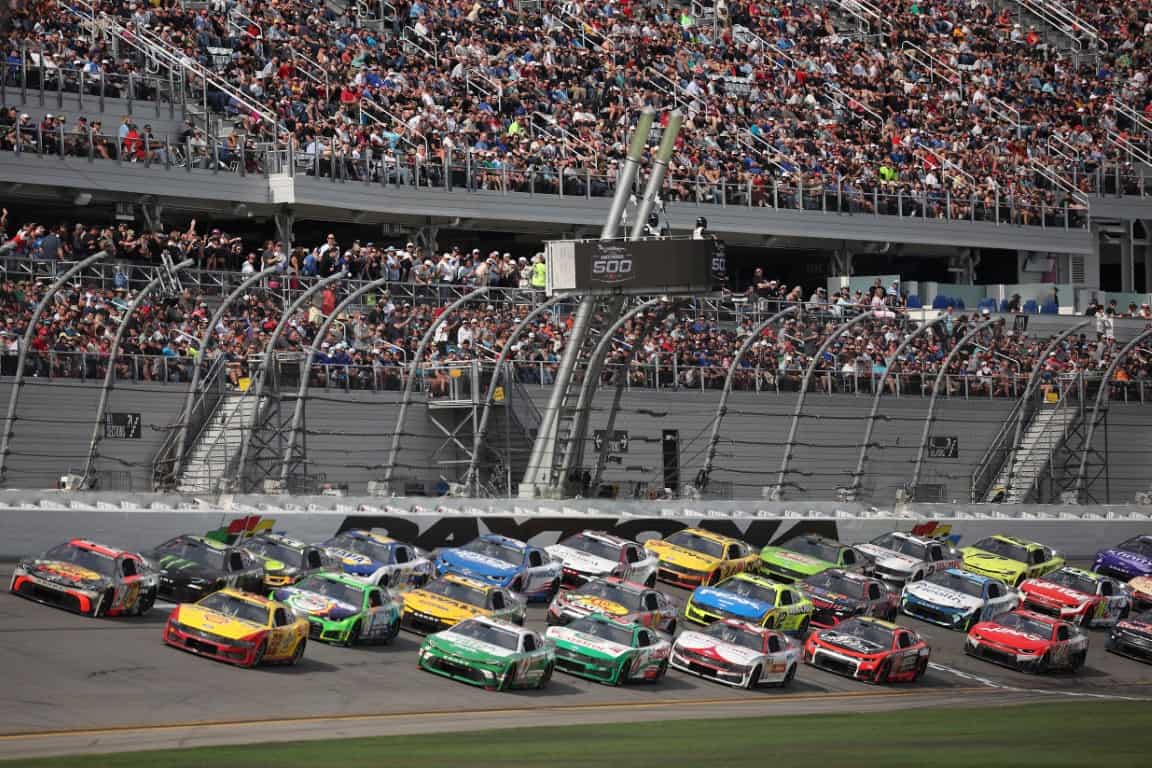
It has long been debated what ended NASCAR’s golden age in the 2000s. Some point to the abandonment of the full-season points format. Others blame the Car of Tomorrow. Some argue the sport was simply a cultural fad that ran its course.
Those explanations all contain some truth and likely played a role, but they overlook what was the defining turning point: the 2008 financial crisis.
The effects of the recession did not end with NASCAR’s golden age. In many ways, the sport is still living with the long-term consequences of that crisis, much like the United States as a whole.

There are clear parallels between NASCAR and the broader country, both before and after the crash. In the years leading up to 2007, optimism defined both. The S&P 500 had doubled over that stretch, reinforcing a sense across financial institutions and government circles that economic growth showed no clear signs of slowing.
NASCAR reflected that same confidence. Attendance was strong, Fortune 500 companies locked down full-season primary sponsorships on NASCAR Cup Series cars, and team ownership had become attractive enough to draw interest from celebrities and business figures alike. On the surface, everything pointed toward continued growth.
But that momentum came to a halt in 2008. As the financial crisis swept across the United States, millions lost jobs, major corporations posted historic losses and the stock market collapsed. NASCAR was not spared. Sponsorships began to disappear, fans cut back on unnecessary spending like race attendance and merchandise and teams were forced to merge, downsize or shut down entirely just to survive.
The big three automakers were notoriously hit especially hard. All three scaled back their motorsports spending dramatically, which had a great impact on NASCAR’s teams.
As sponsorships and manufacturer backing disappeared, teams began to fight for their survival. Petty Enterprises merged with Gillett Evernham Motorsports after struggling to secure funding. Dale Earnhardt, Inc. lost its independence and was eventually absorbed into Chip Ganassi Racing. Bill Davis Racing shut down its NASCAR program, Hall of Fame Racing folded and BAM Racing followed close behind. Yates Racing, which had won a Cup championship roughly a decade prior in 1999, was ultimately absorbed into Richard Petty Motorsports by the end of the 2009 season.
And many team owners in NASCAR are not shy about the financial burden of operating a team in 2026. Sponsorship never returned after 2008 in the same way it existed during the sport’s boom years, and that shift is reflected in teams’ profit margins to this day.
As for the impact on the fans, TIME reported in 2009 that attendance dropped nearly 10% in 2008 alone, and according to PBS, citing Treasury Department estimates, the recession wiped out an estimated $19.2 trillion in household wealth. The average working-class American, who is at the core of NASCAR’s fanbase, would have been hit hard by that, and it is reasonable to assume that many fans never came back because they simply couldn’t.

Today, NASCAR looks different from what it did before the recession. The sport at least seems to be in a stable place compared with the last decade or so, but it is still a far cry from its golden age, and many working-class Americans feel the same about the United States economically.
Many industries never fully recovered their pre-2008 trajectories. Jobs were lost and never came back. The housing market has never fully recovered, and since then, there has been a constant search for economic policies to create a favorable environment for the average American.
NASCAR reflects that same pattern. The sport has thrown countless ideas at the wall to see what sticks, but it is still working to recapture the scale and cultural force it once had.
And when you look at NASCAR today, even in a healthier state than it has been in years, it becomes clear that the sport of the 2000s, like the version of America’s economy that existed before the recession, is not coming back.


Logan Kendall joined the Frontstretch team in 2025 as the Tuesday news writer and eventually branched out into assisting with Frontstretch's social media and video team operations as well. Outside of motorsports, he has an interest in history, meteorology, and government.
Nfl, college football and nba are growing their brand with millions of fans while nascar is being left behind. So to me its not a economic problem its a product problem but as long as nascar makes excuses about the loss of fans and sponsors the carnage will continue untill nascar changes the rules and opens up what a team can do to the cars. But teams dont want to do that bc it will increase cost. So its all about money. The only way nascar sells out races is cut the seating capacity at the tracts which they have by half at some tracks and then brag about sell out crowds. Putting lipstick on a pig and ignoring the faults of top nascar management will not save this sport from itself.
“since then, there has been a constant search for economic policies to create a favorable environment for the average American”
Disagree. There has been constant lip service for economic policies to create a favorable environment for the average American. Since 2008, I’ve seen very little from Washington which indicates any appetite to fix the problems. We now literally have a trillionaire living in our country, and there are many who aren’t far behind him. Our resident trillionaire is worth more than the GDP of over 170 countries. Let that sink in for a moment. The few politicians who offer plans to correct the problem are immediately buried by disinformation campaigns paid for by, you guessed it, the obscenely wealthy.
And before anyone trots out the tax code, the vast majority of this wealth goes on paper as anything other than income, so while the elite still pay the highest percentage of income tax in the US, it’s nothing in comparison to their true earnings. When asked why he didn’t pay any income taxes while being a billionaire, our sitting president replied “because I’m smart”. At least he was honest about it, unlike most of our financial overlords.
NASCAR’s current product isn’t great, and is therefore expendable. NASCAR also has a largely blue collar fan base. The days of many blue collar Americans having the financial wherewithal to finance a day or weekend trip to a race without feeling the pain in their wallet is long gone. Hope I’m wrong, but I don’t see any signs of change on the horizon.
No mention of Brian Z. France taking over NASCAR in 2003? That’s when plenty of fans started heading for the door.
Nascar is a sport (mostly) for uneducated republican, white, obese southerners who are in their mid-40s. This is a fact. They have their demographic but still need to at least attempt to expand.