
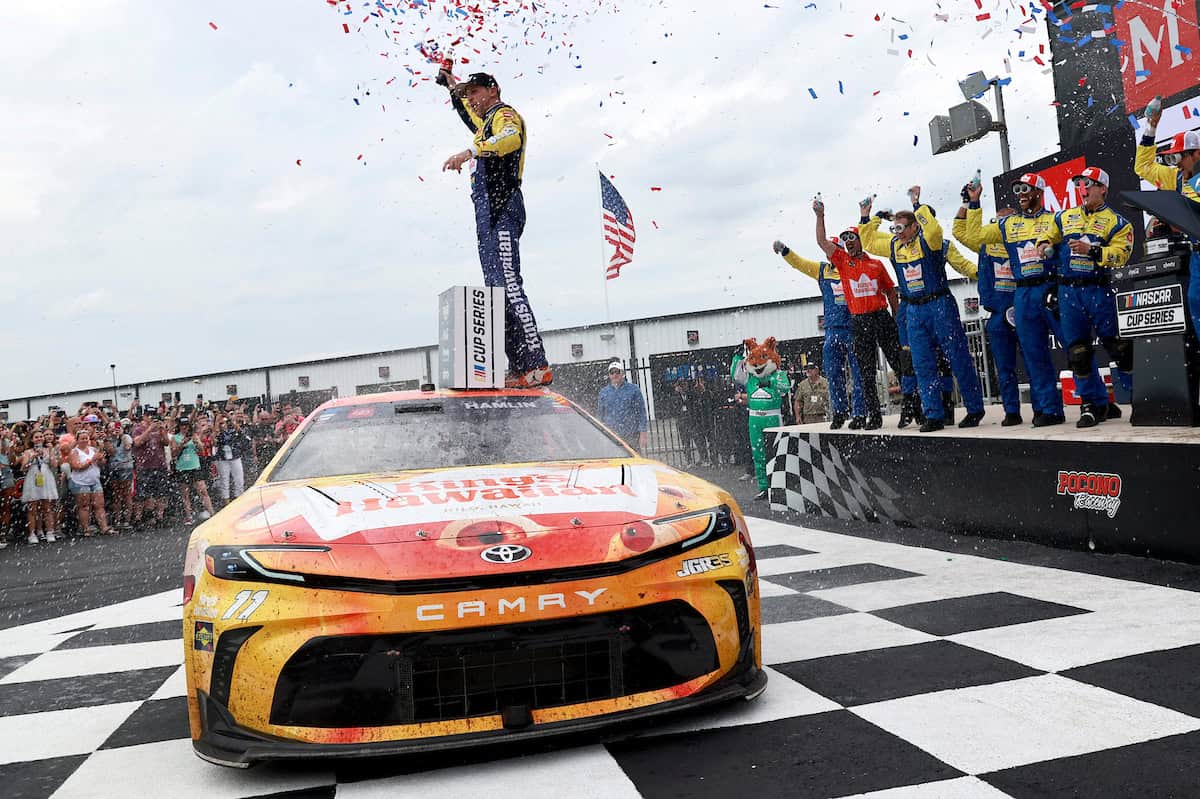
Pocono Raceway can be tricky to broadcast. The NASCAR Cup Series field tends to stretch out. Even though the current track surface was laid down in 2012, the groove doesn’t necessarily widen out that much. Chris Buescher noted after the race that it widened out less on Sunday (June 14) than it did last year.
I know exactly what NASCAR wishes that they could get at Pocono. They aired a small example of it on Monday morning on the NASCAR Channel. It was highlighted coverage of the 1976 Los Angeles Times 500 at the long-gone Ontario Motor Speedway, run on Nov. 21, 1976, but originally aired as part of ABC’s Wide World of Sports on Dec. 18, 1976.
Ontario races for NASCAR were highly competitive slipstream fests that at times could resemble bicycle races with drivers cycling to the front, then dropping back. Interestingly enough, the race NASCAR Channel showed was actually the least competitive NASCAR race at Ontario as David Pearson lapped the field, but the races after 1976 were quite exciting to watch. However, none of the races at Ontario aired on TV flag-to-flag before the track shut down.
On Sunday, you had another race with less passing than last year (according to NASCAR’s Loop Data). At times, there really wasn’t all that much going on. Hard to believe for a race that apparently averaged 20.5 passes per lap under green.
On the guest analyst front, Brad Keselowski pulled double duty on Sunday. He served as the pre-and-post-race analyst and drove in the race. Knowing how his race ended, maybe he would have preferred just doing TV Sunday. Crashing out early and finishing 38th dropped him out of the Chase.
Compared to Martin Truex Jr. last week, Keselowski didn’t really get to ask questions to the drivers much, especially before the race. Of course, that was mainly because he had to get to driver introductions and everything is a long way away at Pocono. That said, his contributions were a lot more helpful to viewers.
Before he left, there was a whole segment about racing injured, which has actually become quite the thing recently in motorsports, not just in NASCAR. Of course, this was based around Christopher Bell’s broken wrist that he suffered in his huge wreck at Michigan International Speedway. Keselowski tried to relate this to his experience racing with a broken foot after a testing crash at now-Michelin Raceway Road Atlanta in 2011 and his recent on-track activity after breaking his leg.
Keselowski has a fair amount of experience on TV from his time as a guest analyst on NASCAR O’Reilly Auto Parts Series races on FOX Sports 1 in recent years. He came prepared and was easily relatable. Admittedly, he lived up to more or less what my expectations. On FS1, Keselowski was one of the better guest analysts on the roster, and we saw more of the same Sunday.
Given the recent form of Denny Hamlin, there was a projection of how Hamlin could run down Tyler Reddick that was shown on NASCAR Live Pre-Race. It indicated that Hamlin could potentially win the regular season championship, but that he wouldn’t overtake Reddick until August. Given Sunday’s performance, it might be sooner than that, but it did account for the fact that Reddick is a better road racer than Hamlin.
That said, the projection was interesting. Usually, something like that is just a straight line based on where you’ve been in the past. Granted, real life can usurp projections at any time.
The race itself was pretty decent coverage-wise, but given the typical type of action we get at Pocono, you’re in a position where it might not be all that exciting to watch. Instead, you end up with a strategy race.
We’ve discussed events like that in the past. It can be interesting to watch. That said, a lot of fans really don’t like that. Those opinions can lead to major rule changes. The stages likely came out of that, as did the caution clock mess in the NASCAR Craftsman Truck Series back in 2016.
When there was racing for position to be had, Prime Video did a pretty good job of bringing that action to viewers. When the strategy took precedence, the broadcasters were very good at covering the various strategies at play.
For example, Bell tried to stretch his fuel from the final caution to the end of the race. This was unlikely at best from the start since it would require him to go 125 miles. Steve Letarte knew what the fuel mileage number that Bell needed to hit was, and they monitored it with the Burn Bar setup. Unfortunately, Bell was not able to hit that number. He pitted late and finished 26th.

There was one random issue that I encountered during the broadcast on Sunday, but it didn’t have to do with the broadcast itself. When I went to rewind to check the command to start engines from the faux Benjamin Franklin, my feed froze up, then threw an error message. I was forced to exit from the race broadcast on the app, then re-enter the broadcast.
In nine Cup races on Prime Video, that’s the first technical issue that I’ve discovered. Not really sure what happened there, to be honest. I hope it doesn’t happen again.
Post-race coverage was quite substantial. Viewers got 13 post-race interviews and plenty of post-race analysis. It says a lot that someone put tape on one of the chairs saying that it was reserved for Hamlin.
Overall, Pocono is not necessarily the most exciting track on the Cup Series calendar. That said, Prime Video did a good job bringing viewers the action on Sunday. The broadcast was strategy-heavy, but given what Pocono races often entail, I’m fine with this. This is the right crew to have for that.
The fact that the start of the race was pushed up by two hours due to impending thunderstorms didn’t really change anything on the broadcast.
That’s all for this week. Next weekend, NASCAR ventures into the complete unknown. A tripleheader weekend at Naval Base Coronado. All we have to go on is random pictures and iRacing right now, but we will have a 3.4-mile course on a mix of streets and concrete apron. There will be elevation changes and a lot of bumps. Should be interesting.
Outside of California, the NTT IndyCar Series will be at Road America, while the ARCA Menards Series will be at Berlin Raceway. TV listings can be found here.
We will have a critique of the Anduril 250 broadcast for next week’s edition of Couch Potato Tuesday here at Frontstretch. In the Frontstretch Newsletter, we’ll take a look at the wreckfest known as the MillerTech Battery 250 presented by KOA.
For Prime Video races, if you want to send feedback, go to the individual race broadcast link and there will be a button at the bottom of the page to provide feedback about the broadcast.
As always, if you choose to contact a network by email, do so in a courteous manner. Network representatives are far more likely to respond to emails that ask questions politely rather than emails full of rants and vitriol.


Phil Allaway has three primary roles at Frontstretch. He's the manager of the Frontstretch email newsletter that publishes Monday-Friday and occasionally on weekends. He keeps TV broadcasters honest with weekly editions of Couch Potato Tuesday and serves as the Frontstretch Sports Car racing editor.
Outside of Frontstretch, Phil is the press officer for Lebanon Valley Speedway in West Lebanon, N.Y. He covers all the action on the high-banked dirt track from regular DIRTcar Modified racing to occasional visits from touring series such as the Super DIRTcar Series.
Thanks as always, Phil.
I realize I’m in the minority here, but I enjoyed this one. For once, the stages didn’t completely throw merit based racing completely out the window, and the race was decided by which cars were fast, and which crew chiefs pulled the correct strings from a strategy perspective. Sadly, this is seldom the case in modern NASCAR racing.
Also agree the booth did a great job. I was wondering how accurate Prime’s fuel burn data was, and the answer turned out to be VERY accurate. Early in the final run, Letarte indicated Bell needed 6.0mpg, and kept noting the data was showing him at 5.9mpg. Sure enough, Bell came up just short. The booth also did a great job of picking up on Reddick’s strategy with new tires, and again was spot on, indicating they felt he would come up just short of catching Hamlin.
Will be sad to see the hand-off after this weekend from Prime to TNT/USA/NBC. That said, this is still preferable to watching Fox mail it in every week.
Yes, agree that Prime is superior to all the other networks, bracing myself for the drop in quality …ugh!!!
Junior has even settled into being a good commentator, not stepping over Adam, whom I really like as play by play. so much better than that doofus Diffey soon to be jammed down our gullets…
lol. We definitely disagree on Diffey, though I do agree he tries far too hard to make every single happening seem more important than it is. There’s a bit of “boy who cried wolf” there, because it means the big happenings are hard to discern from the usual weekly stuff. Still though, Will Buxton (Fox Indy coverage) makes Diffey seem understated by comparison.
I’ve come to respect Alexander more this year. He’s developed a good rapport with McMurray on O’Reilly broadcasts, and has meshed well with Junior and Letarte. I absolutely love Junior as a commentator, despite never having been a fan when he was a driver. Somehow, Junior manages to give the feel of the Southern roots of NASCAR, without dumbing it down or hamming it up. And his genuine passion for the sport always shines through.
Again I totally agree. Sad to see Prime go after this week as their coverage is just superb