
Who… should you be talking about after the checkered flag?
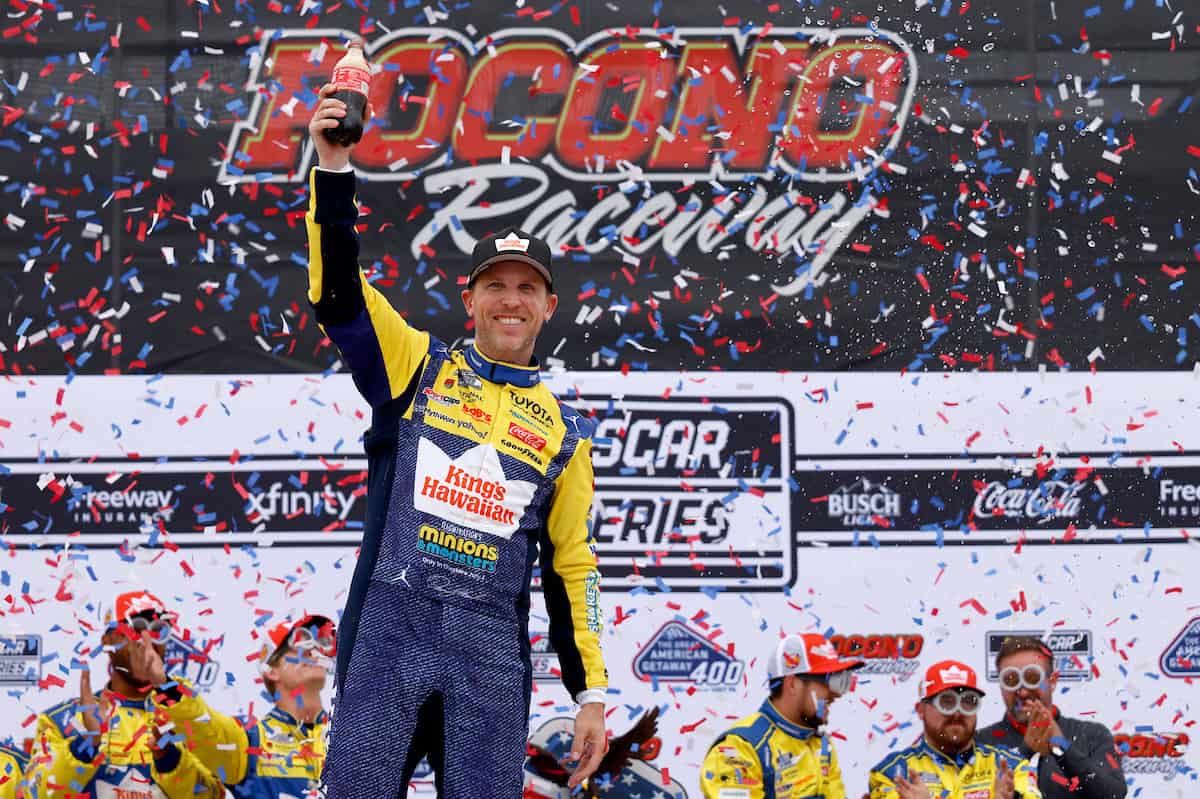
He didn’t dominate, and he was beatable on short runs, but when The Great American Getaway 400 featured a 50-lap run to the finish, it played right into the hands of Denny Hamlin.
Hamlin has been the master at Pocono Raceway, and he started the race from the pole but lost the lead to Kyle Larson on the first lap. Hamlin tracked Larson back down at the end of stage one to win it, but thanks to differing fuel strategies at the stage break, he found himself mired in the pack on the restarts . He finished the second stage in ninth.
Several drivers traded the lead during the final stage, but Hamlin worked his way steadily forward between pit cycles and was in prime position to take advantage of a teammate’s fuel gamble.
Christopher Bell had a huge lead after the final round of pit stops, but his team’s decision to stay on track and try to stretch their fuel tank to the end meant that Bell couldn’t run as hard as he could with a full fuel load. The drivers who did pit had fresher tires, which would prove important. Hamlin had time to run Bell down in the final laps, and adding insult to injury, Bell still ran out of fuel with a few laps left.
As Hamlin surged to the lead, Tyler Reddick (who had pitted after Hamlin and had even fresher tires) closed the gap, passing all but Hamlin despite closing on his car owner in the final laps. Had the race been a few laps longer, Reddick might have caught Hamlin, but time ran out, and Hamlin took the checkers by 1.678 seconds.
Hamlin’s win is his fourth of 2026, third in a row, and the 64th of his Cup Series career. It’s his eighth Pocono victory, the most of any driver.
On the other hand…
With rumors about his future with Hendrick Motorsports swirling, Alex Bowman kicked off the weekend with a solid 12th-place start, third-best in the Hendrick Motorsports camp. By the end of the day, though, Bowman was the last car on the lead lap, finishing 27th while his teammates all posted top-11 runs. That’s 10 positions below his Pocono average and comes at the worst possible time for the 33-year-old.
Bowman’s contract is up after 2026, and while he has eight wins for HMS, he also has struggled with injuries, including a bout with vertigo that kept him for a month earlier this year.
Bowman is a decently consistent driver who can win a few races, but he needs to prove that he can be that driver in 2026 and beyond if he’s going to have a good ride in 2027.
What… is the big question everyone should be asking after the race?
As silly season has gotten underway, Hamlin has hinted that 2027 will likely be his last year as a full-time Cup driver. As he moved into sole possession of ninth on the all-time Cup wins list with 64, how high can Hamlin climb on that list?
The next mark is Dale Earnhardt’s 76 victories. Twelve wins in a year and a half is a tall order … but with four wins so far in the first half of 2026, he’s on pace to at least make a run at it. Should he decide to come back in 2028, it’s definitely on the table.
Beyond that? Hamlin needs 19 wins to match Cale Yarborough and Jimmie Johnson at 83. That would be a tall order in three full seasons. If he does walk away after 2027, that would mean he has 56 races. He’d need a 22% win rate to catch Earnhardt and 34% to catch Yarborough and Johnson. His career winning percentage is 8.7%.
Where… did he come from?
Legacy Motor Club has been making steady gains over the last month or so, but until this week, it’s been largely Erik Jones carrying that torch. This week, while Jones had another strong showing with a sixth-place finish, the spotlight fell on John Hunter Nemechek.
After qualifying eighth, Nemechek led a career-best and race-high 42 laps and backed it all up with a fourth-place finish, also tying his career-best. It’s Nemechek’s third career top five. He also took home a handful of stage points.
While Jones has been at the forefront for LMC over the last few weeks, it will be key to the organization’s overall success that Nemechek also makes gains. Sunday was a solid start for him.
When… are we going to talk about the points?
No positions changed among the top six, and while Reddick saw his lead dwindle to just 19 points, his lead over third place Ryan Blaney actually increased by a few points. Chase Elliott, Ty Gibbs and Larson held steady in fourth through sixth.
There was some shuffling in the back half of the top 10. Chris Buescher and Daniel Suarez each moved up a spot, while Carson Hocevar fell from seventh to ninth with a 20th-place finish. Bell remained in tenth.
With 10 races left in the regular season, the race for the Chase is heating up. Positions 14th through 17th are separated by just 10 markers. Shane van Gisbergen currently holds 14th by just six points over a new Chase contender: Jones. Jones holds 15th on a tiebreaker with Austin Cindric. They only enjoy a 4-point gap to Brad Keselowski, who fell out of the top 16 after his early exit on Sunday.
Van Gisbergen and Keselowski, along with Bubba Wallace and Joey Logano, lost ground due to a stage two crash stage triggered by Austin Hill. Keselowski and Logano took the brunt of the points damage, with Keselowski falling from 15th to 17th and Logano dropping one position to 18th. Logano was just three points below the cut line a week ago but now has 21 points to make up to squeeze in.
Why… should you be paying attention this week?
All three national series head west to San Diego for a brand new street course, this one on Naval Base Coronado. The 3.4-mile, 16-turn layout includes both tight turns and long straightaways. Whether the heavy braking zones will make inviting passing opportunities remains to be seen.
NASCAR offered a driver’s-eye view of the layout via iRacing last week.
The video shows a lap time just north of two minutes for a single-car run. How those lap times will translate into a full field in race trim is unknown, but caution laps are going to be several minutes. Hopefully that will translate into fewer laps needed under caution and more green-flag racing.
The temporary barriers make sightlines challenging for drivers; they’ll be entering some corners virtually blind, making spotter communication critical.
Who to watch? The highly technical layout certainly favors van Gisbergen simply given that it has right and left turns, and given that he has won six of the last eight road course races. Others to watch include Elliott, who is a strong road racer and is having a very stellar season in 2026. Buescher has beaten van Gisbergen straight up at Watkins Glen International, Larson is solid on road courses and has something to prove after a year-long winless streak, and both AJ Allmendinger and Michael McDowell are exceptional road racers.
Bell should also be in the conversation, though how comfortable he’ll be on a tough course with a fractured wrist is the question there. Finally, it’s a good opportunity for rookie Connor Zilisch, an outstanding road racer, to build some confidence in a season that’s been a struggle for the 19-year-old coming off a 10-win NASCAR O’Reilly Auto Parts Series campaign a year ago.
How… did this race stack up?
The closest margin of victory under the green flag at Pocono in the Next Gen era is .682 seconds, not exactly a barnburner of a finish. Sunday’s race fit the trend with a large margin, but also featured the most lead changes (17) of any Next Gen race at Pocono.
Pocono is one of the biggest strategy races of the year — fuel, tires, pit timing, stage timing, you name it, it has the potential to change the game completely. Bell’s team decision to try to stretch fuel to the end ultimately didn’t pay off, but that type of call has been a game changer in the past.
While the race was generally standard Pocono fare with a lot of long green-flag runs and a few crashes, or maybe because it was, it featured some different teams in the mix for top finishes. There are a few drivers, like Jones, who seem to thrive on its unique layout.
Overall, Pocono is about playing — and mastering — the long game. That makes the races interesting to watch due to the varying strategies and racing lines. It doesn’t always make for a close finish, but it also doesn’t make for an exciting day for many fans — but for those who like seeing a full day’s worth of strategy play out, it was worth watching. Reddick’s charge to second in the final laps was more exciting than Hamlin’s coasting to the win.
Thanks to threatening weather, the race was moved to the once-unusual start time of 1 p.m. ET, drawing praise from many fans. Television has been reluctant to move races so far from Sunday prime time, but fans continue to voice a preference for earlier starts. Maybe it’s time to consider it based on weather concerns alone: the skies opened after the race. With later afternoon being when storms often spin up, it just makes sense.


Amy is an 20-year veteran NASCAR writer and a six-time National Motorsports Press Association (NMPA) writing award winner, including first place awards for both columns and race coverage. As well as serving as Photo Editor, Amy writes The Big 6 (Mondays) after every NASCAR Cup Series race. She can also be found working on her bi-weekly columns Holding A Pretty Wheel (Tuesdays) and Only Yesterday (Wednesdays). A New Hampshire native whose heart is in North Carolina, Amy’s work credits have extended everywhere from driver Kenny Wallace’s website to Athlon Sports. She can also be heard weekly as a panelist on the Hard Left Turn podcast that can be found on AccessWDUN.com's Around the Track page.
Congrats to Hamlin. He’s arguably the GOAT at Pocono, having been fast across decades and car platforms. His team played the strategy perfectly, pitting early enough to gain the track position needed, yet just late enough Reddick couldn’t use the tire offset on the last run to track him down.
Though I’ve typically found Pocono boring over the years, a race with long green runs and actual competing strategies was refreshing. Stage racing rarely allows for either of these scenarios. Was also very happy the start time was moved up. Watched more of this one than most Cup races this year.
This week may as well be the SVG Coronado invitational. It’ll likely take luck or a mistake by SVG or his team to allow anyone to take the win away from him.