
Who… should you be talking about after the checkered flag?
After rain delayed the start of the Cracker Barrel 400 (May 31) by over an hour, Denny Hamlin was more than ready to get going. In fact, he might have been a little too ready.
Hamlin started the night on the pole, but immediately lost any advantage when he jumped the start and had to serve a pass-through penalty. He didn’t make a lot of gains in the first stage, but began to pick his way forward, and by the last pit cycle, Hamlin was inside the top 10.
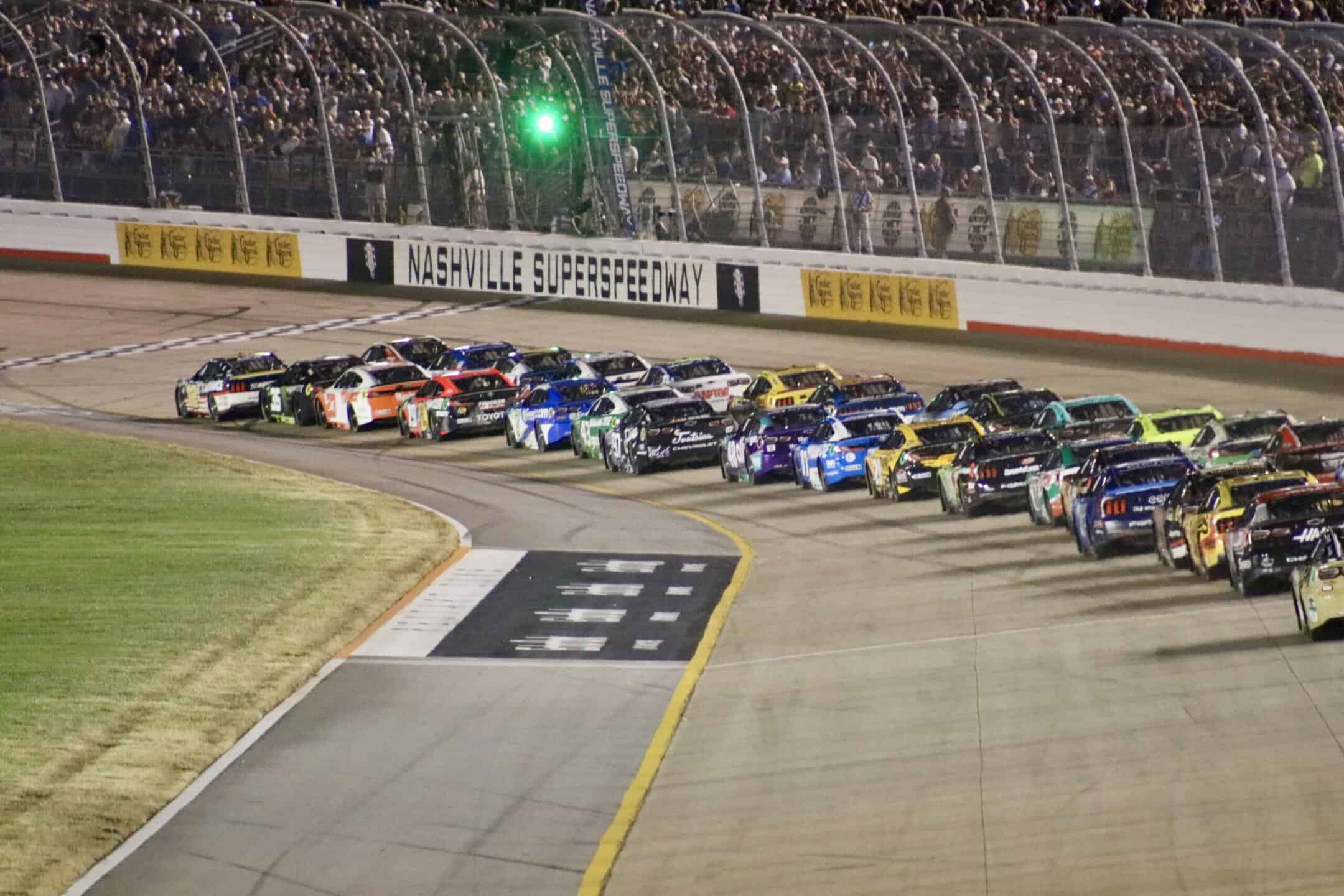
Nashville Superspeedway has produced a lot of cautions for the NASCAR Cup Series, and this week’s edition was no different. Tire management was important, but brake management was the word of the day, with several cars suffering brake rotor failures. The last one came for Chris Buescher with 11 laps to go, and it gave Hamlin the opportunity he needed to make a run at Christopher Bell, who had the best car for much of the night.
On the final restart with just four laps to go, Hamlin jumped to the inside of Bell, who was able to stay with him on the top. Their side-by-side battle allowed teammate Chase Briscoe to catch them, and when he rode his momentum to the top coming to the white flag, it was enough to stall out Bell and allow Hamlin to clear him. Bell mounted a charge in the final turn but couldn’t get back to Hamlin.
Hamlin beat Bell to the line by .115 seconds. Briscoe finished third with Ricky Stenhouse Jr. fourth and Shane van Gisbergen filling out the top five. It’s Hamlin’s second win of the season and the 62nd of his career. He is the sixth driver to win in six Cup Series races at the 1.33-mile concrete Nashville oval.
On the other hand…
The word of the night on Sunday was “brake rotor” as several teams suffered failures. Heat cycles are tough on car components, and drivers use a good amount of brake in the corners while allowing them to cool on the straights, stressing the parts. Connor Zilisch, Ross Chastain and Buescher were among those whose nights ended early following brake failures.
Perhaps the most painful failure happened to AJ Allmendinger, who was in the midst of his best race of the season. Allmendinger won the first stage and led three times for seven laps. He was battling for a top 10 finish on the day, but the day only lasted 172 laps before the right front rotor on his No. 16 failed, causing Allmendinger to slam the wall in turn 1. He was okay, but finished 35th after a promising start.
What… is the big question everyone should be asking after the race?
Thanks to the rain delay, fans got an extended pre-race show on Amazon Prime. One segment featured the 19-year-old rookie Zilisch and brought to the forefront the young driver’s struggles early in his first Cup season.
One of the reasons bandied about was simply that a driver can’t carry the Next Gen race car beyond its capabilities — something a top driver could do in the previous Cup cars and can still do in the NASCAR Craftsman Truck and NASCAR O’Reilly Series. That ability has long been what separates the best drivers from the rest of the field. In the Cup Series, it’s now as much about what happens long before the cars are even unloaded at the track.
The question that needs to be asked in NASCAR’s R&D center is how can NASCAR create a car more like the O’Reilly Series car that a driver can carry? What can be done so that a driver can finish better than his car was capable of on sheer determination and talent?
If the Cup Series is meant to showcase the best drivers in stock car racing, then it should be about the driving. In addition, it’s not a great look when the lower series consistently put on a better show than the Cup Series does. That’s not the drivers’ fault — the Cup drivers could probably put on a barn-burner in NOAPS cars.
Where… did he come from?
Sure, the late caution hurt his finish, but Zane Smith and the No. 38 team ran a smart strategy, both by stretching their fuel with the hope of a long green-flag run to the finish and then by pitting for tires when it didn’t. Had the race stayed under green, Smith would probably have had a top 10 finish, and by putting fresh right-side tires on and restarting ninth with four laps to go, Smith still got that result, finishing ninth. In three Nashville starts, Smith has a runner-up finish, two top 10s and has not finished lower than 13th. Whatever it is about Nashville that suits Smith, he’s made it his best track.
It’s also Smith’s second top 10 in a row.
Also putting up a great showing for the third week in a row was Shane van Gisbergen. He’s followed up his Watkins Glen win with an 11th-place finish in the Coca-Cola 600 and a hard-charging fifth-place run in Nashville.
A year ago, van Gisbergen made the playoffs because he had five road-course wins even though he was outside the top 20 in regular-season points. This year, he’s making a strong Chase bid without a guaranteed spot.
Finally, Stenhouse flew under the radar all night, but he made pitting for tires on the final caution work better than anyone else. At the checkered flag, Stenhouse had his best non-superspeedway finish of 2026. It’s his second top five and third top 10 of the year.
When… are we going to talk about the points?
Hamlin has chipped away at Tyler Reddick’s lead lately, and it’s under 100 points for the first time in several weeks. Reddick still leads Hamlin by 97 markers after Hamlin’s win because Reddick finished a solid sixth despite a hard crash after the checkered flag (he’s okay). Reddick has not finished outside the top 15 in 2026, making catching him before the Chase reset in September a tall order.
Ryan Blaney hung on to third, while Chase Elliott moved around Ty Gibbs for fourth with his seventh-place effort. Gibbs fell one spot to fifth.
Kyle Larson remained in sixth, Bell moved up a spot to take over seventh from Buescher, and Buescher held down eighth over Carson Hocevar and Daniel Suarez, who remained in ninth and tenth this week.
At the Chase cutoff, Austin Cindric took over sixteenth from Ryan Preece. Preece fell to 17th, two points behind Cindric and seven ahead of Joey Logano in 18th.
Why… should you be paying attention this week?
The Cup Series rolls north to the 2-mile Michigan International Speedway to kick off June. Hamlin is the defending race winner at MIS and with three wins, ties Larson and Logano for the most among active drivers.
Gibbs has an outstanding 6.8 average finish in four starts. Among drivers with at least 10 MIS starts, Elliott’s 10.8 average tops the field.
A couple more drivers to keep an eye on thanks to their solid averages include Michigan natives Brad Keselowski (12.0 average, 16 top 10s in 28 starts at his home track) and Erik Jones (14.9 average, sixth among active drivers with 10 or more starts).
How… did this race stack up?
As far as Cup races go, it was … an okay race with a great finish. It had the great finish because of a well-timed caution, not because of great racing. Had Chris Buescher not suffered a brake rotor failure (one of several on the night), Bell would have likely cruised to the win, possibly having to race Briscoe for it. The caution brought out a fantastic finish, but it wasn’t indicative of how the race really looked.
Overall, it was maybe worth staying up until after midnight on a work night but fans shouldn’t have to hope for a late caution to have a memorable race. Sure, fans love a night race (for no good reason as the racing is generally better on a hot, slick track), but Saturday night would have been a better call. The Coca-Cola 600 and Southern 500 work because there’s a holiday the next day, but random Sunday night races are useless.
But the real test these days is how the Cup races stack up not against each other, but rather against the Truck and O’Reilly Series. And that’s where it falls short. The NOAPS race featured a fantastic battle for the win between Justin Allgaier and Brent Crews, with Allgaier running down Crews to take the guitar home. The NOAPS cars are simply the better race car, and many of the drivers still race like they have something to prove.
Bottom line: If you want a great show, tune in on Saturday.
That said, Amazon Prime is again setting a high bar for its race coverage. Between camera angles that show more than a couple of cars, insightful commentary that’s not over the top, and an in-depth postr-ace show instead of rushing off the air, the coverage is easily the best you’ll see all year. Time it right, and the free trial Amazon offers will cover the entire slate of races for fans who don’t already have the service.


Amy is an 20-year veteran NASCAR writer and a six-time National Motorsports Press Association (NMPA) writing award winner, including first place awards for both columns and race coverage. As well as serving as Photo Editor, Amy writes The Big 6 (Mondays) after every NASCAR Cup Series race. She can also be found working on her bi-weekly columns Holding A Pretty Wheel (Tuesdays) and Only Yesterday (Wednesdays). A New Hampshire native whose heart is in North Carolina, Amy’s work credits have extended everywhere from driver Kenny Wallace’s website to Athlon Sports. She can also be heard weekly as a panelist on the Hard Left Turn podcast that can be found on AccessWDUN.com's Around the Track page.
Where are all the comments? Guess they are all still sleeping since they had to stay up until after midnight on a Sunday night to watch a Cup race. Is it really that hot at that track that all 3 races have to be run at night?
FOX had the IndyCar RACE on the main network at 12:30. NA$CAR rates FS1 and most times doesn’t deserve that. How about if the networks switch the NA$CAR events on Saturday and Sunday?