

What happened to result in Brad Keselowski leaving RFK Racing?
The question on everybody’s mind right now in the NASCAR landscape is what exactly went down between Brad Keselowski and his old team, RFK Racing, that led to such a dramatic fallout between the two parties.
According to reporting by The Athletic’s Jordan Bianchi, it wasn’t disagreements within the Roush family that drove the final nail in the coffin, but rather disagreements between Keselowski and Fenway Sports Group over the team’s future direction. As a result, Keselowski will likely be bought out of his ownership stake in the team.

Now that fans know the end result, radio chatter and offhand comments from the last few weeks are starting to make more sense. However, nobody has been able to put the whole picture together yet of exactly why Keselowski has decided that now is the right time to step away. That said, only a few possibilities stand out.
The clear-cut rumor that immediately began swirling was that Keselowski was headed for one of the new Dodge NASCAR Cup Series rides at Kaulig Racing, especially after reports earlier in the year that the manufacturer was trying to have cars ready for the 2027 season. However, that reality seems further away now than before, and most don’t expect Dodge to rejoin until 2028 given the information available now.
So if a Dodge ride isn’t in the picture for at least another full season, that leaves the second possibility: a very real, very intense falling out with his fellow owners over the direction the team needed to take in 2027. There were clearly still issues to work out regarding the team’s third charter. Perhaps Fenway made it clear that RFK actually wouldn’t run a third car as an open entry if a charter didn’t make itself available. Could Keselowski be falling on the sword so that his two RFK teammates, Ryan Preece and Chris Buescher, both can race chartered entries in 2027, as Keselowski knows he has a Dodge seat if he wants it in 2028?
I don’t know the answer, and I don’t see fans getting much clarity on what exactly went down until Keselowski is firmly in a seat for next year, whether that’s in the NASCAR O’Reilly Auto Parts or NASCAR Craftsman Truck series.
Can Erik Jones be a top-10 driver at Legacy?
This week, Erik Jones and Legacy Motor Club agreed to a contract extension, keeping the Michigan native with the team for the foreseeable future. The contract’s exact length was, as usual, not specified. However, we do know that it’s at least a multiyear deal.
Jones is an interesting case study because he’s proven himself a victory-caliber driver even in equipment that has at times lagged behind the field. He’s also a garage favorite and by far the most experienced driver in Legacy’s stable for 2027, as he’ll make his 209th start behind the wheel of the No. 43 this weekend at Las Vegas Motor Speedway.
But does that mean he can bring Legacy a top-10 points finish before this contract is up? I actually believe so, as long as Toyota follows its current trend of dominant speed. Of course, other manufacturers will catch up, but remember, Legacy recently switched to Toyota, and with another manufacturer entering the picture soon, you could argue Legacy should be a higher priority than it is now within the Toyota group.
Jones very obviously has the talent, and always has. He’s just been hampered at times by below-average equipment. Realistically, I could see Jones competing for a much higher Chase standing as soon as next year, especially with leadership like Jimmie Johnson in his corner at Legacy.
Will an even shorter spoiler work for Talladega?
Remember when NASCAR announced it planned to cut the spoiler height at Daytona International Speedway to just 4 inches? Sure, it cut the horsepower, too, but the move made the runs a bit easier at Daytona, according to the drivers. Now, NASCAR wants to cut even more spoiler off for Talladega Superspeedway, which is about 8 ft. wider than its Floridian counterpart.
So will it work?
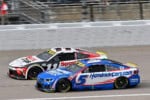
I think so. This time, no more horsepower is being removed from the car. It will use the same engine package that teams ran at Daytona, and the stage lengths will revert to the 98-45-45 structure fans saw at the spring Talladega race. 3.5 inches is quite literally half of the original spoiler height, and at Talladega, should make things much more interesting when it comes to maneuvering through the pack.
Additionally, with the stage manipulation meant to disincentivize fuel saving, it should make for a solid attempt at getting the superspeedway racing right with this car, if such a thing can be accomplished. But that’s the hinge point, isn’t it?
Because realistically, if this doesn’t work, does NASCAR even have a leg to stand on anymore with this car and superspeedway races? If this flops, where does the governing body go from here?
I have an idea. Run the 3.5-inch spoilers, but with the original 500-plus-horsepower package. It’s just a thought.
What does JGR shuttering its ARCA operation say about the series?
Joe Gibbs Racing revealed this week that after the ARCA Menards Series West race concludes at Phoenix Raceway this month, the company plans to end its ARCA Menards Series program to reallocate resources to its O’Reilly efforts.
It was a somber announcement, to say the least, but it’s also, unfortunately, indicative of where NASCAR’s lower developmental series is headed.
Elsewhere in racing, purses are actually growing, and grassroots motorsports hopped on the digital trend as early as they could. Numerous platforms now provide grassroots racing media content to fans, including FloRacing, DirtVision and many others. Meanwhile, ARCA purses have stagnated by comparison, and many grassroots drivers who once chose to spend their money on ARCA racing are now opting for touring oval series or karting.
The CARS Tour, High Limit, USAC, World of Outlaws and others are gaining popularity year in and year out, while ARCA is still trying to make national touring work at such a large scale that, at this point, it is simply not worth the squeeze for most of its teams. Cleetus McFarland can make an ARCA race profitable, but unless he runs a full season, the eyeballs aren’t there during the broadcast windows, and if the eyeballs aren’t there, the sponsors rarely will be, either.
Some course correction is most definitely needed. Otherwise, series like the CARS Tour and the 5 million dirt racing series that travel across the country will be the only real developmental pathway for drivers looking to climb the ranks.


Tanner Marlar is a staff writer for Sports Illustrated’s OnSI Network, a contributor for multiple automotive news outlets, an award-winning sports columnist and talk show host, and a PhD. student at a premier college of media and mass communication. Tanner began working with Frontstretch in 2022, covering the O'Reilly Auto Parts Series.
A name and email address are required to post a comment. The email address is not publicly visible or shared. Please keep in mind that comments are moderated according to our comment policy.
Comments are listed in order from oldest to newest. Leave a comment