
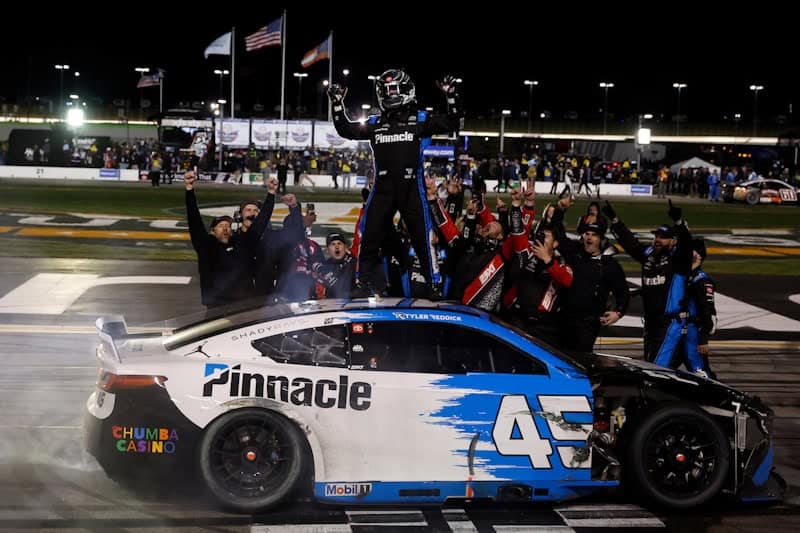
It is a great time to be Tyler Reddick.
Not only did the driver of the No. 45 23XI Racing Toyota etch his name on the Harley J. Earl Trophy as a Daytona 500 champion, but he also followed it up with another checkered flag at EchoPark Speedway on Sunday, Feb. 22.
With the win, Reddick joined an exclusive club in NASCAR Cup Series history, becoming just the sixth driver to win the two races of the season.
Are Reddick’s two checkered flags a harbinger to a successful season? To give us an idea of the answer, let’s take a look at the previous five drivers to go 2-for-2 in victory lane visits to start the season and see how they fared that year.

Matt Kenseth (2009)
In the midst of the Roush Racing era of his career, Matt Kenseth was in the right place at the right time to claim a rain-shortened Daytona 500 in 2009. The Cambridge, Wis., native backed that up with another victory at Auto Club Speedway the next week. It was a burst of back-to-back victories for one of the more quietly consistent drivers in NASCAR history.
So, how did Kenseth do in the Chase that year? Well, here’s the thing: he missed it entirely.

Those two wins proved to be the only ones for Kenseth in a 2009 season that came unraveled, starting with a dead-last 43rd-place showing in the third race at Las Vegas Motor Speedway when the engine blew up on his No. 17 Ford just six laps into the race.
That DNF began a run of finishes outside the top 10 in seven out of the next eight races for Kenseth after his two checkered flags. He mustered only seven top fives on the year, three of which came during the Chase after he was already eliminated from championship contention, settling for 14th in the final points standings.
Jeff Gordon (1997)
Right smack dab in the middle of his Rainbow Warrior prime, Jeff Gordon picked up the first of his three career Daytona 500 wins as well as a victory at Rockingham Speedway the next week to begin the 1997 season.
Unlike Kenseth in 2009, Gordon was far from done visiting victory lane after the first two races.

Gordon and the No. 24 Hendrick Motorsports team collected 10 checkered flags in 1997, the second of three consecutive seasons with double-digit wins. Gordon showed consistency alongside his winning speed with an average finish of 9.6, just enough to fend off Dale Jarrett by 14 points for the 1997 Cup Series championship.
David Pearson (1976)
For our next member of the two wins to start the season club, we’re going back in time to an era when the Daytona 500 was not the opening race.
David Pearson dominated the road course at Riverside International Raceway, leading 124 of 191 laps and crossing the finish line a comfortable 35.9 seconds ahead of the runner-up to win the first race of 1976. Nearly a month later, in one of the most dramatic finishes in the history of the Great American Race, Pearson limped his car across the finish line after a last-lap crash with Richard Petty to win the Daytona 500.
When all was said and done in 1976, Pearson wound up ninth in the final points standings, but there is a caveat to that.

As you can see, Pearson only ran 22 of the 30 races that season; in fact, he never drove in every single race of a season in his career but still won three Cup Series titles despite that fact.
In every other regard, the Silver Fox had a thoroughly impressive 1976, scoring 10 wins like Gordon in 1997 but in 10 fewer races, a win percentage of 45.4%. He also had an average finish nearly three positions better than Gordon’s.
Bob Welborn (1959)
Our final two entries on this list bring us back to the 1950s. Bob Welborn kicked off the 1959 season with a convincing win at Champion Speedway in Fayetteville, N.C., leading 117 of 150 laps. Then, before the inaugural Daytona 500, Welborn won a 40-lap qualifying race that counted for the championship standings. The Daytona 500 itself did not go well for Welborn, who settled for 41st after blowing his engine at lap 75.

Welborn only picked up one more win at Asheville-Weaverville Speedway for three victories on the season and a 17th-place points finish. However, like Pearson after him, Welborn would forgo running the full season. His 15 DNFs are far more than any other season we’ve looked at so far, which can be attributed to an era when mechanical failures were more common.
Marvin Panch (1957)
Finally, we look at Marvin Panch, who won at Willow Springs Raceway in California and the old half-mile Concord Speedway in North Carolina to sweep the first two events of the 1957 season.

Panch carried the momentum from those two wins all the way through 1957, collecting four additional checkered flags and an average finish of 8.5. However, he settled for runner-up in the championship to Buck Baker.
Side-by-Side Comparison
Here is another look at the season statistics of the five drivers prior to Reddick, who opened the season with two wins, along with a few additional numbers.
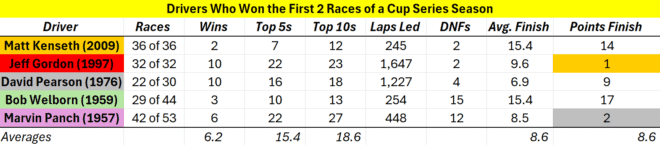
As a disclaimer, this is not a perfect comparison for a couple of reasons. One, the five seasons listed above span different eras of the sport. Secondly, Reddick’s two wins have come on drafting tracks, where luck can be more of a factor than on other track types.
Now, if we are to take these numbers as evidence, they tell us a couple more things.
First, the ceiling for Reddick’s season could be really high, as shown by Gordon’s 1997 championship. On the other hand, the floor could turn out to be lower than anticipated like Kenseth’s 2009 season.
Also, based on the averages in the last row, Reddick could possibly expect somewhere in the neighborhood of six wins and a top-10 points finish.
Where will Reddick wind up on this spectrum of performance? The answer will unfold in the coming months, but even if he doesn’t win another race in 2026, he will always be a member of this exclusive club in NASCAR history.


Andrew Stoddard joined Frontstretch in May of 2022 and is currently an editor and a weekly writer of Stat Sheet. He is a graduate of Hampden-Sydney College, the University of Richmond, and VCU. He works as an athletic communications specialist at Eastern Mennonite University in Harrisonburg, Va.