
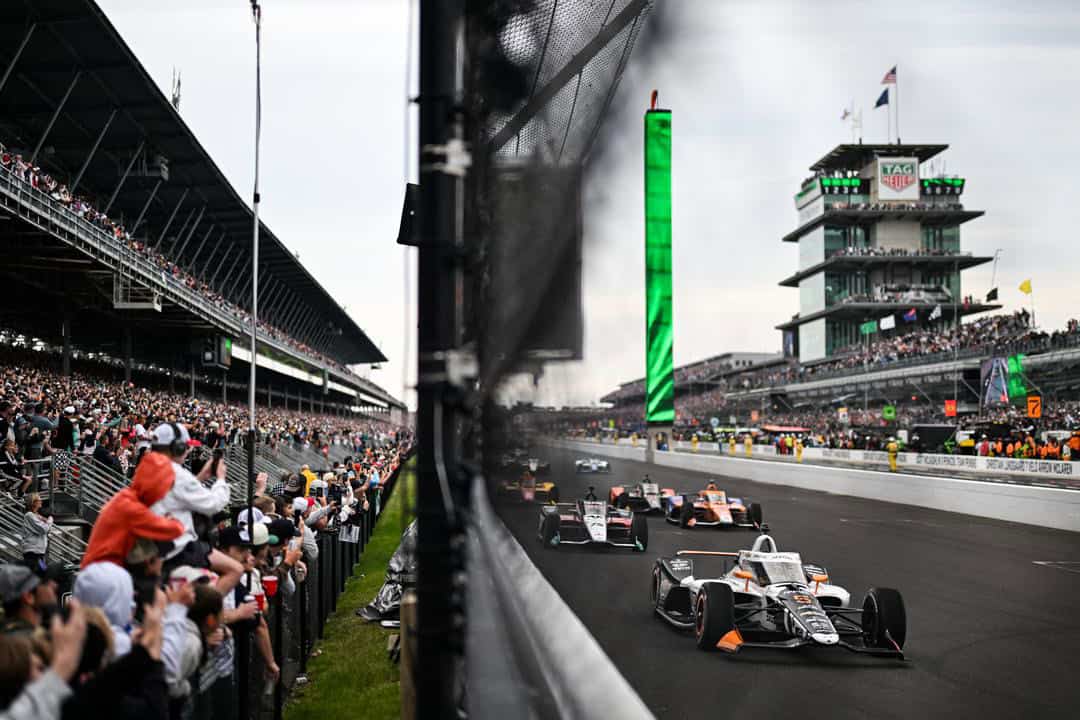
During the opening salvoes in 23XI Racing and Front Row Motorsports litigation against NASCAR on Dec. 2, 23XI/FRM attorney Jeffrey Kessler brought up a prior motorsports event that is shadowing the case.
He referenced the 1996 CART/IRL split that saw the dominant and stable American open-wheel racing diverge into two competing factions.
Many IndyCar fans know that history, but it seemed Kessler relied on the jury not knowing the full details on the topic.
Read all of Frontstretch‘s content covering the NASCAR vs. 23XI/FRM antitrust lawsuit here
According to Sports Business Journal, Kessler said that as a result of the split, IndyCar “teams got a better deal” in the end, adding that was what “NASCAR was trying to block.”
Cue that Jonah Hill GIF of him making the cut gesture at an awards show. Because frankly, if that is the context that Kessler wants to use, he’s not wholly accurate.
The infamous open-wheel split that tore up IndyCar racing from 1996 to 2008 didn’t exactly create a prosperous environment for the teams. Down in methanol flameless smoke and ash went CART, the previous sanctioning body, and stumbling out of a late-night bar fight was the IRL, which morphed into the NTT IndyCar Series.

While Kessler might leverage that line to convince a Charlotte, N.C.-area jury who is less attuned to 16th and Georgetown history, the truth is that the owners didn’t get a better deal.
In fact, no one really did.
What transpired was IndyCar teams surviving two decades in a sport that was propped up by one event: the Indianapolis 500. Sponsorships and viewing audience numbers tumbled together to minuscule levels. Money dried up and only those with a passion and commitment to American open-wheel racing kept their heads in the game.
While open-wheel racing plummeted, NASCAR swooped in and soared. The France family bought up more racetracks, including a strategic master stroke when it purchased Roger Penske’s allotment of tracks, including Auto Club Speedway and Michigan International Speedway. More American open-wheel drivers went south, chasing the dollars spewing out of the exhaust pipes of 43-car fields and following on the heels of Jeff Gordon. Ford, Chevy and even Toyota, all bailed on their rear engine designs and threw their massive budgets into the front-engine, horsepower beasts.
The irony in all that is what prompted the civil war was INDYCAR trying to become like NASCAR. While the stock-car series is a centralized sanctioned sport, IndyCar was not that way before the split. CART was a unified board made up of every team owner on the grid. Each was involved in the decision making and together appointed a chief executive to run the day-to-day operations. It was basically the Race Team Alliance if it ran NASCAR.
From 1979 to the early 1990s, the deal as Kessler put it seemed to work well for the owners in IndyCar as they hit a peak. In 1993, reigning Formula 1 champion Nigel Mansell joined CART and won the title.
But there were cracks.
Imagine a sport where the competitors were also the rule makers, cost controllers and schedule deciders. Some owners had more money than others, so new engine manufacturers and chassis were designed in house or the rich were first in line to receive them. The Rick Ware Racing and Kaulig Racing teams of IndyCar had to wait their turn or wait a year until availability. There were haves and have-nots.
Worse, there were a lot of voices and opinions.
There were so many voices that one of them, Tony George, who owned Indianapolis Motor Speedway, didn’t feel he was heard. That started the journey toward creating a centrally controlled American open-wheel racing series, based on what the France family had with NASCAR.
The model seemed to be a good one. George wanted to control costs, have a major say in what venues to go to and provide more homegrown talent from American weekly series, like dirt racing and karting, access to the Indy 500. A return to production-based engines, no foreign races and an all-oval series was prioritized.
What’s that quote, all roads to that certain place are paved with good intentions? In this case, that road was a pothole-strewn I-465 en route to IMS.
As mentioned previously, George flopped in standing a series up on his own. The first year there were few races. Events were spread too far out on the calendar, clearly a legacy issue with IndyCar. Promotion was poor.
Eventually George won the split, but only because one race pulled everything together: the Indy 500. Today, the series looks like a 1995 CART schedule minus the famed Michigan 500, the field is full of karters and formula open-wheel series drivers, and leased engines.
But did the owners get a better deal as Kessler implied? No, not at all. What they got was almost the exact same thing they had in 1995 with less notoriety, awareness in the public conscious and dollars. The series is competitive, yes, but there isn’t enough money to take on risk. There are two engine manufacturers but little development. Same goes for the chassis. A recent hybrid unit took years to develop because of budget concerns.
INDYCAR has recovered from the split if one were to look at stability and on-track competition, and the Indy 500 has regained its massive attendance figures. But the team owners live on razor-thin wires, something they have in common with NASCAR in the present day. While open-wheel racing was waging civil war, eyes turned to NASCAR with envy as it swallowed up sponsorship, manufacturers and viewers. But now that dynamic has changed, with costs soaring, dollars from companies slowing down and folks changing channels.

As more evidence comes out, it’s clear that NASCAR’s executives are terrified of a stock car split environment. The key to the litigators is that NASCAR went out of its way to prevent a competitive series from forming, one in which 23XI and FRM in theory could take their teams to race. In its effort to prevent a split, NASCAR might have created the anti-competitive, antitrust situation that a jury finds illegal and cost dearly in damages.
Which is something to consider with this lawsuit. Will NASCAR as a whole be in a better spot post-jury decision? While no lawsuit created the split — there were a couple of them still, just ask Paul Tracy about that — it was still over power and control. That’s exactly what is at stake in Charlotte.
While the open-wheel split did not work out for IndyCar owners like Kessler said, in an attempt to prevent one itself, NASCAR may have take itself down a road that doesn’t work out for it.
Now that I think about it, the split did create a good deal for one owner: Penske. With all the money invested in propping up the IRL and IndyCar, the Hulman-George family eventually sold IMS and IndyCar to the longtime owner, who at one time was on the board at CART.
So Kessler was partly right, then. One owner got a better deal.


Tom is an IndyCar writer at Frontstretch, joining in March 2023. Besides writing the IndyCar Previews and frequent editions of Inside IndyCar, he will hop on as a fill-in guest on the Open Wheel podcast The Pit Straight. A native Hoosier, he calls Fort Wayne home. Follow Tom on Twitter @TomBlackburn42.
Yes, the Indy 500 has regained its massive attendance figures. However, the Indy car series has never gained back its popularity since the split. Most the fan base left, and the series has never recovered. Look in the stands. Most tracks are at 50% capacity at best. If it wasn’t for the Indianapolis 500, the series would fold.
the 500 kept it alive for sure. indycar has a pretty solid base now. the lights/nxt fields even have cars there was a time not to long ago. 17 cars on the grid and 8 light cars.
Champion Auto Racing Teams team owners and officials, tried to get sponsors to back them, and it backfired and bankrupted CART. They used B-to-B(Business-to-Business) to attempt it.
And then many of the owners of those teams left Indycars, and never helped fix what they tried to ruin, after professing to Love Indy Car Racing.
Many still believe what they said, and the damage still hasn’t been repaired, as it was all about the money and profits, for them, instead.
No one wants to talk about this.
“Will NASCAR as a whole be in a better spot post-jury decision?”
No matter the decision, it seems the answer to this question is almost certainly “no”.
As the ratings the second half of this season show, NASCAR was already in trouble due to turning their sport into the WWE of auto racing, chasing “entertainment”. Now adding to this, this lawsuit has made public just how arrogant NASCAR and some of their owners are. They call each other “redneck”, “dinosaur”, “clown”, and state some should be “flogged”. They question the literacy of the fans.
I don’t know how closely people are following all this, but I was already leaning against watching much this year, as I’m over the silly rules package. The details from this case only make it less likely I’ll tune in for 2026, and I can’t imagine I’m the only one thinking this way.
It seems they have all forgotten…they need the fans to make their yacht payments. The fans do not need them at all. After all, it’s just “entertainment”.