
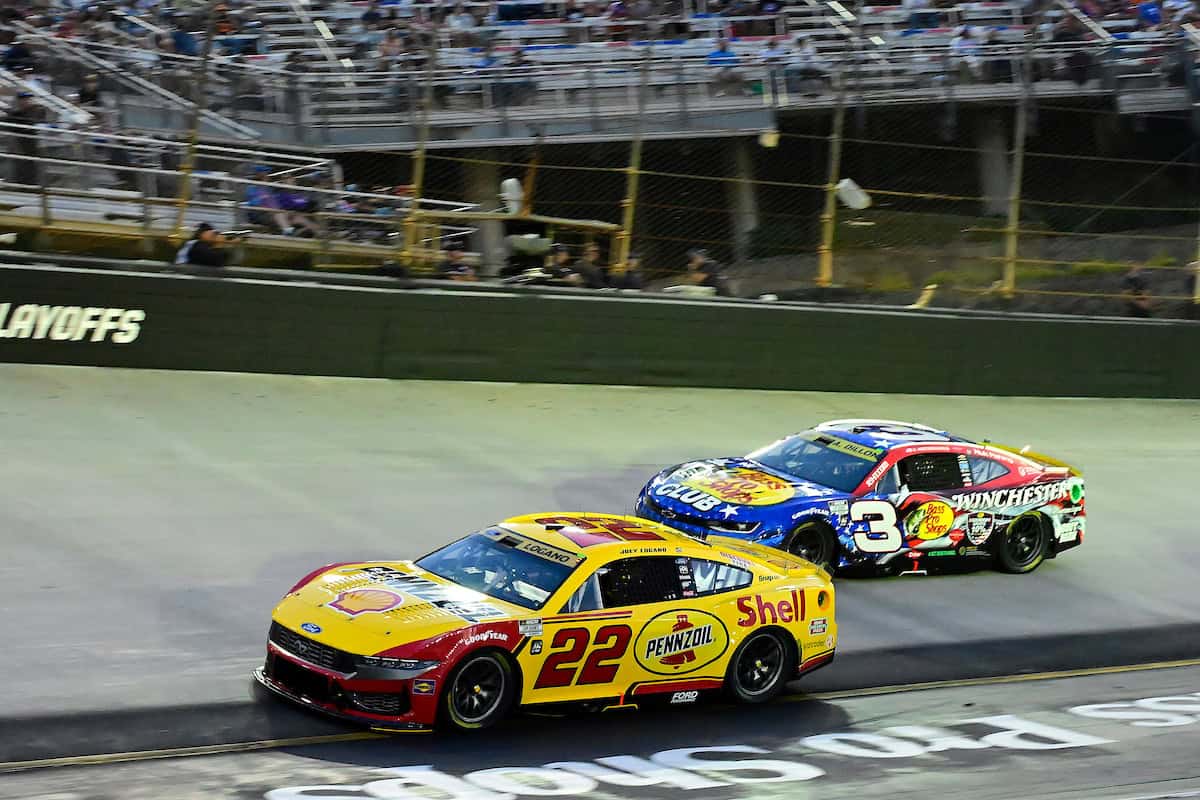
Goodyear promised that it would bring tire wear to Saturday’s (Sept. 13) Bristol Night Race, and it more than delivered on that promise.
The extreme tire wear led to a compelling race — far more so than this year’s spring race and last year’s Night Race — but the wear was so severe that drivers weren’t able to push their cars. Plus, a record 137 laps under yellow led to the slowest Bristol Motor Speedway race in the NASCAR Cup Series since 1974.
The race also muddied the water in figuring out what style of racing and what desired product the fanbase collectively wants to see at Bristol. This was something that Rudy Fugle, William Byron’s crew chief, addressed in his Monday (Sept. 15) appearance on SiriusXM NASCAR Radio.
“If we don’t know what the goal is, we don’t know what we’re trying to achieve,” Fugle said. “I don’t even know what the goal is. Are the fans wanting one of those two (tire wear) races, or are they wanting 1995?
“… If you want 1995, it’s not going to come with a Goodyear tire. It’s going to come from cutting up the racetrack and redoing the concrete back to 1995. I don’t even know if the [Next Gen] car can even produce that kind of racing, but that’s the first step.”
Indeed, it’s as if NASCAR and Speedway Motorsports have been trying for years — via PJ1, resin, tire wear and other initiatives — to recapture the aura that Bristol’s pre-2007 configuration once had.
Is excessive tire wear the desired result, or is the desired result a different Bristol? After all, nearly two decades have passed since Bristol’s most recent facelift. Is it time for a new Bristol configuration, or would such a move only create more questions than answers?
Bristol Is in Need of a Reset
Tire wear has certainly produced a pair of entertaining races in the past two years, and it is a factor that should continue to be stressed for years to come at Bristol.
However, Fugle was right that it feels like Speedway Motorsports and Goodyear are on this treasure hunt to re-capture something even more lucrative — something that goes beyond just tire fall-off.
There’s no question that Bristol still contains an atmosphere unlike any other venue, and the track itself is a must-see. But the struggles of the short track car with the Next Gen car combined with the 2007 Bristol reconfiguration that saw variable banking installed has caused the track to lose some of its luster.
The gem that Bristol embodied in the ’90s and early 2000s featured a one-groove racetrack, one that forced drivers to either find strong corner exit speed or use the bumper.
Now, that being said, there is the glaring issue that the bump-and-run isn’t as effective because of the Next Gen car, exemplified this past week when an absolute fastball thrown by Brad Keselowski to the bumper of Christopher Bell‘s car did little to upset the No. 20. To summarize, changes need to be made to the car.
But even with the car, the Bristol of old has joined a long list of NASCAR spectacles that have suffered because of changing norms in sports viewership, questionable decisions made by sanctioning the body and NASCAR’s popularity dipping in the late 2000s.
The attendance at Bristol has evidenced some of the concern. In the ’90s and 2000s, you’d be hard-pressed to find a patch of empty seats. Now, between both the spring race and night race in the fall (though that is more attended), it’s becoming more and more prevalent to see empty sections in the 146,000-seated facility.
Just look at the passing views of the stands in the 2002 Bristol Night Race, even with over 20,000 more seats than today, then think about what we have seen in recent years.
The other slight concern is Bristol has become a melting pot for other sports, such as the ‘Battle at Bristol’ college football game between Virginia Tech and Tennessee as well as MLB’s Speedway Classic between the Cincinnati Reds and Atlanta Braves this year. Both of which broke attendance records for their respective sports. NHL executives were at the Speedway Classic to explore the possibility of hosting the league’s Winter Classic there, and WWE has been mentioned as a possibility too.
Those are prime opportunities for Bristol, and the potential is there to expose new eyes to what NASCAR offers, but there’s also the risk that Bristol doesn’t hold the same distinction for its racing product.
If the sport continued to race at Bristol with an aggressive tire compound that wears easily, then many wouldn’t have a problem with it. However, there still seems to be a question mark of what glory the track is trying to capture, and if it’s to bring back the same product of the ’90s, the car and configuration have to change. – Luken Glover
Nothing Will Truly Change Until the Car Is Fixed
There was nothing wrong with Bristol until the Next Gen car was introduced in 2022.
Sure, the current Bristol configuration may not live up to its glory days in the 1990s and 2000s, but the Last Great Colosseum was putting on a show in the late 2010s and early 2020s with the Gen 6 car.
All of that came to a screeching halt once the Cup Series implemented a car that had and continues to have a fundamental problem with short track racing in year four.
Major overhauls to the car appear to be off the table for whatever reason, so the attention has turned to the tires, the tracks and any other variables that could play some semblance of a role in the racing product. But all the changes in the world won’t be able to take the elephant out of the room.
A reconfiguration of Bristol — especially a return to its 1992-2007 configuration — would be even more problematic with the Next Gen car. The “old” Bristol was a one-groove conveyor belt that thrived on contact, bump-and-runs and heated drivers to hype up the show.
With the Next Gen car, the bump-and-run is becoming a lost art. As Luken mentioned, look no further than the final lap of Saturday night when Keselowski blasted the back of Bell’s car to the Moon, only for the contact to propel the No. 20 car to the checkered flag instead of up and out of the groove. It’s already hard enough to make contact with another Next Gen car on a short track, and it’s nearly impossible to make hard enough contact to pull off a bump-and-run. Returning to Bristol’s old layout with the current car would only create problems instead of fixing them.
Unfortunately, Bristol is stuck in this limbo as long as the Next Gen car remains the way it currently is. Any reconfiguration is a massive gamble that has the potential to absolutely backfire, and tire wear seems to be the only way to generate any sort of excitement in Cup races, even if it comes at the cost of drivers having to conserve their equipment and not run all out.
It’s a less-than-ideal situation, but until we get the Next Gen 2.0 or the Gen 8 car, tweaking the current tire seems be the only manageable fix to make Next Gen Bristol races somewhat intriguing. – Stephen Stumpf


Stephen Stumpf is the NASCAR Content Director for Frontstretch and is a three-year veteran of the site. His weekly column is “Stat Sheet,” and he formerly wrote "4 Burning Questions" for three years. He also writes commentaries, contributes to podcasts, edits articles and is frequently at the track for on-site coverage.
Find Stephen on Twitter @stephen_stumpf

Luken Glover joined the Frontstretch team in 2020 as a news writer before elevating to a columnist, where he served as the longtime writer for The Underdog House. Currently, he is an editor for the site and conducts feature interviews. Glover has covered several forms of racing for the site including NASCAR, CARS Tour, and SRX events.
A 2023 graduate of the University of the Cumberlands, Glover is a promotional writer, elementary athletic director, and basketball coach. He is passionate about serving in his church, playing/coaching a wide variety of sports, and researching motorsports history.
They simply need to make a Gen-4 car (pre-2007) with as much of the current safety standards implemented as possible. That was the best.
I don’t thank you can blame the diminished interest in the night race completely on the reconfiguration of the track. In 2002 I finally managed to get tickets for the night race. Never felt anything like the electric atmosphere, the stands packed to the max, ‘the wave’ making the rounds like a college football game. Then came ‘the chase’. suddenly, those not in line for the title were very careful not to ‘interfere’ with the cars that were. the, “after you Alphonse’ deferment to the ‘chasers’ was predictable. In 2007 I found myself nodding off with 150 laps to go, I knew it was time to give up my tickets. In pre race, Jeff burton even said out loud, that the drivers that weren’t ‘in contention’ should defer to those that were. That is not the atmosphere that made Bristol one of the hardest tickets in all sports. I remember Richard Childress sitting on his hauler as they were drying the track after a rain delay, timing the ‘wave around the track and saying they were losing time in turn 3. It just isn’t the same.
It’s not the track. It’s the car, the tires, and the ridiculous “Chase.”
Sure, the car is a problem, but Bristol’s issues predate the current gen car. Since Bristol was repaved, it’s generally not been a single groove track. Also, since the repave, Bristol races have suffered in the lower series as well. So I can’t buy the car is the only problem.
Goodyear was able to pull a rabbit out of their hat and correct this for one epic night on Saturday, but something as simple as a warmer evening would have resulted in another boring Bristol race.
I disagree that the bump and run is gone. Yes, Bell was able to position his car in such a way that Keselowski couldn’t move him. But, there were many bump and run attempts down the order, and many were successful. One failed attempt does not mean the concept is dead, and either way, the bump and run shouldn’t be a guaranteed way to gain a position, just another tool in the driver’s toolbox.
Fix the track. Then fix the car when the current gen equipment has run its course. Without fixing the former, I cannot see Bristol being that must see event it once was, no matter what car you put on the track.
Maybe the track needs to be levigated? Maybe the suits need to be levigated?
lev·i·gate
Gotta admit, that got a chuckle from me.
After having tickets for both races at Bristol for years, I finally gave them up about 25 years ago. I loved the track and the racing, and was happy to drive the 10 hours each way to be there. Me, I got tired of being required to pay for my tickets eleven months ahead of time, and for both Cup and Busch.
The current car doesn’t race well on short tracks, but Bristol’s problems predate the Next Gen. Racing changed when they tore the track up to add the progressive banking. Not every race was good before the progressive banking, but almost none have been good since it was added. They can play with different tire compounds and spray stick-um on the track all they want, but as long as the progressive banking remains I don’t think anything they try will fix the racing there.
NAS$CAR needs a raceable stock car and not an IMSA car.