
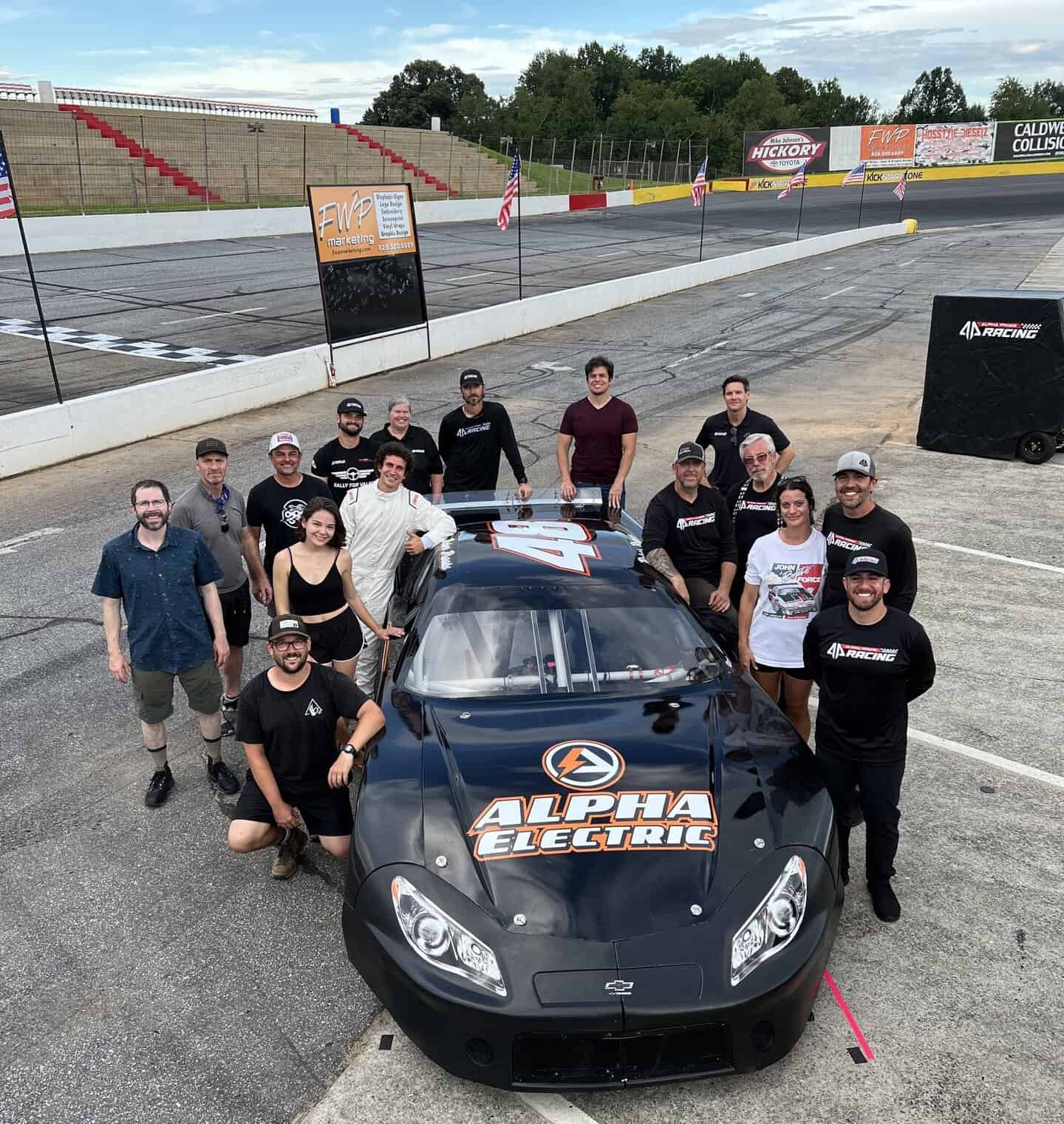
Earlier in 2026, NASCAR owner Tommy Joe Martins added a different kind of title to his resume as a writer and director of a racing-themed short film. Martins, who co-owns longtime staple Alpha Prime Racing in the NASCAR O’Reilly Auto Parts Series, directed Underfunded, a 24-minute short film about a team bringing a new driver into the fold to help them financially.
The film stars Austin Valli, Patrick Logan and Kim Sandwich as drivers; Valli most recently appeared in the Liam Neeson-led reboot of The Naked Gun last year. Underfunded was largely shot at Tri-County Speedway and uses late models for the racing scenes.
Frontstretch’s Adam Cheek sat down with Tommy Joe Martins to talk about bringing Underfunded to life, from the concept coming about to the online release of the short film. This is part two of the abbreviated version of the interview; you can listen to the full conversation in parts one and two on the Bringing the Heat Podcast.
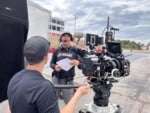
Cheek: How did you guys go about rigging the cameras up?
Martins: That was all GoPros on the race cars. Honestly, what is amazing is the technology that it takes to go make something like this. … The cameras are getting smaller, more dynamic and more compact, so I think there’s a lot now that we can do to get even more shots. … I’m pulling stuff from television, like F1 broadcasts, and where I’m like, ‘oh, that’s a cool shot.’ I have a folder on my social media somewhere where it’s bookmarks [for] image ideas.
The stuff that we couldn’t fake was all the flybys of the car. We couldn’t fake that, and that was shot with a RED camera. That’s probably an $8,000 to $10,000 camera, and that was the most hesitation that I got from anybody on the production, putting the camera in harm’s way, as the cars driving by on the racetrack. I got some really weird looks from everybody where I’m like, ‘just go out there, it’s fine.’
This is where the racecar driver in me is like, ‘this is literally not a big deal at all.’ I’m not gonna hit this camera. I’m driving into a corner. If you threw a nickel out here, I could put [the car] over wherever you want me to put it. When you’re in that mindset, you’re like ‘I can do whatever you want me to do.’
I didn’t even think about that being a danger. They’re like, ‘There’s no way we’re gonna stand out here on this racetrack and shoot this.’ And I was like, ‘I’ll stand there. I don’t care.’ … The shots of the car coming by the frontstretch, the shot of the car going through the corner, and us being really low down there – I mean, we got a longer lens and just shot it.
Cheek: Everyone in the core cast has a few credits in there. How did you go about finding [cast members]?
Martins: We really cast it. We put it out on Actors’ Access. I learned a lot about the pre-production stuff through [girlfriend] Skylar [Schock]. I can’t say enough about Skylar. As the producer of the project, I now see what it takes to produce something. It’s a lot. There’s a reason that when you watch the Oscars, when they give out the best film of the year, the person that gets it is the producer.
[Skylar] taught me about Actor’s Access and putting roles up. We had people audition. Austin Valli flew from L.A. to act in Underfunded. … I was just shocked at the response from actors. We had over 1,200 people submit for those four characters and narrowed it down to probably where we had 10 to 12 people for each character. …
Believe it or not, it’s weird when you do this, when you get somebody to submit a tape and you see it, you go, ‘yeah, that’s it.’ The one that was the slam dunk, the no-doubter, was Patrick Logan for Baker. … The rest of it, it was obvious that Austin Valli was going to be J.D. That was the obvious one, and then the other two, it was down to a few different people, and it was really kind of a tough choice. …
When you’ve written something and you’re seeing an actor bring it to life and interpret it, there’s so much joy that comes from that where you’re almost hearing the words in a different way than even I intended it. And there’s something really cool about that.
Cheek: Were there any racing movies that inspired you for this at all?
Martins: From a film standpoint of what I wanted this to look like, it was Days of Thunder, 100%. You can tell by the way we colored it, the way that we wanted everything to be either sunrise, sunset. Tony Scott is just one of the brilliant action directors that has ever lived. We experimented with a lot of different techniques that I haven’t gotten a chance to play with any of that yet.
On the last couple of days of the shoot, [cinematographer Diego Torroija] had a little three-foot slider. And we could have a little motion with the camera, but we couldn’t move the camera. It kind of broke my brain when I got on set, because how do I create movement with a static camera? How do I create the energy that I want to create?
I literally had images that I was showing to Diego from stills that I grabbed from Days of Thunder, and one of the shots that I’m the most proud of is the really low angle of the car driving through the corner. That was straight out of the Charlotte test in Days of Thunder, where I was like, ‘This is what I want. I want to see the car coming through the corner, and I want it to go right by the camera, and I want the sound to build.’ It’s hilarious; you spend all this time thinking about a shot that takes three seconds.
From a story standpoint, it’s Moneyball. I basically said I want Moneyball, but I want it to be Days of Thunder. That’s where I want this to meet in the middle.
Cheek: I’m glad to find someone else that appreciates Tony Scott as much as I do. How did you balance [Underfunded] with the operations of Alpha Prime, and what were some of the biggest things you learned from making the short film?
Martins: It is such an immersive process, man. We got to the racetrack for the first shots of the trailer coming in — which is a gorgeous shot, and it’s really cool — at, like, five in the morning. So we were there from five and got home at 8 [p.m.]. You can’t really set the schedule for the next day until you know what you got the first day. … From a production standpoint, it is so intensive. It’s really long, hard days on everybody, and everybody loves it because you’re inspired in these moments when you see it.
As far as the race operations, we were just in a good spot in 2022; we had started flowing a little bit at the end of that year, and we had a break week. I just told Skyler, “this is going to be the only chance we have to shoot. If we’re going to try to shoot this, this is going to be my only shot.” We built the entire shooting schedule around a break week for us. … We just basically blocked off the week, and over the course of four days, knocked it out.

Cheek: Is there anything else from the production that you wanted to touch on or was there anything you learned from [making Underfunded]?
Martins: Thinking about it, I now see why it took as long as it did, and I don’t think it would take me as long to make something else now. I’ve learned a little bit about the people that you trust and who you bring in to elevate it.
But I’m so blessed that I have a creative partner that has enabled me to learn the language of this in a way that I can now be in a place to do whatever I want to do, tell whatever story I want to tell. I’ve written other scripts and I’ve written more of Underfunded, and I’ve been so encouraged by the feedback of everyone that next year, this is a real focus for me. I want to dive into that – why can’t we make a television show? …
I don’t think there’s anything stopping us from making a version of this that a lot of people would really enjoy, and I think that’s been the most encouraging part of it. … As I’ve had these conversations with other people that are industry people, now that we’ve put this out, I’ve really learned where I feel like my contribution in storytelling is going to be. I know where I can contribute. It’s not necessarily just being a director: it’s being a writer [or] a consultant.
My whole life, I have wanted to help make our sport better. I’ve wanted to do that on the team side, I’ve wanted to do that as a driver. I’ve really cared about it, very passionately, and I felt like, in a lot of ways, like I’m spinning my wheels. It’s kind of still the same. We’re dealing with a lot of the same problems, and with this, I feel like you really have an opportunity to shape things and expose people to new ideas.
This medium, as a whole, has been a blessing to learn about, because I felt like I’ve kind of been like the struggling artist, the stuff that I’ve written or talked about or whatever, and now I have a way to really put that forward. I really want to build a little group of people that I can trust to go do that and tell these types of stories.
Cheek: I feel like racing movies are going in a good direction.
Martins: I want my stuff to be a little more thought-provoking. I really want it to be a little more character drama than action movie. I know that with our limitations, we’re not going to be able to do the action movie stuff as good as what Hollywood can, but I think I can do the character stuff really well, so let’s lean into the stuff that we think we can do well and try to blow that out a little bit more.


Adam Cheek joined Frontstretch as a contributing writer in January 2019. A 2020 graduate of Virginia Commonwealth University, he covered sports there and later spent a year and a half as a sports host on 910 the Fan in Richmond, VA. He's freelanced for Richmond Magazine and the Richmond Times-Dispatch and also hosts the Adam Cheek's Sports Week podcast. Adam has followed racing since the age of three, inheriting the passion from his grandfather, who raced in amateur events up and down the East Coast in the 1950s.
A name and email address are required to post a comment. The email address is not publicly visible or shared. Please keep in mind that comments are moderated according to our comment policy.
Comments are listed in order from oldest to newest. Leave a comment