
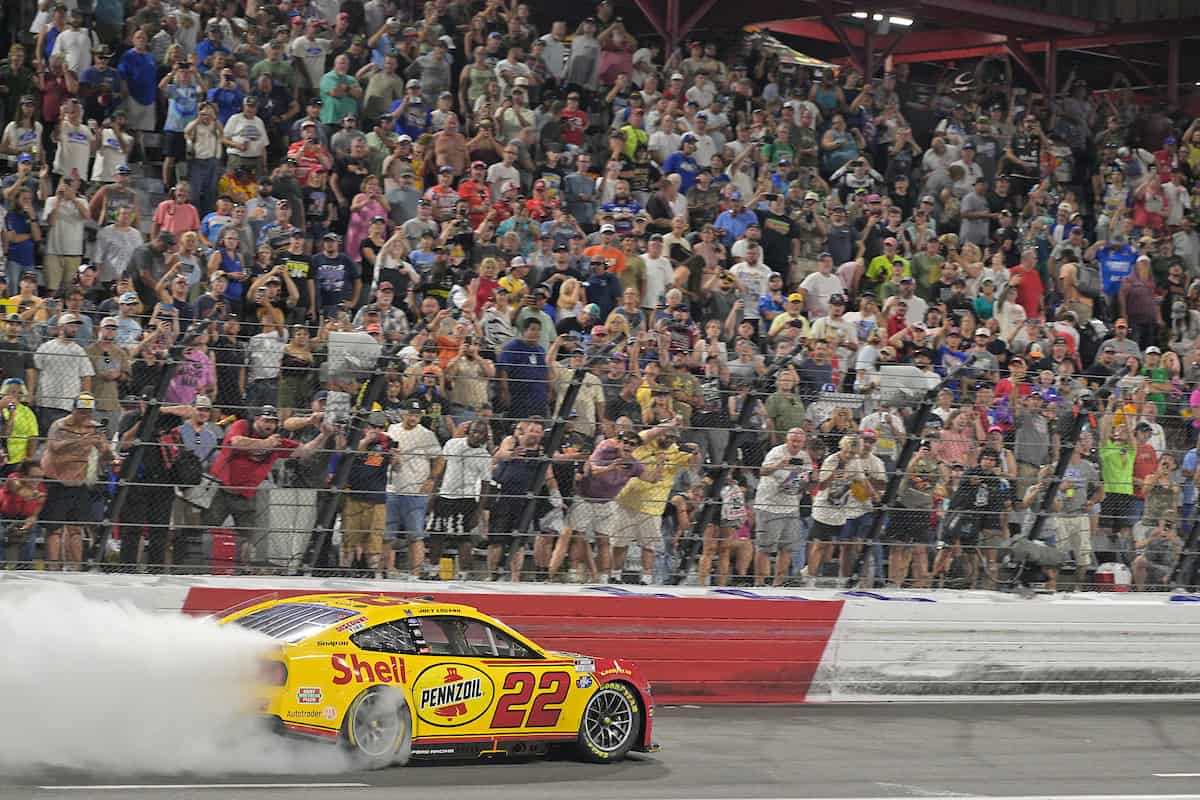
For 30 years, NASCAR fans watched.
They watched North Wilkesboro Speedway lose its two NASCAR Cup Series race dates. They watched it sit silently by North Carolina Highway 421 with only the ghosts of the past still turning laps. They watched it slowly fall into disrepair, get the briefest of reprieves and fall silent again. Nature slowly began to take over, and all they could do was watch. And wait. And hope.
And against all odds, at the eleventh hour, as the track teetered on the brink of being too far gone to save, redemption came to Wilkes County, North Carolina. The sins of the father were righted by his son and the little track in the hills rose from the ashes like a phoenix, hosting three All-Star races to packed stands.
All those years, and the fans never forgot. The track was likened to the field of dreams–if you build it, they will come. And come they did. They came home in droves to a track that represented NASCAR’s rural Southern roots and a past they wanted to touch one more time.

On Sunday (July 19) night, the little track that was left for dead in the weeds along Highway 421 came all the way back, hosting its first full-length, points-paying race since September 1996. The sellout crowd was reminiscent of the late 1990s NASCAR boom. The race was the longest NASCAR race ever at North Wilkesboro, but it didn’t feel too long. The wait for it was so much longer.
So was the racing. With just six cars on the lead lap at the end as Joey Logano put on a display not dissimilar from the one Jeff Gordon put on on a September day when Logano was just six years old.
Gordon led 207 of 400 laps on his way to a dominant win, a win that was the last one for so long for North Wilkesboro. By the time it was over, there were just 10 cars on the lead lap. Thirty-seven cars started and 37 cars finished.
Fans had long been wondering what happened to the racing everyone witnessed in the mid-to-late ‘90s. They found it Sunday. Just six cars left on the lead lap and yet everyone still racing for every position because it mattered.
It wasn’t a three-wide finish with doors banging and tires screaming. It was an old-school, unmanipulated race (save the stage cautions, which didn’t have a lot of bearing on the outcome) on a hot, slick track on a sultry Southern summer night. No phantom cautions, no All-Star race showmanship. Just gritty, balls-out, pure racing.
The track showed it didn’t just deserve the points race because it’s a legacy track. It proved it deserved one for the racing.
It’s never going to be akin to Daytona International Speedway. It doesn’t have to be.
When NASCAR rolled out the Next Gen racecar, it was designed in response to fans wanting better racing on the intermediate tracks that dominated the schedule. And it has improved that kind of racing, at some tracks drastically. But it has happened at the expense of road courses and short tracks.
The racing at Richmond Raceway has, perhaps, suffered the most, with Martinsville Speedway also taking a hit. Bristol Motor Speedway had already declined since it was reconfigured several years ago. North Wilkes, to a degree, defied that notion. It wasn’t a perfect race, but it was a throwback to another era.
It not only deserved this date, but it also deserves a second one.
The big question is what track’s expense it could come from. If NASCAR wants to keep the number of short-track races at its current seven, the date would realistically have to come from Bristol. It’s close in proximity, ticket sales have declined rapidly, and it has the same owners as North Wilkesboro.
Track ownership has a few tracks with multiple dates that it could move. From a racing standpoint, the top candidate should be Las Vegas Motor Speedway. It’s been the least exciting intermediate for the Next Gen, and it has two dates. Charlotte Motor Speedway also has two dates, but one of those is the crown jewel Coca-Cola 600 and the other has been a Chase fixture since the beginning. Plus, Charlotte is the teams’ home track and they would likely be loath to give up a chance to sleep in their own beds for a weekend.
The newly-reconfigured EchoPark (Atlanta) Speedway is unique enough to keep two dates.
NASCAR is unlikely to loosen its grip on a race date, but if it did, the most logical track to take the hit is Martinsville. It hasn’t filled the stands in some time and the racing has suffered with the Next Gen. Even so, Martinsville has a legacy as deep as North Wilkes and should exit a conversation it should never truly be a part of.
Richmond has perhaps suffered the most with the Next Gen, and if we’re telling the truth, for several years before that. The racing has declined and with it, the attendance. If it had to be a short track for a short track and NASCAR was willing to take the sanctioning fee and cut its losses, Richmond is the obvious choice.

From a pure racing standpoint, LVMS or perhaps Nashville Superspeedway should probably be first in line. Another avenue is to cut a race from Phoenix Raceway. The biggest obstacle to moving a date from any of these three is that they’re the only game in town where the Southeast is fairly saturated.
Another thing to consider is that if it survives the IHRA implosion, Rockingham Speedway might also look for a Cup date in the near future. It could replace Dover Motor Speedway or another track as the All-Star host, but that doesn’t really open up a schedule date as Dover will likely slot in as a points race somewhere in place of whichever track hosts the All-Star event.
In a perfect world, North Wilkes would come full circle, reclaiming a second date. Perhaps someday it will.
But then, if it just keeps one race for the time being, well, absence makes the heart grow fonder, and demand outweighing supply is never a bad thing when it comes to race tickets; that hasn’t happened at many tracks in some time.
In the meantime, the track that came back against all logic of time and tide has regained its rightful spot on the Cup Series schedule, and the racing, as it turns out, picked up just about where it left off, just with different names echoing through the stands. That it happened at all is remarkable and special. In that light, it’s already a pretty perfect world.


Amy is an 20-year veteran NASCAR writer and a six-time National Motorsports Press Association (NMPA) writing award winner, including first place awards for both columns and race coverage. As well as serving as Photo Editor, Amy writes The Big 6 (Mondays) after every NASCAR Cup Series race. She can also be found working on her bi-weekly columns Holding A Pretty Wheel (Tuesdays) and Only Yesterday (Wednesdays). A New Hampshire native whose heart is in North Carolina, Amy’s work credits have extended everywhere from driver Kenny Wallace’s website to Athlon Sports. She can also be heard weekly as a panelist on the Hard Left Turn podcast that can be found on AccessWDUN.com's Around the Track page.
I agree that NW needs a second date. That said, a single date at NW and one at Rockingham would make this old fan happy.
The schedule problem is there’s a finite number of dates available. In order for someone to win, someone has to lose. Personally, I loathe the cookie cutters and would happily put Chicago back in the grave / lose Kansas, Texas, Vegas dates partially or entirely.
Ditto the big track at Indy as I never bought into the hype. There’s a wonderful little bullring just west that produces fantastic racing. The trucks will be there Saturday.
Totally agree!
Not that i was a supporter, but the press including fs fails to mention this track would have never been re opened if if wasnt from the millions of dollars from the american rescue plan under the Biden administration. Alot of business including race teams recieved federal money that they didnt have to pay back. And we wonder why America has a huge debt. Your readers can google it if you dont believe me.
This is absolutely true. Modern presidents have repeatedly kicked the can down the road for decades now. The debt decreased slightly in the late 1990’s into the early 2000’s (odd combo of Clinton and W Bush), but otherwise, it’s been skyrocketing. Biden increased the debt by around $8 – $10 trillion. Trump’s first term, he increased the debt by around $8 trillion. Thus far, Trump’s second term is on a similar trajectory.
And as you said, readers can google it if you don’t believe me. Just watch out for the widespread disinformation out there, especially over the past decade, from both sides of the aisle. I know at least one guy around here who can’t be bothered to fact check himself (not you, Mike), instead accusing others of spreading lies, when he’s the one blindly following propaganda which dovetails with his existing world view. Bonhoeffer was correct…we can defeat evil, but we are powerless against stupidity.