

NASCAR implemented some sweeping changes in the lead up to last Saturday’s (Aug. 29) Coke Zero Sugar 400 at Daytona International Speedway to try and fix the racing.
Too often in the Next Gen era, both drivers and fans alike have complained about three-wide fuel-saving gridlock on a consistent basis at both Daytona and Talladega Superspeedway.
With the sanctioning body reducing the spoiler height and horsepower, did they do enough to fix what has figuratively been a black hole in the sport? Christopher Hansen and Thomas Dunn ponder that on this week’s 2-Headed Monster.
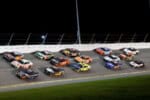
The New Changes Were a Big Improvement
Superspeedway racing outside of EchoPark Speedway at Atlanta has faced a lot of criticism in the last few seasons.
Sure, drivers still race in tight three- and four-wide packs, but races at Daytona and Talladega with the Next Gen car have been dominated by fuel mileage.
Enter the summer weekend at Daytona.
NASCAR took a big swing with a series of aero changes at Daytona in an attempt to replicate the kind of racing that Atlanta has provided over the last couple of seasons. Safe to say, the changes definitely helped make last Saturday night’s Cup race an entertaining one to watch.
Not only was it the final race of the regular season to determine the 16-driver Chase field, there was so much uncertainty in the lead up to the green flag with drivers not knowing how their cars would handle in the pack with the new package. In several instances, drivers attempting to pass for the lead with a big run were able to take a run and, given the momentum, complete the pass, whereas with the old rules package, drivers probably wouldn’t have been able to make those kinds of passes.
Chase Elliott, who finished 23rd last weekend, took full advantage of a good handling car and took every run possible with his No. 9 Chevrolet. On the flip side, when Carson Hocevar attempted a similar move in the closing laps of the race, we saw the effects of a car getting loose all on its own.
With the previous rules package used at Daytona and Talladega this season, the chances of someone getting loose completely on their own were slim to none. I believe the rules package NASCAR put in place for last weekend’s race is a major step forward to improve the racing product on drafting tracks.
Not only were drivers able to complete passes provided by the draft they got from another car ahead of them, but how a car handled in the pack seemed to matter more last Saturday night compared to past Daytona and Talladega races with the Next Gen car. While it’s yet to be seen if NASCAR will make the rules package used last weekend permanent moving forward with superspeedway racing, what we saw in Daytona drew flashbacks of its mid-2000s version.
After drivers got their introduction to the package without the aid of practice, that’s about as big of a win for NASCAR as one could ask for. – Christopher Hansen

We Don’t Have a Representative Sample Yet
The eye test tells me that things were trending in the right direction after Saturday night’s regular season finale.
But there are enough factors at play that I’m not ready to crown this package as the savior that everyone was looking for yet.
For starters, there was immense talk throughout the night about fuel saving and running part throttle. Bubba Wallace remarked postrace that Daytona still had a lot of those characteristics.
Now in part, this was a function of the Cup Series’ stage lengths on Saturday night. The first 35 laps of the stage didn’t show much of an issue, but the final two segments, due in part to restarts from stage cautions, put the teams in a place where they could eliminate a pit stop.
Naturally, they took advantage in doing so, and the pace sandbagged to an all-too-familiar spot.
With a lot of the race falling under those conditions, there was only so much time to get a good feel for what NASCAR was after. Some drivers reported slick conditions that they enjoyed while others felt trapped in a similar box.
To be clear, there were elements of guys being able to navigate themselves to the front and take runs when going hard. Cody Ware and Elliott vaulted to the front in stage two, being able to change lanes and not drop like a rock after immediately doing so.
But when those margins and sample size are so minute, you can’t make a grandstanding conclusion about where we’re going. Even a pulse of something relative to the dead-on-arrival superspeedway racing isn’t a telltale sign of everything being fixed and ready to go.
The drivers and crew members said as much postrace.
Christopher Bell and Joey Logano were adamant about where this package needs to grow and their experiences with it.
Even in the closing laps, in part due to the aforementioned stage lengths, the main pack was racing their mileage as opposed to the checkered flag. The main story was from a group of cars that were initially 20 seconds back and attempting to racing their way to the front while running full throttle.
Talladega can be a better barometer if NASCAR plans ahead with the stage lengths when looking into this package. You do that, then we can start to enjoy the effort taking shape to fix an eyesore.
Denny Hamlin mentioned that he expected the racing to be 20% better this past weekend. Ultimately, I’m just not sure we had enough time to digest how much things went in the right direction. – Thomas Dunn


Thomas is in his second year covering NASCAR at Frontstretch. A Bay Area NASCAR fan for over 15+ years, he found his love for the sport through Jeff Gordon. He helps manage the 2-Headed Monster Column.
Thomas has enjoyed several trips to Sonoma Raceway in his time and currently covers college athletics in the Bay Area, writing about the California Golden Bears and doing play by play broadcasting.
The drivers should have been allowed to have a practice session to see how the cars handle with these changes. It’s just irresponsible for Nascar to not have that time set aside.