
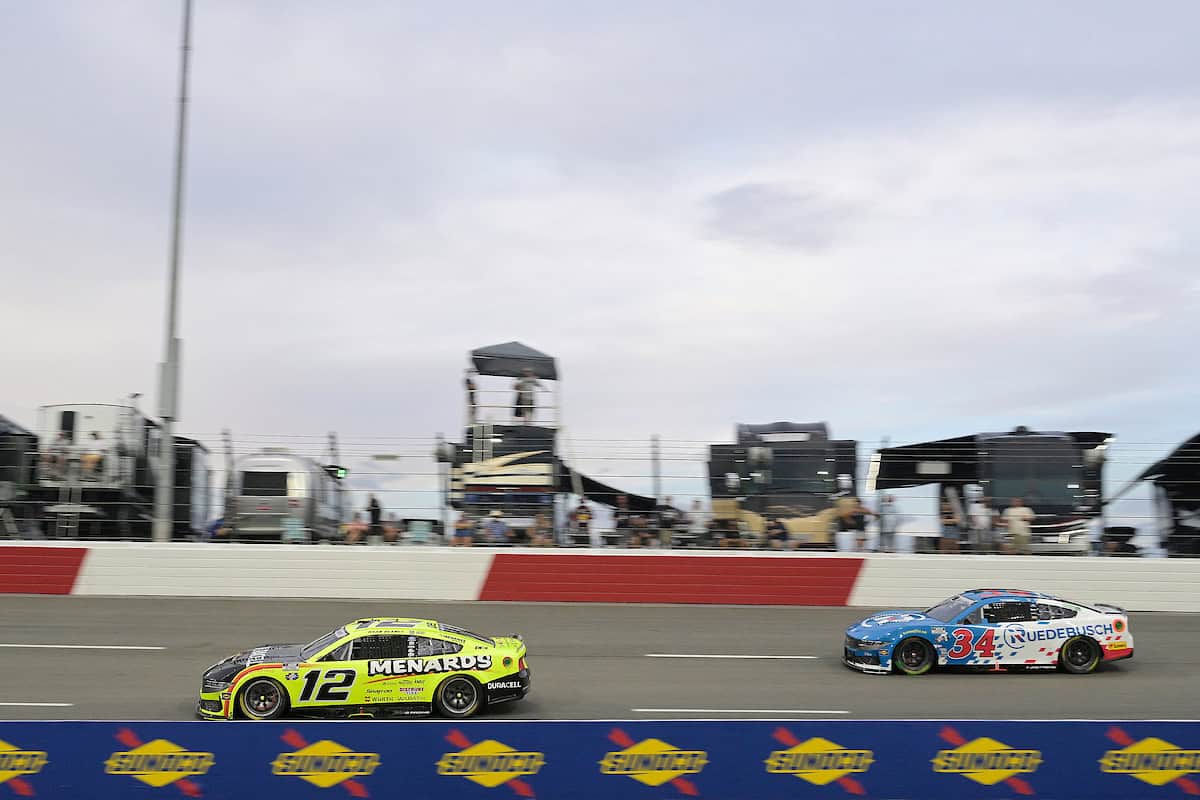
Last weekend was a feel-good time for NASCAR. The NASCAR Cup Series returned to North Wilkesboro Speedway for its first points race there since 1996. There was a full house on hand to watch the action, and the race was quite competitive… away from the lead.
However, it’s unclear what people truly expected from North Wilkesboro. While past races had incidents from time to time, they were not wreckfests. Sunday night’s race (July 19) had five cautions. That’s generally in line for North Wilkesboro. The last 10 point races there had six or fewer cautions.
That means that you have long runs and, more than likely, some pit stops under green. That’s exactly what we had Sunday night.
During NASCAR Nation Pre-Race, the intro of the show had this whole piece that insinuated that North Wilkesboro Speedway was left for dead. Then, “a prophet” showed up and helped to bring it back to glory.
In this case, the prophet was Dale Earnhardt Jr. In all honesty, he likely thought the battle was already lost. He just wanted to clean the place up back in 2019 so that iRacing could laser scan it and include the track on the service. It is a role that iRacing has played for multiple tracks. Examples include Myrtle Beach Speedway, Concord Speedway and Australia’s Oran Park Raceway.
The idea of Earnhardt Jr. as a “prophet” for North Wilkesboro is a little weird and off-putting. It’s very similar to how race fans have beatified Dale Earnhardt since he died in 2001.
The show had a feature about what North Wilkesboro means to NASCAR and the local community. Yes, moonshining was critical to the development of the track in the first place.
Dean Combs, who was interviewed in the feature, has been arrested for acts involving moonshine multiple times. He spent time in federal prison for running moonshine in 1974. He actually got busted again back in 2009 at his house just outside the track’s property. In 2016, it happened again.
The Smith and Bahre families likely didn’t really think about what they were doing to the community when they shut the track down. They just wanted the Cup dates (one for the then-new Texas Motor Speedway and one for New Hampshire Motor Speedway). Officially, Speedway Motorsports Inc. and Bob Bahre jointly owned the facility and couldn’t agree to do anything with it until SMI bought New Hampshire in 2007. That brought North Wilkesboro under 100% SMI ownership.
Terri Parsons, widow of Benny Parsons, was integral to getting racing back at North Wilkesboro. She was part of a group that leased the track at one point to host late model races around 2009 and 2010. She explained that getting North Wilkesboro was something that Benny wanted badly. That list that Terri was talking about? The origin wasn’t stated in the piece, but there’s a good chance that it was likely a list of final wishes from Benny before he died in 2007.
She believes that Earnhardt Jr. was critical in bringing racing back to North Wilkesboro. If nothing else, Earnhardt Jr. was in a position to put the idea forward to the right people. Of course, the State of North Carolina was critical as well and those people weren’t really mentioned in this piece when they should have been.
Racing-wise, this race was more or less what I expected it to be. Imagine if last year’s NASCAR All-Star Race was 450 laps instead of 250 and you wouldn’t be that far off. Competitive, but mainly clean.
In the 1990s, North Wilkesboro races (except the Spring race in 1991) were the cleanest of the short track races. There was contact, but not that much.
The repave has been way better than I would have ever thought it would be. In recent years, a complete repave results in single-groove racing for years. This is only the third year on the current pavement and people can race everywhere.
That can be a double-edged sword since being able to race anywhere means that there won’t be as much contact. I’m fine with that as long as the product is still enjoyable to watch. For the most part, I thought it was.
That said, once Joey Logano snatched the lead, it was a tough road for anyone else. He led 323 of 450 laps. His first lap led was lap 86 after Ty Gibbs got sent to the rear for speeding on pit road. From that point on, Logano led all but 43 laps.
As a result, there wasn’t all that much action at the very front of the field. At least not until Denny Hamlin got close enough to pressure Logano in the closing laps.
It was said on the broadcast itself that this race might have been quite different had Gibbs not gotten penalized early. For that matter, it might have been different had Ryan Blaney not sped on pit road under green, or had to change his steering rack and go to the rear for the start.
Passing-wise, a lot of people thought that there wasn’t any Sunday night. That’s not the truth. I can’t directly compare Sunday night’s race to the All-Star events of the past three years since there’s a significant difference between 20 cars on-track and 37. What I can say is that there were quite a few more passes per lap under green Sunday night than we had at Bristol and Martinsville earlier this year. According to NASCAR’s Loop Data, there was an average of 8.3 passes per lap, which isn’t bad. Bristol was at 5.2 and Martinsville at 4.9. Last year’s NASCAR All-Star Race averaged about 5.7 passes per lap with a 23-car field.
Therein lies an issue. There was a decent amount of action to be had in Sunday night’s race, but viewers weren’t really seeing a lot of it, especially in the second half of the race.
In addition, with all of the stage breaks, lucky dogs and such that we have these days, races with single-digit drivers on the lead lap are incredibly rare. Sunday night’s race had only six on the lead lap at the finish.

Quite simply, I don’t think TNT (or any of NASCAR’s TV partners) really understand how to cover a race like that today. They need to go back and check out how North Wilkesboro races were covered on ESPN in the 1990s since this was common (Earnhardt Jr. noted during the race that they had never had more than 13 cars finish on the lead lap there).
It seemed like there was some edict to not show racing for position between drivers who were not on the lead lap. If that is so, Sunday’s race would severely limit who could be shown. On a lot of timing and scoring setups, once you fall off the lead lap, you no longer get a delta time to the next car, which makes it a little more difficult to keep track of things.
That was to the broadcast’s detriment at times. Remember, Blaney, who finished 11th, was the first driver two laps down. After the final stops, most of the coverage centered on Logano and Hamlin for the final 50 laps. While yes, there was battling and dicing through lapped traffic, there was a lot more going on that we didn’t really see much of. This is definitely a race that was likely more exciting in person than on TNT.
Once again, I have no idea who does the scheduling at TNT (and by extension, TruTV), but it seems like they have no idea how long these races actually last. Even if the race actually started on time, there was no way it was going to finish before 10 p.m. ET. Even with the extra 50 laps, the race still finished in under three hours.
Having said that, post-race coverage was pretty average. Viewers got a decent amount of post-race interviews and analysis from the TNT stage outside of turn 3.
Overall, Sunday night’s race provided what I expected on-track. There was decent action and the broadcast struggled at times to bring it to viewers.
That’s all for this week. This weekend is a quasi-split weekend. The NASCAR Cup and O’Reilly Auto Parts Series will be at the Indianapolis Motor Speedway. Meanwhile, the NASCAR Craftsman Truck Series will set up show eight miles away at Lucas Oil Indianapolis Raceway Park along with the ARCA Menards Series. Formula 1 will also be at the Hungaroring. TV listings can be found here.
Next week’s edition of Couch Potato Tuesday here at Frontstretch will cover the Brickyard 400 by PPG. The Critic’s Annex in the Frontstretch Newsletter will cover Saturday’s FaithFest 250.
If you have a gripe with me, or just want to say something about my critique, feel free to post in the comments below. Even though I can’t always respond, I do read your comments. Also, if you want to “like” me on Facebook or follow me on Twitter, please click on the appropriate icons. If you would like to contact either of NASCAR’s media partners, click on either of the links below.
As always, if you choose to contact a network by email, do so in a courteous manner. Network representatives are far more likely to respond to emails that ask questions politely rather than emails full of rants and vitriol.


Phil Allaway has three primary roles at Frontstretch. He's the manager of the Frontstretch email newsletter that publishes Monday-Friday and occasionally on weekends. He keeps TV broadcasters honest with weekly editions of Couch Potato Tuesday and serves as the Frontstretch Sports Car racing editor.
Outside of Frontstretch, Phil is the press officer for Lebanon Valley Speedway in West Lebanon, N.Y. He covers all the action on the high-banked dirt track from regular DIRTcar Modified racing to occasional visits from touring series such as the Super DIRTcar Series.
I thought this was a pretty fair assessment of the race, Phil. It definitely wasn’t a wreckfest, and while I would’ve loved to see one as a younger fan, this race felt… good. The television crew could’ve been better (but then again, when is that not the case) but overall I enjoyed the feeling that was encapsulated by the return. I grew up with books about NASCAR tracks listing the track as defunct, never to return again. To see that proven wrong was awesome.
Can I assume that you are also unhappy with the ‘beatification’ of Kyle Busch?
Calling Dale a “prophet” in bringing back North Wilkesboro made me chuckle. Dale only wanted it to be scanned for iRacing so that he could line his pockets and get a photo opp. The real heroes are Terri Parsons and her coalition that never gave up, even when it seemed bleak at times. They are the real “prophet,” not Dale.
Nascar got lucky that there wasn’t a lot of cautions or even a red flag. The race was relatively clean and was still 3 hours. More cautions or red flags and we were looking at a 4+ hour race. Sunday night races stink!!
Thought it was a good race, but could have been better if the broadcast truck knew how to follow a race. With all the lapped cars, they obviously didn’t know who was racing for position, so they just kept a hyperfocus on the front of the field. To the detriment of the tv viewers. I’m sure it was a much better race in person.
It would have been nice to actually see cars passing cars.