
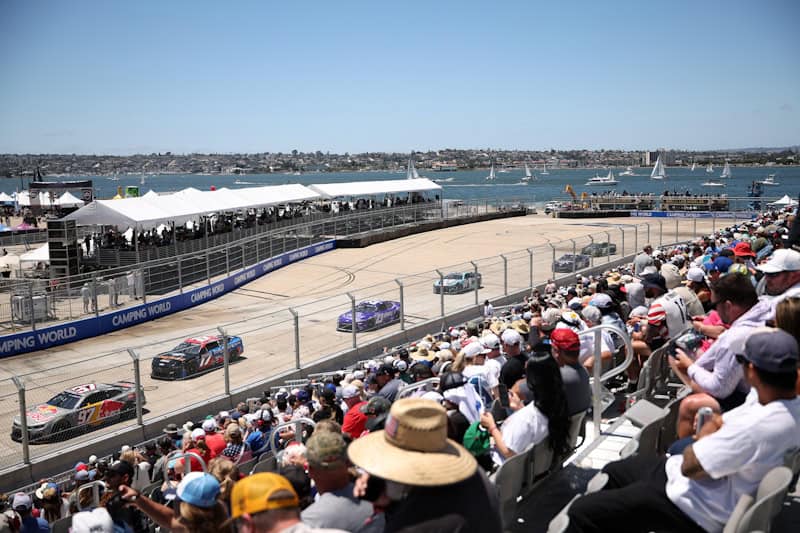
We’ve reached the great unknown of the Prime Video portion of the NASCAR Cup Series season: Naval Base Coronado.
We had no clue what to expect. Stewart Friesen told me last Tuesday night (June 16) that, “It’s going to be wild. Really, really rough in spots, and a very, very challenging course.”
We had every bit of that and more over the weekend. The event on Sunday was way more competitive than I thought it was going to be.
As with all temporary circuits, you have something of a compromise regarding booth setups and where your people are. Prime Video had what might have been the craziest booth setup in the history of motorsports. Adam Alexander, Dale Earnhardt Jr. and Steve Letarte spent the weekend working out of the bridge of the USS Carl Vinson. Not everyone gets to go up there.
While the view was likely pretty iconic, they probably couldn’t see all much. Such quarters appeared to be pretty cramped.
The USS Carl Vinson, which overlooked turn 3 of the Qualcomm Circuit, got quite a bit of use during the day. Not only did the bridge serve as the broadcast booth, but NASCAR Live Pre-Race was on the deck of the carrier with a number of sailors as the audience. It’s the kind of shot that you really can’t have anywhere else.
There were a number of pieces based about the Navy during the show. Even though he was actually in parts unknown during the broadcast, you saw more Carl Edwards on Sunday than in the past three weeks combined.
Prior to the season, Edwards did some Naval training to show the kind of preparation that sailors have to endure. Obviously, Edwards is in very good shape even in retirement, but that was taxing for him. Also, we saw him learning how to fly a Navy chopper.
The main piece of the show was not about Edwards. It was about Heather Gibbs, Ty Gibbs’ mother and co-owner of Joe Gibbs Racing. Following the death of Coy Gibbs in 2022, Heather took over as team co-owner. The piece more or less showed how she moved into the role. That said, there’s been a lot more that Heather has been involved with over the past year or so that wasn’t really touched on here.
During the race, there were a couple of somewhat weird things. For instance, the broadcast insisted that Ryan Blaney wasn’t all that good in stage points this year. Entering Sunday, he was fourth in stage points for the season.
Another thing that was somewhat puzzling was the notion that the concrete walls set up on Coronado Island were designed to be a cheap SAFER Barrier-esque solution since they could move. Sure, they moved multiple times. Most recognizably Saturday during The Big One in the NASCAR O’Reilly Auto Parts Series race, but it was quite substantial in the Cup race on lap 32.
No crash into a wall feels good, but hitting these unprotected concrete walls can’t be all that great. The first hit on the barriers occurred Friday afternoon, during NASCAR Craftsman Truck Series practice, when Justin Marks slid into the wall, sending a credentialed photographer scurrying.
As someone who has been credentialed as a photographer with Frontstretch at 13 different tracks since 2017, this would give me pause. A number of tracks have strict rules regarding the distance that photographers must keep from the fence (Ex: Watkins Glen International has a blanket three-foot rule outside of photo holes and certain sections where it’s 10 feet minimum).
One of the biggest takeaways from the race was just how significant the track changed not just over the three-day weekend, but during the Cup race itself. Discussion early in the race was all about tire conservation and drivers talking about their rear tires being gone three laps into the race.
By the end of the race, drivers were three seconds a lap faster. The fastest laps of the whole weekend were set in the final three laps of the race. Outside of maybe a superspeedway race, that never happens.
On the broadcast, this was attributed to the track taking rubber, which is always good to have. Unfortunately, NASCAR doesn’t really allow for enough practice for that to happen these days.
Rubber being laid is only part of the story. Only part of Qualcomm Circuit is concrete. The track had some really old asphalt in sections. Turns 4 to 7 had the oldest pavement. The drivers learning the course also probably played a bigger role than you’d think.
We also ended up with 20 lead changes. There were a number of different places where major passes were made. It was possible to move up.
Prime Video brought viewers a decent amount of that action. However, the size of the facility created scenarios where it was unclear why certain things happened. For example, Noah Gragson’s crash. We know what happened for sure: Kevin Magnussen spun him out after getting sick of a bumping match with the Front Row Motorsports driver. However, we didn’t have a clear shot of it.
More notably, I have no idea what happened on the final lap. Whatever happened cost Riley Herbst a top-five finish, which is a shame since he deserved that.
As stated above, tire conservation was a lot more important early in the race. That benefitted drivers such as Bubba Wallace. Later on, outright pace was key.
Post-race coverage was quite extensive. Viewers got a bunch of interviews and post-race analysis from onboard the USS Carl Vinson. Still not a fan of delaying some of the interviews with the top finishers. It was something like 50 minutes before we heard from Wallace, who finished second. That’s inexcusable, and I just don’t get why they do that.
Overall, I enjoyed the race on Sunday. It was a pleasant surprise and didn’t run anywhere near as long as the O’Reilly race did Saturday. However, it may not become a regular occurrence, because you never know what you’re going to be able to do from year to year. Having it on a holiday weekend is very limiting due to regulations on who can be on the base in general, so if it happens again, it needs to be on a non-holiday weekend.
For the five-race series, Prime Video held onto its momentum from 2025. It is a pleasurable broadcast to watch. I generally come away quite informed. I have no idea why the broadcast is so quiet on my TV though. I don’t have the same issues watching regular shows on Prime Video. It’s just the races. I have turn up my volume 50% to get to the same level I get on other shows on the service like Night Court.
Those broadcasts need to place its post-race interviews better, because viewers shouldn’t be waiting the better part of an hour to hear from the runner-up under any circumstances. Other than that, Prime Video is in a good place broadcasting the Cup schedule.
That’s all for this week. Next weekend, the TNT portion of the NASCAR season starts off with a trip to Sonoma Raceway. Here, the Cup Series will headline with the O’Reilly Series and ARCA Menards Series West on the undercard. Formula 1 will be at the Red Bull Ring. The ARCA Menards Series will be at Elko Speedway in Minnesota, while IMSA will be at Watkins Glen. Remember that with the Cup Series moving to TNT, practice and qualifying coverage will also move to TruTV and HBO Max for the remainder of the season. TV listings can be found here.
We will provide a critique of TNT’s first race of 2026 in next week’s edition of Couch Potato Tuesday here at Frontstretch. The Critic’s Annex will cover the complete marathon that was Saturday’s United Rentals Driven to Serve 250, a broadcast that ran to nearly 10 p.m. ET.
For Prime Video races, if you want to send feedback, go to the individual race broadcast link and there will be a button at the bottom of the page to provide feedback about the broadcast. For other broadcasts, use the links below:
As always, if you choose to contact a network by email, do so in a courteous manner. Network representatives are far more likely to respond to emails that ask questions politely rather than emails full of rants and vitriol.


Phil Allaway has three primary roles at Frontstretch. He's the manager of the Frontstretch email newsletter that publishes Monday-Friday and occasionally on weekends. He keeps TV broadcasters honest with weekly editions of Couch Potato Tuesday and serves as the Frontstretch Sports Car racing editor.
Outside of Frontstretch, Phil is the press officer for Lebanon Valley Speedway in West Lebanon, N.Y. He covers all the action on the high-banked dirt track from regular DIRTcar Modified racing to occasional visits from touring series such as the Super DIRTcar Series.
Really going to miss Amazon’s coverage. They seem to be the only broadcaster who consistently nails the proper feel of NASCAR being a real sport, yet not being too serious. I really wish American racing could figure out a way to adopt the F1 model. Zero commercials in every race takes F1 from watchable to must see programming.
For me, this was one of the better NASCAR races this year, and possibly the best. Great coverage, strategy, a little drama, driving skill on display, and tire wear meaning cars would ascend/descend throughout most runs.
The layout of the track was brilliant. I know this article is about coverage, but the people who designed and built that track deserve a big “Well Done.” The coverage was really good, and the racing was excellent. I enjoyed all of it.