
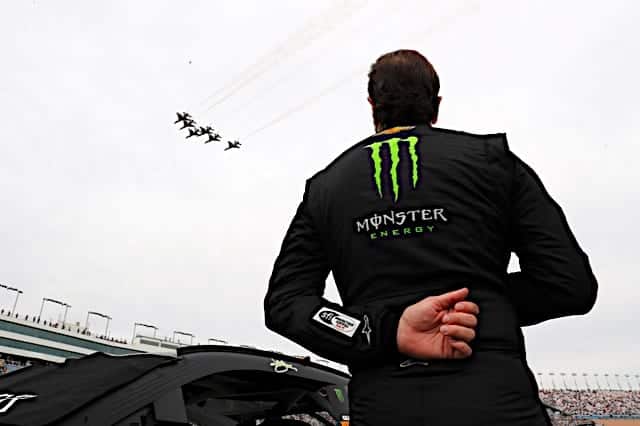
This weekend, all three national touring NASCAR series will go racing in San Diego at Naval Base Coronado. This move goes well beyond the usual close relationship the sport enjoys with the U.S. military. Instead of merely acknowledging, honoring or celebrating the armed forces, the relationship becomes fully wed, with both organizations working together to provide this surprising spectacle.
The ever-tightening relationship between sports and the U.S. military continues to offer wild displays of what one might argue is displays of patriotism. The military service academies have long fielded teams, with former presidents playing football and/or baseball at places like West Point. The annual Army-Navy football game enjoys such a prominent place in American lore that the NCAA avoids scheduling other marquee games that day, and President Donald Trump put forth an executive order preventing the NCAA from scheduling any BCS playoff games that day.

In addition, the Navy has held basketball and volleyball competitions on aircraft carriers, ensuring that the connection between the two never fades. Of course, these ties ignore the fact that seemingly every sport breaks out military-themed uniforms of some sort or that even domed stadiums enjoy flyovers before big games.
The summation of this effort is the reasoning behind a deeper reasoning, as asserted by President Dwight Eisenhower. He opined that, “The true mission of American sports is to prepare young men for war.” Hence, the two are a self-perpetuating circle of feeding the other.
So putting NASCAR on a naval base is about as mask-off as one can get when thinking about hype machines run amok in modern day capitalism. If NASCAR, as Mark Yost avowed in 2007, is 200-mph billboards, a modern manifestation of big money as circus, then the question arises of what besides product is being advertised.
One might ask the same thing regarding the military. In 2019, Michael Serazio wondered what we should make of the ostentatious displays coming from the sports-military marriage. In his piece for the Washington Post, he noted how the military budget itself to is meant to keep this relationship alive.
Serazio wrote, “Why else would it have spent nearly $7 million to sports teams over the years to honor service members in what seemed like (free) heartwarming displays but turned out to be propaganda budget line items? Paid patriotism helps ‘buy’ war. And though recruiting was the obvious aim, sports culture has long delivered far more than that — voluntarily and misguidedly so.”
The cost is not a surprise. Keeping the war machine fed is an expensive endeavor, and sports provide a beautiful audience for maintaining support. When we are bombarded by constant messages pushing us to support the troops and honor their sacrifice, it becomes difficult to ignore, and even harder to escape.
I’ve never met anyone who did not support the troops. But that message is strategic. Supporting the troops is not the same as supporting America’s constant military interventions (if you want to call them that). The Iran whatever-you-want-to-call it is another example of how the country is incessantly engaged in battles somewhere (and that is excluding those it has with itself).
None of this means that NASCAR is doing something wrong by racing at Coronado. The spectacle should be a reason for joy, and the willingness of the sport to do something different for a moment should be acknowledged.
The racing on the base, regardless of the outcomes and whether or not it happens again, will be awesome just because of its rarity. We can all enjoy that, and amazingly, NASCAR doesn’t own the track so we can smirk at how it has to share the revenue.
That aside, this race is no different than Formula 1 visiting Baku or some of the Middle East tour stops in the wonderful enterprise of sportswashing. And that is what sportswashing does, allowing us to give in to the spectacle to avoid considering the real cost of the war machine.
We’re never meant to peer behind the curtain. In fact, we’re not even supposed to know that there is a curtain to look behind. The pace of the cars on the track will not be fast enough to have the curtain sway to know its there. The American project on full display.


As a writer and editor, Ava anchors the Formula 1 coverage for the site, while working through many of its biggest columns. Ava earned a Masters in Sports Studies at UGA and a PhD in American Studies from UH-Mānoa. Her dissertation Chased Women, NASCAR Dads, and Southern Inhospitality: How NASCAR Exports The South is in the process of becoming a book.
Impressive writing here, covering a topic which will invariably be unpopular here at FS, but is sports related, due to the venue of choice. Unfortunately, I have found this sort of dialog tends to fall on deaf ears. It is a living example of Bonhoeffer’s Theory.
“We’re never meant to peer behind the curtain. In fact, we’re not even supposed to know that there is a curtain to look behind.” This is spot on. And for many Americans, hiding the curtain is highly effective. Questioning any military actions is generally met with volcanic responses, and labels like “Un-American”, “disrespectful”, and “ignorant”. This also holds true of most Americans choices of political parties or individuals. There is no sharing of perspectives to be had. Just shouting based upon emotion, not fact. We have turned against one another, because we were told to do so.
I respect the sacrifices veterans have made, and understand the armed forces are a necessity to protect our country. I can trace my family’s military service back to the late 1,700s. As Ms. Ladner notes, the vast majority of Americans agree veterans are to be honored and respected. Still, I will not be kowtowed into blindly accepting propaganda as fact, no matter the source of the narrative.
Sadly, it seems fewer and fewer Americans are willing to question the answers. They live in their preferred echo-chambers, irrespective of their political dogma. Our country’s existential crisis is accelerating, not abating. Yet, vanishingly few are taking the time to honestly examine their own positions or beliefs. I don’t see this changing. I hope I’m wrong.