
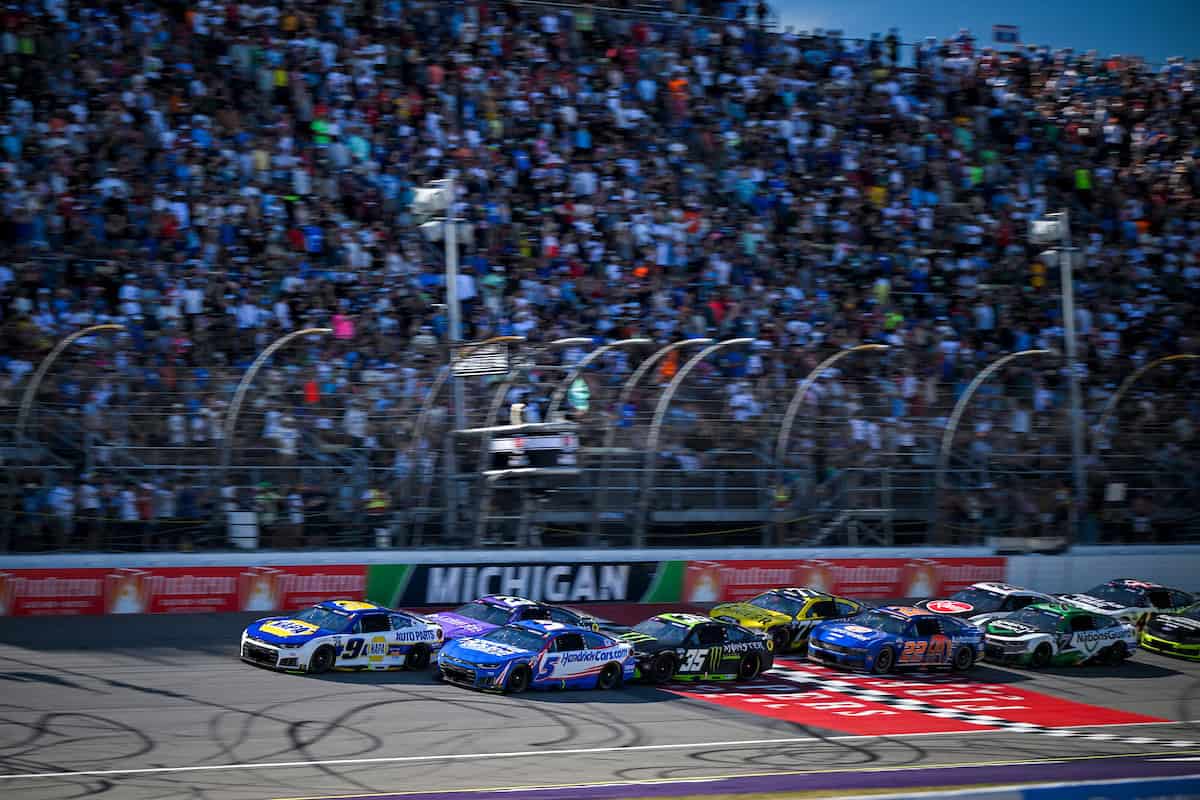
Michigan International Speedway has always been a very important track for the manufacturers in NASCAR. The “Big Three” are based nearby, and the brass would always come out. It’s changed a bit since Toyota entered the sport and the track was cut down to one race a year, but it’s still a good place to win.
On Sunday, June 7, the guest analyst on the broadcast was Martin Truex Jr., who keeps himself up on what’s going on even though he’s been spending a lot of time fishing. Last week, I thought that, if at all possible, Amazon Prime Video should have swapped Truex and Mark Martin’s weeks. Sunday’s coverage more or less co-signed that though.
During his career, Truex never particularly struck me as all that talkative. His signing on for the role was fairly surprising when it was announced.
In Michigan, he came off as knowledgeable but struggled at times regarding how to phrase questions to interview subjects. Knowing information and being able to get that info out there in a way people can use it are two very different things.
This is a very different type of communication for Truex. While I was happy to see him on the broadcast and that he’s doing well, he needs to get more training before working on another broadcast. This is what can happen when you have a bunch of guest analysts coming in cold. You’re going to have a mixed bag. Some of your analysts are going to pick it up quickly, while others won’t.
Some analysts will be nervous. That’s natural to a degree. Others will be intimidated and feel they’re unable to contribute much to the broadcast.
Michigan is Carson Hocevar’s home track. A feature aired where Hocevar read an essay about himself with the backdrop of Kalamazoo Speedway, a short track where he got his start. Honestly, there are a number of people who appeared in that piece that I would have wanted to hear about. Who are those people and what role did they play (if any) in Hocevar’s budding career?
Sunday’s NASCAR Cup Series race will likely be remembered for two things. One is the big wreck on lap 83 when nine cars piled up on a restart. This took Tyler Reddick out of the race and completely changed the complexion of the event.
It didn’t take long before the finger was pointed toward one man in particular. Hocevar. Now, it’s obvious that Hocevar didn’t mean to do this.
Given the situation with the Next Gen car’s setup, I’m reasonably confident that he had no idea what was going on with Kyle Larson’s car on that restart. The result of Larson not coming up to speed was that people started running into each other. Hocevar ran into the back of John Hunter Nemechek and triggered the incident.
The broadcast booth indicated that they thought Hocevar was trying to move to the inside of Nemechek to go three-wide. Yes, this would be an aggressive move, but what isn’t aggressive from Hocevar?
Dale Earnhardt Jr. stated after that, “[Hocevar’s] going to catch some heck for that.” Sure enough, he did. Austin Dillon roasted him during his interview at the infield care center.
The second notable moment was when Chase Elliott and Christopher Bell collided and crashed savagely on lap 148.
This was a nasty crash. A 20-minute red flag was needed to fix the SAFER Barrier. That is a very rare instance.
Much of the coverage here was centered around how the various safety changes made in NASCAR over the past 25 years worked together to allow Bell to walk away from the crash under his own power. It is true that if this had been in 2000, the outcome could have been very different.
That isn’t really different from how MRN Radio covered the crash. They were giving thanks to Dr. Dean Sicking, the creator of the SAFER Barrier when he was at the University of Nebraska-Lincoln.
Racing-wise, NASCAR’s Loop Data indicates that there was significantly less passing Sunday as compared to last year. This year’s race averaged 14.9 passes per lap under green, which is down 18% over last year. Interestingly, that is the same thing that I noted last year.
The thing is, it really doesn’t look like it on TV. What did it look like on Prime Video? Exciting…until Denny Hamlin decided to take his ball and go home.
You always had a decent amount of competitive racing to watch on Sunday. It was rarely boring to watch. You had good coverage all over the field.
Post-race coverage was substantial. In Prime Video’s one-hour NASCAR Live Post-Race, viewers saw a dozen interviews, analysis, point and result checks and more. It was quite comprehensive. The kind of comprehensive coverage that can be provided when you don’t have to worry about leaving the air to get to a UFL game or something like that.
A point of difference in coverage could likely be seen regarding how Hamlin’s celebration was covered. Over what seemed like five minutes, Hamlin received a special No. 18 flag at the start-finish line. He then drove to the end of the pit lane, turned around, drove the length of the frontstretch grandstand, spun around, then did a burnout back to the start-finish line and did donuts until he blew out both rear tires.
The posts above only cover part of the celebration. There was no commentary over this celebration as Adam Alexander and the rest of the booth lay out.
There is something to be said for that. Hamlin raced as a teammate to Kyle Busch for 15 years of his career (2008-2022). Few people in the sport knew Busch as well as Hamlin.
The decision to just let the celebration speak for itself was likely the right decision. I doubt anyone on the broadcast could have added much to it that would have boosted it in any way.
The news about Bell suffering injuries in the lap 148 crash didn’t come out until the very end of post-race coverage, so they couldn’t really talk much about it. Bell was not made available for interviews after he left the infield care center on Sunday.
Overall, Sunday’s race was a bit wreck-strewn. That’s not exactly what anyone wanted to see. Despite the wrecks, I enjoyed watching the race. The coverage was pretty good and we saw some good action.
There were some technical issues with Kim Coon’s microphone during the race. It cut out multiple times during interviews both before and during the race. I don’t think that was her fault, but it couldn’t be fixed during the broadcast. Hopefully, that is taken care of before the next race at Pocono Raceway.
That’s all for this week. Next weekend, the Cup Series makes its annual visit to Pocono. They’ll be joined by the NASCAR O’Reilly Auto Parts Series and the ARCA Menards Series. Formula 1 will be at the Circuit de Barcelona-Catalunya, while the 24 Hours of Le Mans is this weekend, starting a new TV deal with races on TruTV. TV listings can be found here.
We will provide a critique of The Great American Getaway 400 broadcast from Pocono in next week’s edition of Couch Potato Tuesday here at Frontstretch. The Critic’s Annex in the Frontstretch Newsletter will cover Saturday’s 250-mile Truck race at Michigan.
For Prime Video races, if you want to send feedback, go to the individual race broadcast link and there will be a button at the bottom of the page to provide feedback about the broadcast.
As always, if you choose to contact a network by email, do so in a courteous manner. Network representatives are far more likely to respond to emails that ask questions politely rather than emails full of rants and vitriol.


Phil Allaway has three primary roles at Frontstretch. He's the manager of the Frontstretch email newsletter that publishes Monday-Friday and occasionally on weekends. He keeps TV broadcasters honest with weekly editions of Couch Potato Tuesday and serves as the Frontstretch Sports Car racing editor.
Outside of Frontstretch, Phil is the press officer for Lebanon Valley Speedway in West Lebanon, N.Y. He covers all the action on the high-banked dirt track from regular DIRTcar Modified racing to occasional visits from touring series such as the Super DIRTcar Series.
I am pleased with the way Amazon covers NASCAR. So far the racing has only been decent, but it’s certainly presented in such a way as to make it interesting and engaging. I agree that Martin Truex didn’t add much to the broadcast. In general I’d rather have someone trained in broadcasting than just a famous driver.
I totally agree. Amazon has taken an average race and made it rather exciting through their coverage! I may be in the minority but I would rather Prime have full season coverage than Fox or others.
ARCA RACE on REVTV on Friday at 3.