
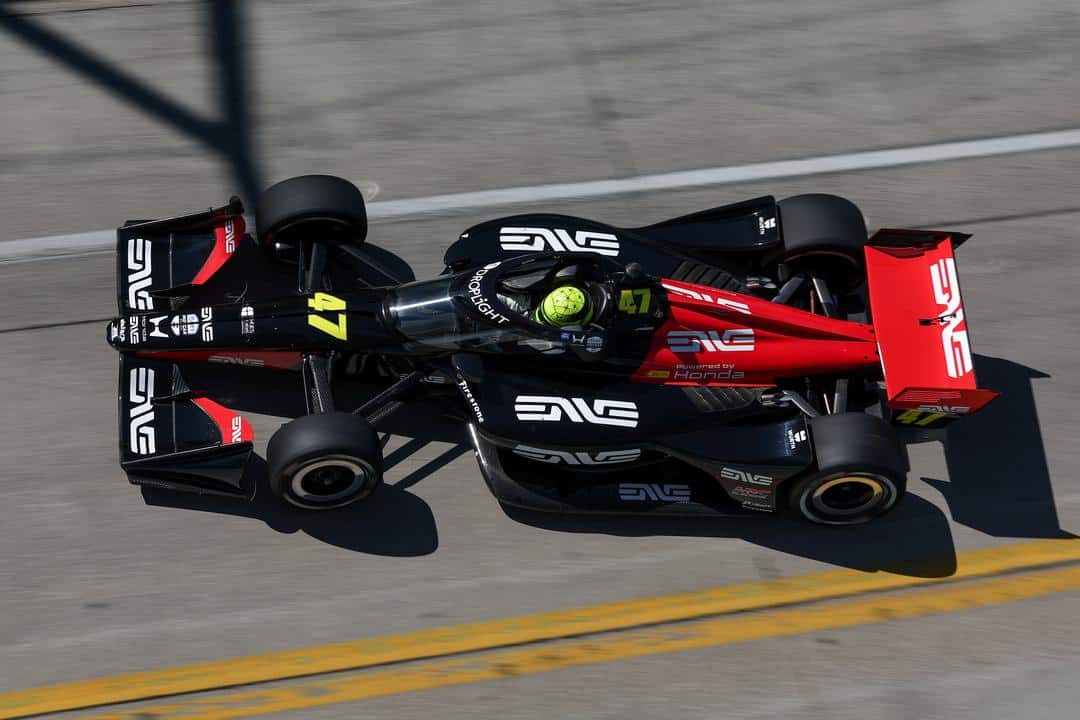
It’s not easy trying to forge your own path in motorsport. It’s even harder trying to do so with the weight of one of the most famous surnames in sports hanging over you, bringing extra attention to your every move.
When things go well, it’s pure elation at a job well done. When things go poorly, unmitigated micro-analysis of every action and mistake turns social media into a minefield.
That has been the existence of the NTT IndyCar Series career of Mick Schumacher with Rahal Letterman Lanigan (RLL) Racing. After two seasons in both Formula One and the FIA World Endurance Championship, the son of Michael Schumacher, one of the greatest racing drivers to ever hold a steering wheel, is eight races into the IndyCar portion of his career and is currently last in points among full-time competitors.
It’s a harsh reality for a driver that has had so much expected of him. Let’s dive deep into the start of Schumacher’s IndyCar journey.
The 2026 season has been full of mostly valleys for the 2020 Formula 2 Champion. In St. Petersburg, a first-lap accident that wasn’t his fault injured Schumacher’s wrist severely enough that he’ll need surgery when the season ends.
There was a bright spot at Phoenix with a second-row qualifying effort, but an air gun malfunction on an early pit stop led to an 18th-place finish. Contact with Christian Lundgaard and a spin in Arlington made that race one to forget.
At Barber, the team incorrectly believed that the red-sidewalled Alternate compound tire rule also applied to road courses as well, which would explain why teammate Louis Foster finished 25th just behind Schumacher. The team’s other driver, Graham Rahal, finished third.
Long Beach never properly got started after mechanical trouble in the first 10 minutes of Friday’s practice session was followed by an incident late in Saturday’s practice.
Things were looking up for Schumacher as he ran 12th late in the going at the Indianapolis Motor Speedway (IMS) road course, but a late bit of contact that sent Santino Ferrucci spinning gave Race Control no other option but to give the German a drive-through penalty. Had there been no contact, Schumacher likely would have finished 10th or 11th.
At the Indianapolis 500, being the only rookie to complete all 500 miles helped propel Schumacher to win Rookie of the Year. It can be argued that fellow rookies Dennis Hauger and Caio Collet had more impressive races, but Hauger sped on pit road and the subsequent penalty put him a lap down while Collet crashed in the race’s final 10 laps.
Which brings us to the most recent IndyCar race, the Chevrolet Detroit Grand Prix. A qualifying crash put Schumacher in 23rd place on the starting grid and led to much vitriol on social media.
Schumacher ran in the midfield during much of the 100-lap race before making his final scheduled pit stop on the race’s 64th lap. A couple of laps later, Rinus VeeKay and Ferrucci had contact that caused a full-course yellow.
With the vast majority of the field making their final scheduled pit stops under this yellow, Schumacher found himself in third place on the next restart behind eventual race winner Alex Palou and Alexander Rossi.
But wait, there’s a penalty coming! Rossi pitted and took full service just seconds after the pits were closed, forcing Race Control to give Rossi a drive-through penalty to be served when the race went green for a full lap, moving Schumacher to effectively second place.
That’s when Schumacher’s race fell apart. Somehow during that caution, the radio stopped working. While other race engineers were telling their drivers which engine fuel map to select ahead of the restart, the No. 47 Honda’s engine was in a caution fuel map for the restart.
That explains why David Malukas was all over Schumacher for the entirety of the first half of the restart lap. Schumacher then missed his braking point going to turn 5 and caused both competitors to miss the corner, bringing out another full-course yellow.
Schumacher had a slow puncture that eventually required him to pit, but not until Ferrucci’s throttle pedal broke, causing his car to stall on track at Turn 4 for another full-course yellow, closing the pits.
Schumacher had to serve a drive-through penalty for taking service in a closed pit. Because of the lack of radio communication, Schumacher didn’t serve the penalty because he didn’t know about it.
That led to a black flag for a lack of radio communication, which is an obvious safety issue. Schumacher pitted and finished the race 21st after the crew fixed the issues.
IndyCar racing has been an extremely tall mountain for the second-generation racer to climb. Cars with no power steering require a different driving style compared to F1 and WEC, while ovals require a complete mental reprogramming to what her has raced on throughout his career to this point.
Is it possible that Schumacher underestimated how steep the learning curve is in IndyCar racing? Yes, absolutely. We’ve seen former F1 drivers have success in IndyCar racing, so it’s possible Schumacher figured the same was possible for him.

Many former F1 drivers joined teams capable of winning. Rossi and Takuma Sato scored their first Indianapolis 500 victories for then-named Andretti Autosport. Marcus Ericsson scored several victories for Chip Ganassi Racing, including an Indy 500. Both are top-tier teams.
In contrast, RLL is trying to regain its winning ways. Lundgaard’s triumph at Toronto in 2023 remains the Zionsville-based squad’s last win, and the team’s last multi-win season was back in 2019 when Sato won at Barber and World Wide Technology Raceway at Gateway.
Racing is hard. Forging your path in a new form of racing, especially for a team that is trying to regain its winning form, is extremely difficult.
It was never going to be sunshine and rainbows for Schumacher. When push comes to shove, he would admit as a professional that some of the incidents (Arlington, Long Beach, Detroit) were of his own doing. As a rookie, mistakes are expected, and all three full-time rookies have made them.
But for someone joining IndyCar from outside the American open-wheel racing ecosystem, it would perhaps be good to remember that not everything is going to go smoothly the first time around, and progress can be limited based on execution.
I believe Schumacher will figure IndyCar out. That requires time and patience, which are in short supply for many of his supporters and detractors. Instead of overreacting to social media clips, take everything in stride and remember that this is a lengthy process for both team and driver to get to the front of the grid.
A little grace can go a long way for some. Let’s see how Gateway goes for Mick.


Christopher DeHarde has covered IndyCar racing and the Road to Indy for various outlets since 2014. In addition to open wheel racing, DeHarde has also covered IMSA and various short track racing events around Indiana. Originally from New Orleans, DeHarde moved to the Indianapolis area in 2017 to further pursue a career as a motorsports writer.
Thanks for choosing to comment on this article. A name and email address are required to post a comment. The email address is not publicly visible or shared. Please keep in mind that comments are moderated according to our comment policy.