
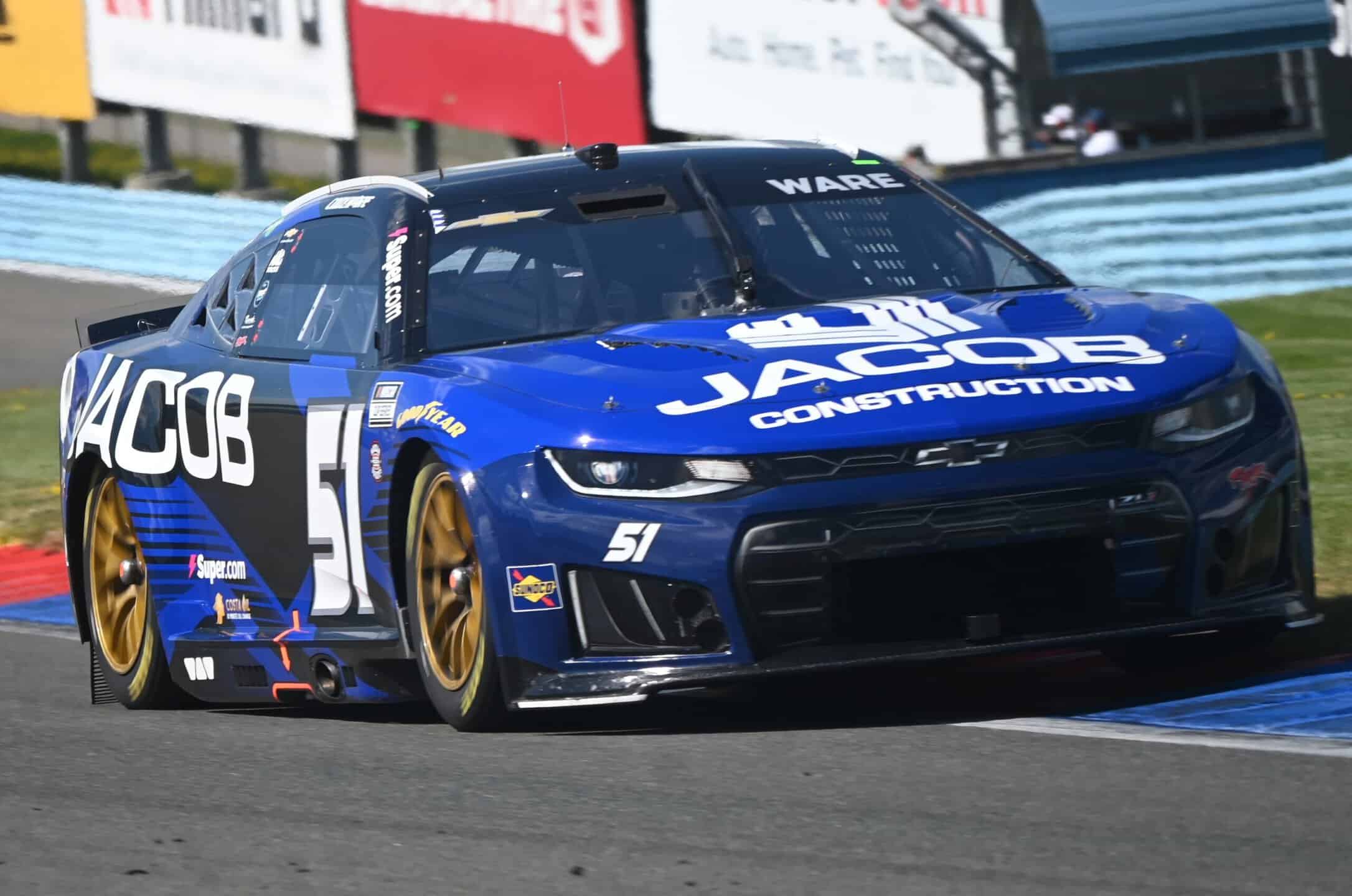
Did You Notice? … With 10 laps to go in Sunday’s (May 10) Go Bowling at The Glen, Cody Ware suffered a hard crash that somehow, someway, failed to warrant a caution.
If you missed it on race day, you’re not the only one. FOX and its broadcast — which showed more replay footage of a flying tent than it did for any of the on-track incidents in the actual race — missed it too.
Before Ware drove his car back to the garage, which allowed NASCAR to keep the race under green flag conditions, TV viewers at least got a brief glimpse of his damaged car to know that an incident occurred. What the viewers didn’t see was the wreck itself, how close Ware came to crashing into oncoming traffic and the fact that he hit the wall so hard it bent.
If that crash doesn’t warrant a caution, I’m not sure what would.

The no-call was egregious, but it’s not totally surprising in the context of NASCAR’s late-race officiating in the 2026 season. The final lap of the 2026 Daytona 500 saw a Big One that collected a dozen cars in turn 1, but NASCAR kept the race green and everyone was able to drive away. Chase Elliott and Ty Dillon crashed while taking the white flag at Bristol Motor Speedway last month, but both cars continued and NASCAR kept the race green. Kyle Busch punted John Hunter Nemechek in turn 3 with two to go at Texas Motor Speedway, but once again, Nemechek was able to drive away and the race stayed green.
NASCAR was hesitant to either end the race under caution or send the race to overtime in all of these cases, and since everyone was able to drive away, not throwing the caution was objectively the right call. And when considering NASCAR’s past history of being trigger happy in throwing cautions, race control’s willingness to try and let races be settled under green should be applauded.
But in this case, it wasn’t the final lap at Watkins Glen. There were 10 laps to go, which is an eternity on a road course, and breaking the wall draws a caution in 99.99% of cases (with Sunday serving as the .01). Why was this different?
Was it because FOX never bothered to show the incident on replay and race control never realized its severity? Was it because the on-track action was about to heat up, with Shane van Gisbergen being just a lap or two away from taking the lead from Ty Gibbs and completing his remarkable comeback? Was it because Ware drew negative press for spinning in front of the leaders with two laps to go at Kansas Speedway last month, and NASCAR was trying to avoid a backmarker team turning the complexion of yet another race upside down?
To the average observer, those theories would be easy to latch onto. However, NASCAR addressed the no-call in its Hauler Talk podcast for the week and said that if the accident was seen in real time, it would’ve been a caution. But race director Tim Bermann did not see it and was instead told by a spotter that there was a crash in turn 6. By the time Bermann had switched the monitor to turn 6, Ware was driving away from the scene and the spotter said that the track was clear. Thus, no caution.
On the other hand, there were 10 laps left in the race, and there wasn’t a single person in race control that saw the massive break in the wall at any point before the checkered flag? Even if there’s a reasonable explanation for why a caution wasn’t put out, the decision made race control look incompetent, and it absolutely needs to change its process for scouting the track going forward. More on that in a moment.
Coincidentally, NASCAR wasn’t the only racing series last weekend to find itself embroiled in controversy for a controversial no-caution call. During IndyCar’s race at the Indianapolis Motor Speedway road course on Saturday (May 9), Alexander Rossi stalled his car right at the start/finish line. A local yellow was displayed, but the race remained under green flag conditions as cars were in the midst of a green flag pit cycle. After sitting idle for more than a minute, Rossi climbed out of the car, which finally drew a caution.
The incident was heavily criticized and was an instance of prioritizing the racing over safety. With swift blowback, IndyCar announced two days after the race that pit cycles will not be considered before electing to display a full-course caution going forward.

Let’s consider the worst-case scenario for both races: what if a driver crashed into Ware or Rossi while they were in harm’s way? What if another driver crashed into the now-ineffective wall that was damaged from Ware’s crash? Either one would’ve resulted in disaster.
To show an example of the dangers of a delayed caution or keeping a race green, look no further than the NASCAR O’Reilly Auto Parts Series practice at the Chicago Street Race in 2024. Justin Allgaier crashed into a tire pack, and because he was likely in a blind spot on the track, the track was kept green after he became immobilized. Most of the field was able to pass by without issue, but Alon Day ran the corner wide and clobbered the side of the No. 7 car about 15 seconds later in a scary-looking crash that totaled both cars.
The drivers were OK, but not throwing a caution in a situation where a caution is absolutely warranted leads to scenarios that put everyone at risk.
And what will happen if there’s an incident this year in which NASCAR hesitates or fails to display a caution that leads to an awful crash? Race control would get raked over the coals, and it would likely overcorrect by throwing the caution for every instance that may or may not need one — just as it did by throwing a caution in an O’Reilly race at Darlington Raceway in 2022 for a few sprinkles just one week after the entire NASCAR Cup Series field crashed in a rain shower at Daytona International Speedway.
In other words, NASCAR needs to avoid another disaster on the scale of an entire pack crashing in rain by fixing its process to where a wreck like Ware’s would correctly — and immediately — be called a caution. And to its credit, it is exploring avenues to change that, starting with a process to expedite information from each car’s incident data recorder in order to receive an immediate gauge of crash severity.
Something needed to change after Ware’s crash, and NASCAR recognizes it. Safety is paramount, and an inexplicable mistake of that magnitude simply can’t happen again.


Stephen Stumpf is the NASCAR Content Director for Frontstretch and is a three-year veteran of the site. His weekly column is “Stat Sheet,” and he formerly wrote "4 Burning Questions" for three years. He also writes commentaries, contributes to podcasts, edits articles and is frequently at the track for on-site coverage.
Find Stephen on Twitter @stephen_stumpf
Maybe NA$CAR is tired of Cody B. Ware bringing out cautions near the end of the examples of Brian’s product. I know i thought , “Oh not again! He did his job!” Again! Oh well, he tried.
Hard to manipulate the outcome of races if Cody spins and no one sees it. Seriously, how many times has this happened? It’s a pattern and certainly impacts those foolish enough to gamble on NASCAR.
Every single week it’s Ware. He’s tearing up expensive equipment and most would be fired running so many laps down and wrecking every week. So maybe he is getting paid to do it.
100% truth. The thing that needs to change is Cody Ware needs to go back to the O’Reilly series or Truck series, closer to his talent level.
There was a time when race control had to rely on oral reports from corner workers. And mistakes could be made. However, given today’s technology, it should be possible for observers in race control to monitor ever inch of the track via now-inexpensive TV hardware.
Maybe NASCAR should institute a Virtual Pace Car like F1 to keep the race flowing without slowing down too much for minor incidents. Keep aware it should only be used at road and street courses. However I think there should be an automatic system like IndyCar when there’s a full course yellow and also when a car hits hard