
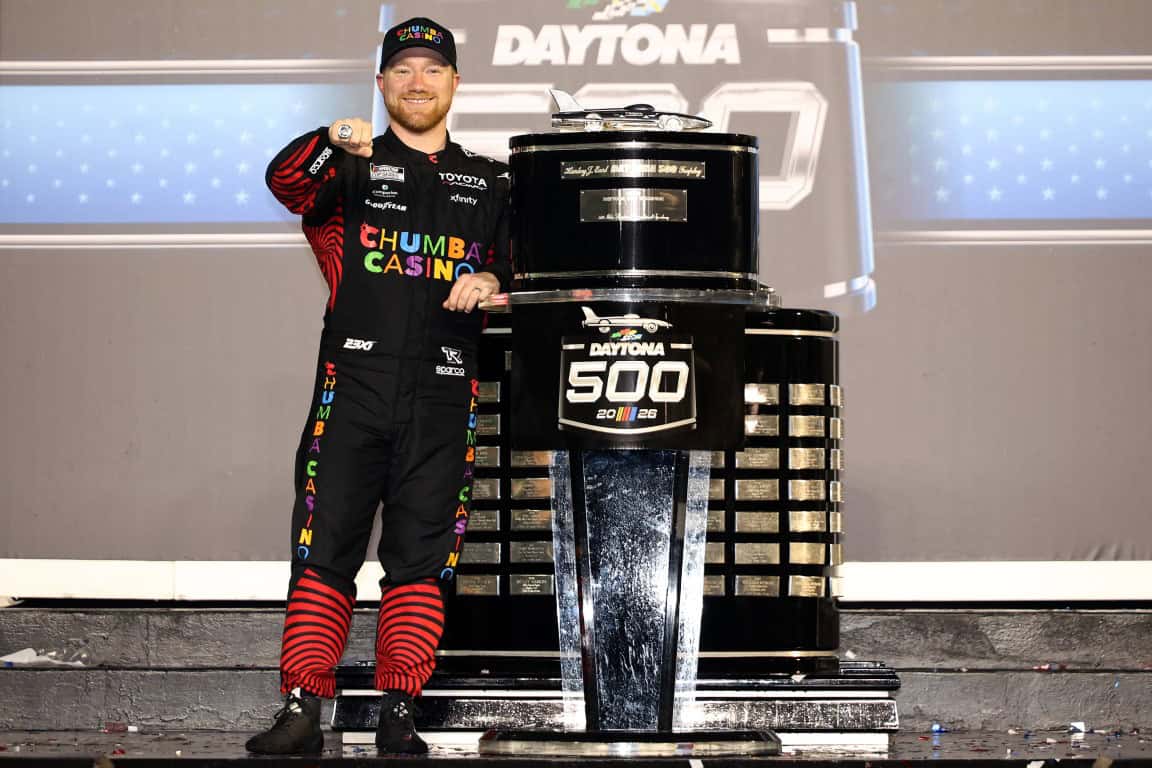
NASCAR carried so much momentum into Sunday’s (Feb. 15) Daytona 500.
From a veteran scoring his first pole at Daytona International Speedway, a pair of last-minute qualifiers (one of whom had to thrash to fix their car just to start the race), the return to the track after a tragic offseason and a first-time winner taking the checkers for a team that took on NASCAR head-to-head in court, the weekend had the potential to be one of the most memorable in recent memory.
Instead, it was a dose of the same-old same-old.

With 45 cars on the entry list, there was a little drama right from the start. Under current qualifying rules, there are four starting spots up for grabs after the chartered teams slot in. There’s an extra provisional for an outstanding driver, but that’s determined ahead of time through an application process and if granted, it adds an extra starting spot, so the actual qualifying process isn’t really affected.
Only the front row is set on qualifying night, and two of the four open spots are given out to the two fastest non-chartered cars.
Winning the pole for the Great American Race has not traditionally been a great indicator of where the polesitter will finish on Sunday, but it is a point of pride. And face it, two-time NASCAR Cup Series champion Kyle Busch hasn’t had a lot of good moments in recent years. Since moving to Richard Childress Racing in 2023, Busch has struggled. He’s had a few wins and a couple of poles, but 2025 was by far Busch’s worst statistical full-time season.
But on Wednesday night, Busch looked like the terror of old, winning the pole for the first time in 22 attempts. An older and wiser Busch looked ready to write a new chapter to open the season, but he didn’t (more on that later).
With just one Daytona 500 starting spot left for the taking in each of Thursday night’s qualifying races but three cars after each, all eyes were on the part-time teams looking to make a splash. And they didn’t disappoint.
In the first of the two Duels, there were two cars owned by teams with multiple full-time Cup entries and Carl Long’s Garage 66 entry. Long is a bit of a fan favorite because of his tenacity, particularly after a fine stemming from an engine infraction in the 2009 All-Star Race. The $200,000 fine was the largest ever issued at the time and far beyond Long’s limited budget. It would be nearly a decade before he could return to the Cup Series.
Long’s Daytona 500 entry, driven by journeyman driver Casey Mears, who hasn’t competed full-time since 2016 and had just six starts since then, was underpowered. Mears spun getting onto pit road in his qualifying race and lost a lap, leaving NASCAR Craftsman Truck Series driver Chandler Smith to duke it out with RFK Racing’s entry for Corey LaJoie for the transfer spot.
Smith was involved in a crash with three laps remaining in the 60-lap race. The caution gave Mears his lost lap back. Smith was able to continue. The race went to an overtime restart, and the fireworks weren’t done. Entering turn 3 on the final lap, LaJoie got turned into the wall. Mears got a piece of the incident as well, but never lifted even as he smacked the wall. Improbably, Mears beat Smith to the line in a No. 66 that was a good bit worse for wear.
Mears, who is hoping to make his 500th NASCAR national series start this season, was barely able to hold back tears in his press conference after the race as he spoke about having the opportunity to reach the milestone start and to be at the track.

The second qualifying race featured three part-time teams: Beard Motorsports’ No. 62 entry driven by Anthony Alfredo, the No. 78 driven by BJ McLeod for his Live Fast Motorsports team and JJ Yeley in the No. 44 for NY Racing Team.
As seems to be the case for the Duels, the second race didn’t feature any on-track mayhem after the eventful first one. After 60 caution-free laps, it was Alfredo holding that last entry into the Daytona 500. Like Mears, Alfredo fought tears as he celebrated simply making the main event.
It didn’t last.
Alfredo’s car failed technical inspection for some unattached hoses and was subsequently disqualified. NASCAR hastened to run McLeod’s car through tech before announcing that he would indeed get the final spot.
Meanwhile, Mears, Long and their skeleton crew of dedicated people pulled the body panels off their EchoPark car to put onto the No. 66 to repair the damage they’d suffered in the race. That meant withdrawing from this week’s race because they don’t have another car ready.
All that and it wasn’t even race day yet.
Sunday dawned sunny and bright—though the forecast for later prompted NASCAR to move the race up an hour, a wise decision as rain rolled in just as the race ended. Even though the sun shone, there was a lingering sadness in the air after one of the most difficult offseasons in recent memory. A December airplane crash claimed the lives of Greg Biffle, his wife, two children and three others. Just weeks later, Denny Hamlin’s father lost his life in a house fire that also hospitalized Hamlin’s mother (who had recovered enough to attend the race) after she was able to pull him from the flames.
And the race? It was about the race for the first time in a decade. With the “win and you’re in” playoffs a thing of the past, the focus was on winning the 500 because it’s still NASCAR’s Super Bowl, the most prestigious and sought-after race on the schedule. No trophy is more coveted than the Harley J. Earl Trophy with its sleek speedster from another era perched on top.
At the end of the day, Tyler Reddick hoisted the huge trophy along with team owners Hamlin and basketball great Michael Jordan—who, just weeks earlier, had fought NASCAR in court for its charter system and, for all intents and purposes, won, though the case was officially settled.

It was Reddick’s first Daytona 500 victory, the biggest of his career. He’d had his own battles in recent months, with his newborn son Rookie having to undergo surgery for a growth on his kidney. Rookie joined his parents in victory lane, healthy once again.
With all of these feel-good moments, the 2026 Daytona 500 could have been —and should have been — NASCAR’s shining moment. The sanctioning body had made significant changes over the winter, replacing the oft-maligned Playoffs with the old Chase championship system and adding more horsepower to the cars at many tracks. There was so much to celebrate.
And yet, the race itself was anticlimactic. Like most other superspeedway races in recent years, much of it was spent saving fuel with cars in a tight pack, sometimes three-wide, but only at part-throttle, with few attempts to make moves except at the stage ends when points were on the line.
The race ended at the scheduled distance—a rarity these days when multi-car crashes often lead to multiple overtime restarts, and Reddick’s move to pass Chase Elliott for the win was bold and unexpected, with the No. 45 weaving between cars, first to the outside and then to the inside to put himself in position. He crossed the line as the cars behind him crashed and slid across the line.
Meanwhile, Busch dropped to the back as the field came to the white flag because he wanted to avoid the inevitable trouble, which came in the form of a turn 1 incident well before the last one at the finish line. Maybe it was a chicken move but Busch finished 15th instead of 25th, so it can be argued it was a smart move.
There was so much to be excited about for the 2026 Daytona 500 and even after it ended. It’s just that on a weekend where the Great American Race should have been all the way back, the race itself as a whole wasn’t really one of them.

Amy is an 20-year veteran NASCAR writer and a six-time National Motorsports Press Association (NMPA) writing award winner, including first place awards for both columns and race coverage. As well as serving as Photo Editor, Amy writes The Big 6 (Mondays) after every NASCAR Cup Series race. She can also be found working on her bi-weekly columns Holding A Pretty Wheel (Tuesdays) and Only Yesterday (Wednesdays). A New Hampshire native whose heart is in North Carolina, Amy’s work credits have extended everywhere from driver Kenny Wallace’s website to Athlon Sports. She can also be heard weekly as a panelist on the Hard Left Turn podcast that can be found on AccessWDUN.com's Around the Track page.
It was the usual wreck fest. I expect nothing more from Daytona and am awaiting the first real race, one in which the drivers can really drive instead of running in a pack hoping they aren’t the next victim of plate racing.
Other than Reddick’s moves at the end of the race, it was pretty boring.