

Actions have consequences.
At some point or another in our lives, we’ve either been taught this by our parents or have found out the hard way.
Since the meteoric rise of social media and the Internet in the last two decades or so, the way we have to present ourselves is different — the things we share don’t just get shared to our inner circle of friends, they get shared to anyone in the world with eyes and an electronic device capable of accessing social media.
As such, the term “actions have consequences” has seen a revival in usage, only this time for what we post on social media. Putting thoughts out into the ether for anyone outside of your friend group to engage with can wield ugly results if there’s disagreements or controversial statements.
Motorsports drivers, somehow, have not figured that out yet.
On June 17, Spire Motorsports fined Carson Hocevar $50,000 for comments he made about Mexico City prior to traveling there for the NASCAR Cup Series race at Autodromo Hermanos Rodriguez. He is also to undergo sensitivity training as well.

Hocevar made the comments on the streaming platform Twitch, where he frequently streams himself playing iRacing; the streaming platform is a large part of how Hocevar has built his fan base.
”If the travel was better,” Hocevar said while streaming. “If getting here was easier, if you felt safer getting to and from everywhere, if it wasn’t such a shithole, if the track limits were a little better enforced, if it was going to be a little bit better of a race and it wasn’t so easy to, or feel so locked down like you can’t leave anywhere, it’d be a great experience.”
Hocevar is just the latest driver in a long list of NASCAR and NTT IndyCar Series drivers the past couple of years to be penalized either by their teams or by their sanctioning body for actions that they have said or done on social media.
Throughout his entire IndyCar career, Agustin Canapino had a fanbase filled with people who sent death threats to drivers who raced him aggressively, namely his former Juncos Hollinger Racing teammate Calum Ilott and later former Arrow McLaren driver Theo Pourchaire. Not only did Canapino not speak out against the death threats, he was also found to be actively supporting fans who tweeted death threats by liking tweets on X.
With all the backlash mounting against him, Canapino and JHR parted ways halfway through the 2024 season. But Canapino is not the only driver to find himself in deep waters for liking posts.
Halfway through his rookie Cup season with Legacy Motor Club, Noah Gragson was suspended and later released by request from the team after it was discovered he liked an Instagram meme with a picture of George Floyd and the words, “Unda da knee,” playing off the song “Under the Sea” from The Little Mermaid.
Of course, before Gragson, there was the infamous suspension and firing of Kyle Larson from Chip Ganassi Racing in 2020, after he was caught casually using a racial slur during an iRacing event in which several high-profile drivers took part.
However, most people forget that Larson was not the only one to be bitten by the nature of the Internet.
During a NASCAR Pro Series Invitational race amid the COVID-19 pandemic, also on iRacing, Bubba Wallace ended up rage-quitting from the event (held at the virtual Bristol Motor Speedway) after getting caught up in one too many crashes.
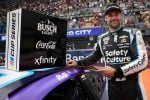
Blue-Emu, a sponsor of Wallace and his team, Richard Petty Motorsports, was sponsoring Wallace when the situation happened. The resulting fallout was Blue-Emu deciding to end its sponsorship of Wallace and RPM, both virtually and in the real world.
If you’re keeping score at home, that’s five drivers in the last six seasons who have been bitten by the consequences of their own actions on social media or just the Internet in general.
Say what you want about what a driver says or does about a certain place or a certain meme, the reality is that drivers are representatives of their team and their multi-million-dollar sponsors that pay big money to back them in their racing endeavors. They are not like you and me, who could conceivably get away without consequences.
Hocevar’s comments about Mexico City directly don’t just reflect on him, they reflect on Spire, they reflect on his sponsors such as Zeigler, Premier and TotalPlay, which is headquartered in Mexico. In the same vein, had CGR not fired Larson, there was a high chance that Credit One Bank and McDonald’s could have left the team.
Sponsors often bankroll teams’ operations, and if a driver says or does something that doesn’t align with sponsors’ values, they will quickly protect its sponsorship over its driver; otherwise, the team will go out of business with how expensive racing is.
Racing is all about protecting a brand, and teams have to do what they can to protect theirs. Drivers, meanwhile, have to quit acting like they are invincible on the Internet, because every single important eye, including executives from NASCAR, teams and sponsors that puts them under a greater spotlight than if they were a normal person.
For some reason, drivers haven’t grasped the full understanding of the consequences of their actions via the Internet. It’s happened time and time again from driver to driver, and nobody has seemed to learn.
As the Internet and social media continue to take over how we communicate and connect with others, hopefully drivers will think twice before speaking their mind there, lest they suffer the same fate as those before them.
But Mexico is a shit hole.
The penalty for speaking the truth. By the way, bring your own food, and water. And hella security to boot.
Great article, noting what so many seem to be missing.
The purpose of most businesses is to make money. We can argue whether this is good or bad, but we cannot argue this truth. If you say or do something which is likely to cost your company money, you should expect negative consequences for your actions.
This is not a new concept. This expectation of individuals has existed as long as capitalism has existed. A driver can say anything they want, constitutionally protected by the right to free speech. But, a business is free to react as they wish, which is also constitutionally protected.
People keep trying to make this political. It is not. It is a business decision, pure and simple.
you really must have taken a “deep dive” to find those Indy Car drivers names…. did they ever drive in the Series ? perhaps you should go back to online gaming coverage….
What exactly is this Sensitivity Training supposed to be conveying? I am not understanding what triggered not just this training but a monetary fine. Is it the “sh**hole” comment? Is calling a city a shi**hole an automatic fine? So, we just need to praise cities as clean Meccas of Utopia? If you want him to not malign a Nascar decision or location on the schedule, I’m not seeing how the fine and training would address that. He didn’t marginalize or diminish any human beings and did not jeopardize the safety or dignity of anyone. Show me the crime, please.