
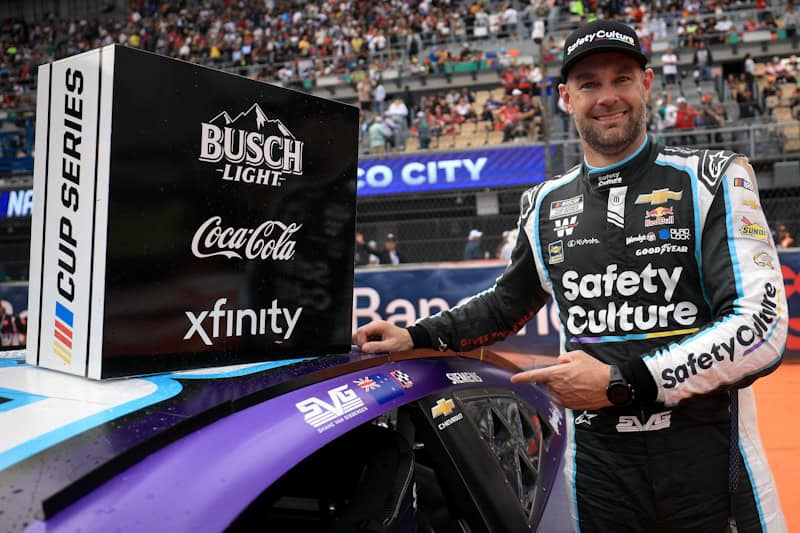
With Shane Van Gisbergen reminding the entire NASCAR community why he got a NASCAR Cup Series ride in Mexico City last weekend, the age old debate of whether this playoff format stinks or not came up early and often.
SVG locked himself into the playoffs with the win, and according to the current format, earned the right to go trophy-hunting after a dismal start to his full time Cup Series oval career in 2025. However, he didn’t just eek out a win over the rest of the field, he dominated, leaving some to wonder if this is a new viable strategy within the sport.

For the second week in a row, three Frontstretch writers decided they had all the answers, and all their answers were just a little bit different.
Let the Drivers Who Earned the Points Keep Their Spot
NASCAR’s “win and you’re in” policy for playoff eligibility has been overpowered since the first year of its inception, 2014.
In that year alone, four drivers in the top 16 in points were absent from the playoffs: rookies Austin Dillon and Kyle Larson, as well as Jamie McMurray and Paul Menard. Their replacements after the cutoff race at Richmond Raceway were Kyle Busch (17th in points with one win), Denny Hamlin (19th in points after missing one race for metal in his eye with one win), Aric Almirola (22nd in points after a rain-shortened win at Daytona International Speedway) and AJ Allmendinger (23rd in points with a win at Watkins Glen International).
With the implementation of the Next Gen car and the abolishment of the top 30 in points rule, these examples have only intensified with how deep in the points NASCAR winners can be to jumble up the playoff picture for no good reason.
Take for example Harrison Burton, Chase Briscoe and what could have been Dillon if it weren’t for the egregious move for the win he made in overtime to win at Richmond Raceway last year. Instead of the automatic berth taking up one of the 16 spots belong to the so-called “best drivers in the series,” Dillon finished 32nd in points.
On the other hand, Burton, who was an already confirmed exit from the Wood Brothers Racing No. 21, miraculously won in overtime at Daytona International Speedway, holding off Busch in a storybook finish with father Jeff Burton on the call in the NBC booth.
But instead of the story being about WBR’s 100th victory and Burton’s first win, the conversations were about how Burton shook up the playoff picture, eventually leading to Ross Chastain, 14th in points, being held out. Chastain would later win a race at Kansas Speedway, but not in time for the playoffs thanks to the win-and-in rule.
The same applies to Briscoe’s win in the Southern 500. Briscoe got a dying Stewart-Haas Racing into the playoffs with an unbelievable drive. Unfortunately, RFK Racing’s Chris Buescher was the odd man out thanks to this ridiculous rule.
Buescher would also steal a playoff race in the first round at Watkins Glen.
Drivers who put on the consistency deserve to be given the credit for their performance week in and week out, and drivers who have been terrible all season whether it’s because they’re just good on road courses or are lucky enough to survive at a superspeedway simply should not be rewarded for that.
Now we come to this year’s contestants: Josh Berry and Shane van Gisbergen.
Getting his first win at Las Vegas Motor Speedway, Berry looked like he could stay in the top 16 in points, and he could surely make his way back in there with only being down 10 points to Michael McDowell. Regardless, his win would move the cutoff line up a little bit more, but a Berry win isn’t a massive offender here.
Van Gisbergen, welcome to the playoff spoiler party!
After his dominant victory in NASCAR’s inaugural race in Mexico City, van Gisbergen would jump from a staggering 30th in points to occupy one of the top 16 spots in the standings.
And for what?
Instead of McDowell being the cutoff, Buescher once again is in the hot seat with a 19-point gap to RFK teammate Ryan Preece, who by his standards, has had an impressive season.
Want to know something else about what the playoff bubble would look like?
Daniel Suarez, who sits 28th in points, would have a one-race gap in points to 16th, 54 points behind McDowell. That would leave a blistering 12 drivers still in the hunt for the final transfer spot: 12 drivers with 10 races to go. That would be exciting to watch and would make the midfield positions matter much more all season long.
However, fans don’t get that when you have a guy who is sub-30th in points taking a spot because of one good race. This is far from the last time this could potentially happen.
Brad Keselowski is more than capable at winning anywhere besides a road course.
Ty Dillon has been quietly running up front at other races. Cole Custer was in the running for the win at the Daytona 500 before wrecking a chunk of the field on the last lap. Noah Gragson is with a competitive team as well. Riley Herbst has been formidable on superspeedways too.
Add the rest of the drivers between 17th and 29th in points for the next 10 races to the mix, and Buescher, Alex Bowman, Briscoe and others could potentially be at risk despite being rewarded with the results they earned.
So please NASCAR, if you do anything with the playoffs after this season, for the love of God, get rid of this awful rule and let earned points determine your best drivers. – Wyatt Watson

Don’t Like It? Just Win
There’s no substitute for winning.
No matter how you get to victory lane, the fact of the matter is that you did and that’s what counts in a race.
It’s great to run second place, but if we’ve learned anything from Ricky Bobby, second place is just the first loser. Now, there are some out there who say that simply being fast all season long should give someone a shot at a NASCAR Cup Series championship.
While that’s admirable, allow me to be serious for a moment and ask an important question: Why do you think NASCAR isn’t running the old points system any more?
Because there came a point where it simply didn’t work. By the end of the old points era, fans had been treated to a few years in a row where it simply wasn’t exciting anymore — and who could blame them?
The argument for the old points system is typically that every other form of motorsports in the world runs it, and guess what, they complain about it too. Imagine if McLaren hadn’t found some speed in Formula One or the Red Bull team hadn’t gone through the controversy it had. If you thought fans were sick of tuning in to watch Max Verstappen dominate the field week in and week out then, imagine if it was still going on today.
This was the reality of the situation when NASCAR made the switch.
I have a hat that I cherish. It reads across the front “AK Racing.” It’s orange and white, with a big No. 7 on the side. I bought this hat because out of all of the historically fun racers in NASCAR, Alan Kulwicki is one of my all-time favorites.
Those familiar will know that he won the Winston Cup in 1992 in what is widely regarded as one of the greatest championship comebacks in the sport’s history.
The harsh reality, though, is that one of the biggest reasons 1992 sticks out in so many minds is because it was one of the very few that were actually close, and even then, it was only close because of Special K’s six-race extravaganza to close out the season and a few underperforming drives from Bill Elliott.
Even then, Elliott beat Kulwicki in the final race of the season, and people argued then that he should have been the champion.
By the time it was retired, the Winston points system had shown its age, and it was hurting fans around the sport. The champion had been decided well before the season was over, and there’s quite literally no fun in that. We talk about comparing NASCAR to other sports a lot, and no other league outside of motorsport decides its champion until the penultimate matchup, because that’s how it should be done.
I don’t think there’s a problem with the current format. Burton winning at Daytona last year bothers you that much? You should have been faster at one of the dozens of earlier races that season.
SVG dominating on a road course grinds your gears? Be a racecar driver and beat him. In a sport that has a longer season than just about any other professional league, fans and drivers alike are complaining that their favorite driver simply didn’t have enough chances to get to victory lane. I have a wonderfully simple solution.
Just win. – Tanner Marlar

Things Can Be Fixed
Of course, the best possible way NASCAR could revamp the championship is to use full-season points, but since that’s not going to happen, how can the sanctioning body make sure that the champion is decided based on top performance?
The “win and you’re in” idea is actually a decent one — it pressures teams to perform. One complaint that dogged both the Chase and full-season formats was that drivers could win a title by playing it safe. Fans didn’t like drivers settling for a “good points day” instead of doing what it takes to win, even if that meant a mechanical failure or a crash.
Rewarding drivers who take risks to win with a playoff spot makes sense on paper. The last full-season champion, Matt Kenseth, won just one race in 2003, but he led all drivers in average finish, suggesting (perhaps unfairly) that his team settled for top fives instead of racing for wins. In contrast, Ryan Newman won eight times that year but finished sixth, due at least in part to seven DNFs for crashes and mechanical failures.
Some fans felt that drivers like Newman should be rewarded.
The Chase didn’t really do that, so when the system was revamped again for 2014 and beyond, NASCAR added the win and you’re in clause.
For several years, it carried a caveat: For the win to count for a playoff berth, the driver also had to finish in the top 30 in points. When Kyle Busch fought back from missing eleven races, nearly half of the regular season, he won four of his first nine races back, but still took until late August to climb into the top 30.
If NASCAR wanted title contenders to show their worthiness by racing as hard as possible every week, Busch in 2015 is the poster child. He risked the top-30 finish chasing wins, but once he was there, he ran consistently well for the rest of the season. If the goal of winning the title in the playoff era is taking both risk and reward, Busch’s 2015 title is probably the most worthy of the playoff era.
So naturally, NASCAR dropped the top 30 requirement.
Here’s the thing: Winning should matter. But it shouldn’t matter so much that a poor performance is rewarded with a chance at a championship. One race does not a championship-caliber season make.
Van Gisbergen is a talented driver and a fan favorite for his personality. But he’s 30th in points with just one top five and two top 10s in 16 races. Only four drivers have a worse average finish than van Gisbergen’s 23.8.
Usually the drivers that squeak in on wins (and van Gisbergen is a favorite to win on every road course) get eliminated in the playoffs, but that’s not guaranteed. A mid-pack driver with a couple of wins isn’t really a worthy champion, even if he does win in the final race. That’s more about being in the right place at the right time.
Keeping the win and you’re in incentive is fine, but NASCAR needs to reinstate and strengthen the points requirement to at least 25th. A good argument can be made for 20th only because there are 16 playoff spots to begin with. A 20th-place driver who ran the entire regular season as champion doesn’t sit well. A driver who claws his way into contention with 11 fewer races on his card than the rest of the field is one thing, but a driver who underperforms for 25 weeks and has one great one is another.
If NASCAR insists on keeping the playoff format (and they will because the TV networks want it), the win and in portion should stay, but with a solid points standing also required. Cut the field to 12 and put a top-20 cap on the win clause. This would help ensure a deserving champion. – Amy Henderson


Tanner Marlar is a staff writer for Sports Illustrated’s OnSI Network, a contributor for multiple automotive news outlets, an award-winning sports columnist and talk show host, and a PhD. student at a premier college of media and mass communication. Tanner began working with Frontstretch in 2022, covering the O'Reilly Auto Parts Series.
Though I preferred the old non-playoff scoring system, I completely understand why NASCAR as well as the networks want to keep the current system. Win and you’re in means every race carries large importance in the outcome of the season, which may garner more viewers.
Thus far, we’ve not had so many winners in a season that a top points team has been left out due to lacking a win, and I can’t really get myself too worked up thinking about a team who is 10th or so in regular season points missing out on the playoffs. Win a race, or run well enough in the season a win isn’t needed. Should a season occur where someone in the top three or so in points misses the playoffs due to too many unique winners, I’d probably have issue then.
Personally, the structure within the playoffs really needs work. One race at the end is too small a sample size to crown a champion. There’s too much variability in a sample size of one race, especially with stage racing artificially stacking the pack atop one another a few times.
The final group of four should decide the champion over a minimum of the final three races, with track variety to match. I’d actually prefer it be four races. (Speedway, super speedway, short track, road course.) This way, a well-rounded driver/team would have an advantage, as I believe they should.
I think people might value the champion a little bit more if the championship round was over a 4 week period. As it is right now, its hard to take the champion seriously in a one race championship unless he was winning races and high in the point standings all season.
Also, people have a hard time taking seriously a long grueling 36 race season coming down to one race for the championship.
Personally I would rather see race winners get something like 25 more points for the win, but use strictly points to determine the champion. People were screaming for Nascar to do that before they went to the playoff gimmick. Sadly I think those days are gone now.
I do agree, one race at the end puts too much pressure on those four teams to be perfect, as one mistake ruins what they’ve worked for all year. But 10 races, as we had before, was too much and still allowed one or two drivers to run away with it.
12 drivers, 10 races, eliminate the bottom 4 after 3 races, eliminate the next 4 after 3 races, and the final four race for it all over the final four races.
Racing doesn’t play out to be a great ‘head to head’ sport. Its one team against a large field every week. There are ‘race within the race’ situations and those are exciting but hard to manufactor with a system. They just happen.
The old points system with Championship sometimes decided weeks before the end of the season is truely the best measure for racing. Stick and ball sports do the best of 7 games and it suits them well. It doesn’t work in racing, As daytight mentions ‘one race is too small of a sample size to crown a champion’.
Being the champion is over rated. Many great drivers and players never win championships (Ernie Banks, etc.). I think because of TV and other media we will be stuck with a promoters gimick like the playoffs forever. Playing with the format (good suggestions above!) is as entertaining as some of the races I’ve seen.
I would like to see races end under caution again rather than manufacture an exciting finish.
Well said. Agree on all fronts.
No, watching one driver or team dominate all year and run away with the championship is not fun or exciting.
16 drivers is too much, drop it to 12. That would really make “win and you’re in” mean more, because fluke or one-off wins wouldn’t guarantee a playoff spot. Also, I’m pretty sure we’ve had at least 12 winners every year.
When the Yankees clinch their division with 20 games to go in the season and another division comes down to the last game MLB doesn’t change the rules to TRY to guarantee a close finish all the time. Like NA$CAR, they would fail miserably.
Clinching the division is not the same thing as winning the championship. Your example would be like Harrison Burton winning the final race last year.
Baseball has clinching before the last games. Football has divisions clinched before the last games. They don’t change the rules to try to end that. There are still games to play just like there are NA$CAR events that drivers and fans still think are important. Though not to you.
The last games of a season are almost always meaningless, both for teams that are locked in and for teams that are locked out. Teams rest their starters and play the second string. Its usually not important.
In NASCAR, the last race is still important and determines playoff seeding every time.
the difference with the ball sports is that all the teams don’t play each other every game, so a playoff makes at least some sort of sense. When the Cup teams race against each other every race it’s a whole different ‘ball game’.
While watching a driver dominate all year may not be fun or exciting sometimes thats what you get when someone is really good (Boston Celtics dynasty, Yankees for a while). Unless..you decide to come up with some BS rule(s) to bring the consistant team DOWN a level.
I’m now thinking the cookie cutter cars have provided the parity needed to do away with the play off mess. Alas, that will never happen.
I liked the old system. This has been bogus from the start. An addled idea from BZF brain along with the brick on wheels.
NASCAR has gotten so bad, my family and I quite watching the races