
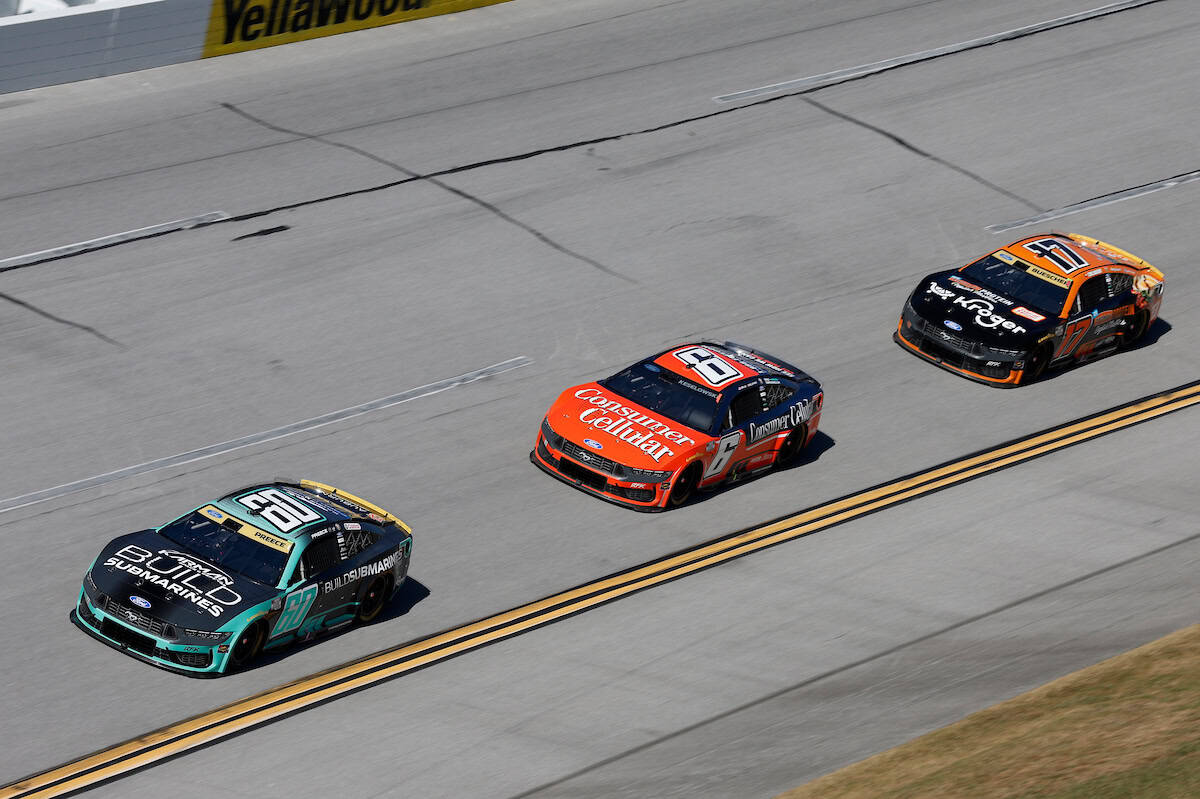
For the first time since fuel saving began at superspeedways, we got a truly definitive look at how absurd it is.
All it took was one team going against the grain.
Fuel saving in the 98-lap stage one in Sunday’s (Oct. 25) YellaWood 500 at Talladega Superspeedway was to be expected. After all, that’s what the NASCAR Cup Series teams did at Talladega in the spring before running full throttle in the final two stages.
But the fuel saving seen to start Sunday’s race wasn’t your normal, average, everyday fuel saving. It was … advanced fuel saving.
A typical lap at Talladega in a full-throttle pack takes between 48-50 seconds. Even the most blatant cases of fuel saving in the past seldom saw laps slower than 54-55 seconds. But the pace at the start of Sunday’s 500-mile affair slowed so much that the field was recording laps north of 60 seconds on lap 30.
A one-minute lap at Talladega is an average speed of 159.6 mph; Chase Briscoe’s pole speed on Saturday was 186.065 mph.

Drivers and observers alike remarked that the opening laps were as if the Richard Petty Experience decided to run a race.
Once the field reached lap 30 and their cars had saved enough fuel to make it to the conclusion of stage one on lap 98 on one pit stop, the RFK Racing cars of Brad Keselowski, Chris Buescher and Ryan Preece enacted a simple but genius plan: what if we just run full speed and leave everyone behind?
What followed next is something that I have never seen in my 17 years of following the sport. RFK flipped the switch, and while the rest of the pack picked up the pace, they were unable to respond. RFK was outrunning the fourth-place car by approximately three seconds a lap, and in just 10 laps, they had pulled a 20-second advantage over the rest of the field.
By the time pit stops began on lap 50, the RFK cars were 45 seconds ahead of fourth place and drafting off the tail end of the main pack. When the RFK cars went to pit, they received a round of applause from the main grandstands. They were so far ahead that after stopping, they blended back in with the remaining cars that had yet to hit pit road for service.
With the pit cycle complete and 42 laps left in the stage, the RFK cars found themselves with a 40-second lead. This time, the main pack realized the error of its ways and filled their cars with enough fuel to try and run them down at full speed, but it was all for naught.
The main pack at full speed was gaining about a second per lap over the RFK cars running at full speed, but the comeback came to a halt when the RFK trio picked up their speed by gaining drafting help via lapped cars. Realizing that they would run out of time to catch them, the main pack waved the white flag and started racing side-by-side in a battle for fourth-place stage points, stalling their progress out even further.
By the time the dust settled, the RFK trio had enough fuel to win stage one by 17 seconds. The team saw an opportunity, executed a plan to perfection, added life to a stale first stage and caught the rest of the field with their pants down.
To the untrained eye, there is only a subtle difference in visual speed between packs running all out and packs lifting off the throttle here and there. Having both strategies play out simultaneously showed just how stark the difference between the two truly is.
Keep in mind, the main pack upped the pace to roughly 53-second laps once the RFK trio left everyone else in the dust. Had the pack kept running 60-second laps while RFK ran away with laps between 49-50 seconds, the top three would’ve lapped the entire pack in just five laps.
Five.
It was a blessing that stage one went caution-free, because we all got to see the strategy play out to its conclusion. Had there been a caution with 20 or 30 laps left in the stage, everyone would have wondered whether or not the RFK cars would have the fuel or if the pack would’ve been able to run them down. We got all the answers we needed: RFK outfoxed the competition and embarrassed them.
It’s an embarrassment that no one will be able to replicate.
“You will never see that again,” Preece said. “You’ll see every team in this garage react and will not allow that to happen ever again.”
The strategy worked to perfection because the pace had slowed to 59-second and one-minute laps. The cars were running so slow and saving so much fuel that RFK felt it had the go-ahead to turn everyone loose.
All the extraneous circumstances played out their way too, as the trio exited pit road together, blended back in with a pack that had yet to pit and added lapped cars to their pack after pit stops — all of which helped them increase their speed, save more fuel and go the distance.
Will RFK’s strategy put an end to fuel saving in the future? No, but it will change the game. Next time, the teams won’t run so slowly that a group of cars will be able to take off and leave everyone in the dust like RFK did, or they will run just as slowly as they did to start Sunday but know that they will be able to take off and run full throttle at the same time the RFK cars did.
Fuel saving isn’t going to go away unless incentives for leading are implemented or competition cautions are placed to eliminate the need for green-flag pit stops. Until then, the teams will try and find any way they can to outsmart everyone else, and that’s exactly what RFK did in stage one.
And while the rest of the race didn’t go the team’s way, all of RFK can look fondly on that first stage, with a strategy so simple but so brilliant that it left the rest of the field wondering what hit them.


Stephen Stumpf is the NASCAR Content Director for Frontstretch and is a three-year veteran of the site. His weekly column is “Stat Sheet,” and he formerly wrote "4 Burning Questions" for three years. He also writes commentaries, contributes to podcasts, edits articles and is frequently at the track for on-site coverage.
Find Stephen on Twitter @stephen_stumpf
A name and email address are required to post a comment. The email address is not publicly visible or shared. Please keep in mind that comments are moderated according to our comment policy.
Comments are listed in order from oldest to newest. Leave a comment