
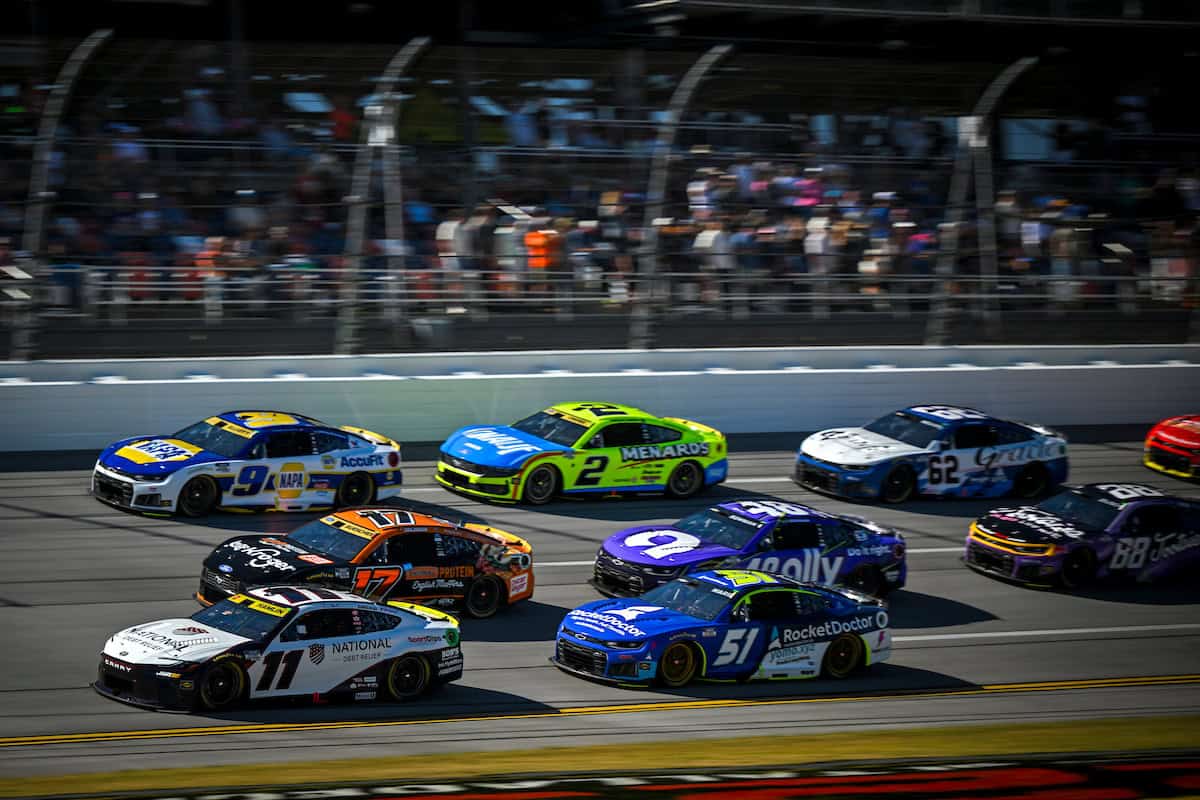
Talladega Superspeedway is always a toss-up.
You never know quite what’s going to go down. Sunday’s (Oct. 27) YellaWood 500 was quite unusual.
NASCAR switched up the stage lengths to prevent teams from intentionally running multiple seconds off the pace to save fuel. That spectacularly backfired.
Without lap times displayed on the broadcast and no live speeds for much of the opening stage, it can be hard to get a frame of reference for how fast (or slow) everyone was going. However, you got an idea that something was up when Brad Keselowski pulled to the inside and drove by the entire field on lap 14. While doing it, he was only doing about 182 mph.
From there, the pack slowed down even more. If you remember the NASCAR Goody’s Dash Series of subcompact cars, they raced at Daytona International Speedway with restrictor plates that limited their engines to something like 250 horsepower, and they could run faster in the draft than the Cup cars were for much of the opening stage. That’s not even a joke. In a single-file draft, they could average 170 mph at Daytona. The Cup cars weren’t doing that for multiple laps Sunday.
Honestly, I’m happy that RFK Racing exploited the ridiculousness and drove away from the field. They deserved that. This whole fuel-saving thing is ridiculous, as the teams wanted to skip an extra can of fuel during their pit stop. Big whoop. Usurping this was the right move, even though it likely embarrassed the sanctioning body.
Ultimately, it skewed much of the race after that point since a number of would-be contenders (Ex: Ross Chastain, Ty Gibbs, Carson Hocevar) ended up a lap down.
How did the booth handle this whole mess? It seemed like business as usual for the first 20 laps. If you didn’t know that the fuel saving was going on, you wouldn’t have thought much of the situation. However, the cars were visibly slower than normal and had a lower pitch.
Once the RFK teams drove away, it was met with wonder, as if “I can’t believe this is happening.”
Going in, less horsepower was going to make it harder to get back up to speed after you slow down, even with a decrease in drag with the smaller rear spoiler. You saw a collective struggle Sunday. That’s why it seemed like the field couldn’t adjust to the RFK teams’ move for laps at a time. By the time they adjusted, they were already 15+ seconds behind.
If you didn’t watch the race and only saw SportsCenter, that show only covered the final lap. Here, viewers got a great shot of Kyle Larson getting hung out to dry by Austin Hill exiting turn 2, then charging back to win with help from Chastain.
In the aftermath of the race, there was conjecture about whether Larson crossed the double yellow line in the tri-oval.
NASCAR seemed to decide pretty quickly that Larson was in the good, but that’s debatable. A significant chunk of USA Sports Post-Race coverage was spent looking at replays to see if he was good to go or not. I’m leaning toward no on this one.
Also of note, there was no real reference to the fact that fuel could have been an issue at the end of the race. And I’m not saying this because I lost a bunch of points in our staff fantasy league because Hill ran out of fuel on the final lap. That’s something that should have been looked at a little more closely.

The Big One late in the race was another scary moment. There are a group of people who want to blame Chastain for this crash for having the audacity to even be there in the first place. He shouldn’t be blamed though.
Given the situation, NBC held off on showing replays until after Joey Logano was out of the car after his roll, which is fully understandable.
However, the booth didn’t realize just how big some of the hits ultimately were at the time. Riley Herbst took two nasty shots. The second one was every bit as bad as the one Brad Smith took in 2015 in an ARCA Menards Series race.
I don’t think that they should have shown the view from Herbst’s in-car camera. Yes, he was out of the car by then, but that was ugly and we had seen that he was struggling to stand up after getting out of the car.
Regarding the regular racing, it was pretty normal, to be honest. Compared to recent Talladega races, it might have been less competitive since creating a third line was very difficult when drivers were going all out. The 41 lead changes were the lowest in a Cup race at Talladega in four years.
Post-race coverage was fairly substantial but was broken up. However, I knew that was going to happen before the race even started. Since this race was on NBC as opposed to USA Network, it had a hard out at 6 p.m. ET to get to local news. At that point, post-race coverage switched to the USA Sports YouTube channel.
There was a decent amount of post-race coverage, including a number of interviews. We actually heard from Herbst here after his nasty crash. However, on the surface, it looked like they no-sold the fact that Herbst was actually injured.
Here’s the thing. That wasn’t Kim Coon’s fault. Herbst didn’t want to talk about it, but he apparently suffered a wrist injury in The Big One. Honestly, he fortunately got off easy from that hit, as it could have been much worse.

Overall, this was a very weird race. The revised rules likely didn’t have the effect that NASCAR or USA Sports was expecting. They had to wing it for the first half of the race. It took a while to get used to, but they did their best.
They did a good job of keeping track of Larson on the final lap. The helicopter view really came through here, even if it wasn’t the best at times on Sunday. The booth was pretty decent for much of Sunday as well. It’s just that this race was strange and no one could have prepared for that.
That’s all for this week. Next weekend, NASCAR will have a tripleheader weekend at Martinsville Speedway, where it’s possible that a championship could be clinched. Another championship could be clinched in Mexico City for Formula 1 as well. Finally, the ARCA Menards Series West season will wrap up in Bakersfield, Calif. TV listings can be found here.
Remember that Daylight Saving Time will end this weekend. If you have clocks that have to be manually adjusted, make sure you turn those back before you go to bed Saturday night. Because of that, it will more or less be dark by the time the Cup race ends Sunday.
For next week’s edition of Couch Potato Tuesday, we’ll have a critique of Sunday’s broadcast of the Xfinity 500 from Martinsville. The Critic’s Annex in the Frontstretch Newsletter will cover Friday’s Love’s RV Stop 225 for the NASCAR Craftsman Truck Series.
If you have a gripe with me, or just want to say something about my critique, feel free to post in the comments below. Even though I can’t always respond, I do read your comments. Also, if you want to “like” me on Facebook or follow me on X, please click on the appropriate icons. If you would like to contact either of NASCAR’s media partners, click on either of the links below.
As always, if you choose to contact a network by email, do so in a courteous manner. Network representatives are far more likely to respond to emails that ask questions politely rather than emails full of rants and vitriol.


Phil Allaway has three primary roles at Frontstretch. He's the manager of the Frontstretch email newsletter that publishes Monday-Friday and occasionally on weekends. He keeps TV broadcasters honest with weekly editions of Couch Potato Tuesday and serves as the Frontstretch Sports Car racing editor.
Outside of Frontstretch, Phil is the press officer for Lebanon Valley Speedway in West Lebanon, N.Y. He covers all the action on the high-banked dirt track from regular DIRTcar Modified racing to occasional visits from touring series such as the Super DIRTcar Series.
A name and email address are required to post a comment. The email address is not publicly visible or shared. Please keep in mind that comments are moderated according to our comment policy.
Comments are listed in order from oldest to newest. Leave a comment