
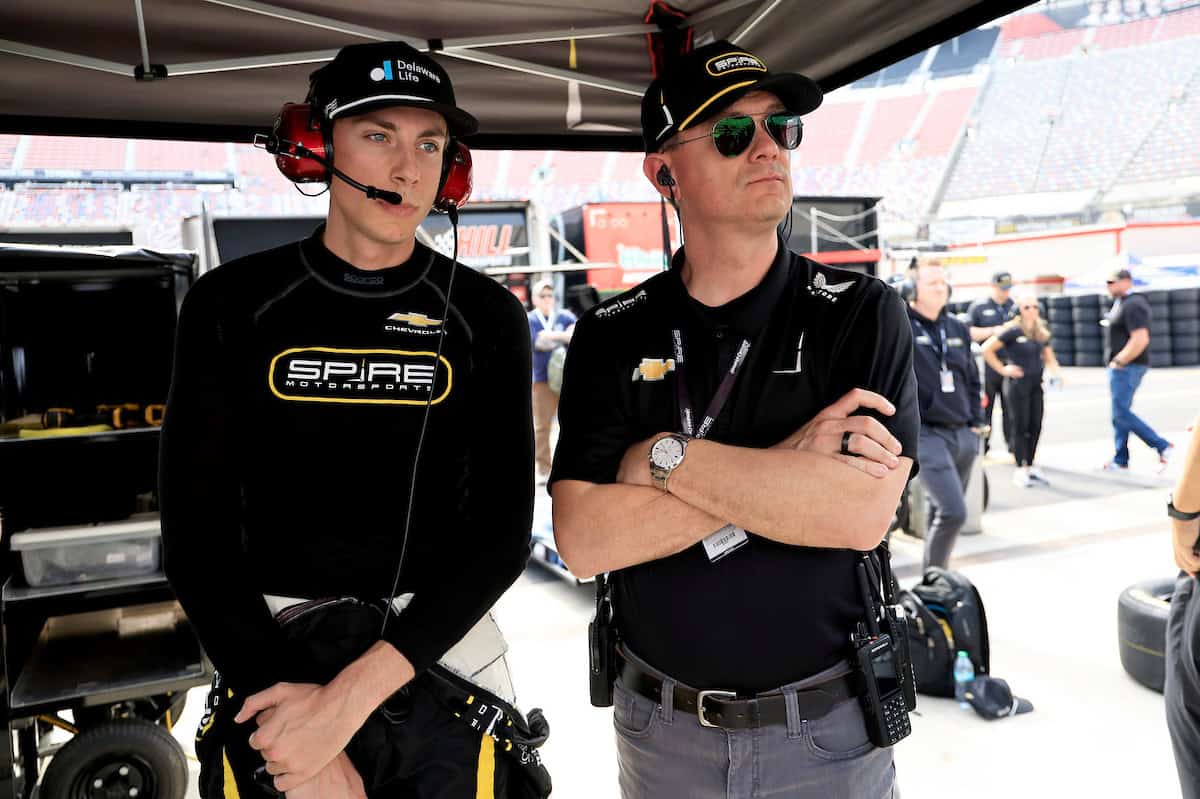
The lawsuit between Joe Gibbs Racing vs. Chris Gabehart and Spire Motorsports raged on this week, with all parties continuing to grapple with the other side.
JGR pursued litigation against its ex-competition director in February after it alleged that Gabehart misappropriated confidential information and breached his separation agreement with the team after he left in November 2025. Shortly after filing the lawsuit against Gabehart, JGR amended it to include Spire in the claims for relief, arguing that the organization wanted to shortcut its way to competitive standing in the NASCAR Cup Series by encouraging Gabehart to share the trade secrets.
While Gabehart has admitted to taking photos of JGR’s confidential data, he has maintained that he didn’t share the confidential information with Spire, and that he returned the material in his possession.
Both Gabehart and Spire have filed counterclaims, with Gabehart accusing JGR of not fully compensating him, breaching his separation agreement and employment contract and trespassing upon his personal devices and accounts. Spire claims that JGR never provided a competition-level employee or $100,000 payout in exchange for Robert “Cheddar” Smith, Spire’s car chief in 2025 who it permitted to depart for JGR.
A trial date is set for Feb. 1 in the Western District of North Carolina, with Judge Susan C. Rodriguez presiding over the case.

Catch up on all of the action below in a week where the lawsuit took on a few notable twists and turns.
Read all of Frontstretch’s content covering the JGR vs. Gabehart lawsuit here
- One of the most notable facts from this week was a filing from JGR withdrawing one of its allegations against Gabehart and Spire.
- In its second amended complaint, JGR alleged that a Spire employee told a JGR employee that Gabehart “is in charge of and/or significantly participating in Spire’s competition strategy and decisions.” Gabehart is under a temporary restraining order and preliminary injunction that bars him from serving in a similar role to his former competition director position at JGR.
- As a result, Spire requested information proving those allegations, to which JGR responded that it does not have sufficient information to support those claims.
- Ultimately, JGR agreed to remove those allegations from its complaint, and the court granted its request.
- Two weeks ago, Spire filed a motion to compel JGR to produce documents containing key information in the case, arguing that JGR was delaying its document production and still possesses several critical documents yet to be disclosed.
- JGR responded on Tuesday (July 28) with a memorandum in opposition of Spire’s motion, standing on the grounds that it has already provided a substantial amount of documents from its discovery.
- Spire argued that JGR had not matched the volume of documents compared to itself or Gabehart. Spire claimed Gabehart produced roughly 800 documents, while it produced 600. It also claimed JGR provided 800 documents, but that more should be provided seeing that JGR pursued litigation to begin with.
- JGR responded by saying that “raw page counts are not a measure of compliance.” It also claimed it has provided roughly 3,100 pages of documents.
- Spire accused JGR of withholding documents possession information about JGR’s enforcement of non-competition or non-solicitation provisions against employees, and that it has withheld information about the departure of other competition personnel.
- JGR countered by stating that its second supplemental response accounted for employees whom it enforced restrictive covenants against, as well as those it allowed to leave for other teams since January 1, 2022.
- JGR also said Spire oversteps boundaries with its request, stating, “To the extent Spire still demands that JGR catalog “each and every departure” of any employee bound by a restrictive covenant regardless of seniority or circumstances, that demand goes beyond the scope of Spire’s interrogatory, which is limited to roles “comparable to or similar to Gabehart’s.”
- In response to Spire’s claims that JGR is withholding its own trade secrets outside of those that were misappropriated, JGR said it is producing confidential information when it is relevant.
- JGR also maintained that while some of its confidential information is relevant, it does not have to produce all of its trade secrets that would “support a fishing expedition into confidential information and trade secrets that are not relevant to the claims or defenses,” the filing stated.
- JGR affirmed that, despite the requested documents occurring outside the scope of discovery, it will produce documents containing communications between Gabehart and itself regarding his employment agreement.
- Additionally, Spire requested that JGR produce metadata from a forensic review of Gabehart’s devices and accounts, as well as original source documents from the items Gabehart misappropriated.
- JGR responded by stating it doesn’t have the right to access Gabehart’s devices and accounts for forensic images, and that it is in the process of providing a “full set” if the original sources of misappropriated materials.
- Spire also sought materials detailing JGR’s confidentiality agreements with third-party sources such as Legacy Motor Club, 23XI Racing and Toyota Racing Development. However, JGR opposes the disclosure of those agreements because those are not relevant to the case, and it would need permission from those parties even if it did want to produce those documents.
- JGR maintained that it has already committed to providing documents containing information about its trade secrets’ value and the harms and damages it will suffer as a result of the misappropriation.
- Initially, Spire accused JGR of producing a “laundry list” of Gabehart’s responsibilities at the team, but not producing documents evidencing that he performed those duties. JGR said it will provide documents showing Gabehart’s services at the team as well as his role as the crew chief for Ty Gibbs and the performance of the No. 54 car.
- JGR also agreed to produce annual financial statements and forecasts since January 1, 2022.
- In the past two weeks, JGR issued opposition to both Gabehart’s and Spire’s counterclaims against it. This week, Spire filed a response to those counterclaims.
- “When talent, sponsors, and victories flow in JGR’s direction, JGR has done no wrong. But when talent, sponsors, and victories flow anywhere else, JGR sues and complains. JGR’s effort to dismiss Spire’s counterclaims is emblematic of this mindset,” the filing opened with.
- Spire contended that JGR breached a verbal contract by not providing personnel or compensation in return for Smith. It defended the credibility of the contract by stating that there was an offer, acceptance and consideration between the two parties.
- Spire also averred that after offering to release Smith from his non-compete so that JGR could hire him for its No. 54 car, JGR made a counter-offer by requesting Smith be exchanged for one of its competition-level employees or $100,000. Ultimately, the alleged exchange was agreed upon.
- JGR argued that the implied contract “lacks the essential definiteness required to form a binding contract,” and that Spire’s requests for the hiring of either Tyler Allen or Ryan Towles were “new negotiations.”
- Spire decried this dispute, stating that the mutual agreement allowed it to pursue a competition-level employee.
- “Spire alleges that JGR’s performance was reasonably expected by the end of the 2025 season and that, well into the 2026 season, JGR has rejected every requested trade and never paid the alternative amount due,” one of the accusations read.
- Gabehart’s attorneys also filed a response to JGR’s opposition to his counterclaim, which accused JGR of not fully compensating him, breaching his employment agreement, and trespassed on his personal devices and accounts after an forensic examination.
- Gabehart’s attorneys maintained that JGR failed to pay him earned wages, manufactured a for cause termination and selectively enforced restrictive covenants.
- The former competition director argued that he was subject to be paid wages until his termination on Feb. 9, 2026. JGR responded by saying that it held the right to pay Gabehart until he ceased providing services for the organization, which was Nov. 10, 2025.
- Gabehart’s counsel countered by stating, “JGR placed him on “garden leave,” told him not to return, and instructed him to tell anyone who asked that he was “on vacation.”

- The counsel also said that the agreement entitled Gabehart to compensation until he was terminated for cause. According to JGR’s internal records brought up by Gabehart’s team, Gabehart remained employed by the team on Nov. 24, 2025.
- JGR contested that Gabehart was also not owed bonus pay because he didn’t give a date for when the bonus was due. However, according to Gabehart’s attorneys, the agreement ensured that an employee receive bonus pay “within 45 days after JGR’s receipt of applicable prize money.”
- Gabehart’s team also defended its position that he invoked a term of his agreement by providing notice that his job was not as advertised. In turn, this should have reduced his non-compete from 18 months to one week. JGR said that it was not satisfied due to “a disputed negotiation,” which Gabehart argued was a result of JGR demanding more material items than what was required.
- Initially, Gabehart accused JGR of allowing other employees similar to or with his seniority to his role to leave the team without enforcing non-compete and non-solicitation terms with them. JGR said Gabehart’s argument failed in regard to not being able to identify a specific person.
- However, Gabehart’s team pointed out Michael Guttilla, JGR’s former chief operating officer who left for Legacy Motor Club in April. Gabehart argued that Guttilla, who held seniority over Gabehart’s role, never faced litigation or injunctive relief from JGR.
- Lastly, in response to JGR’s claims that it cannot trespass upon Gabehart’s accounts on a device it owns, Gabehart’s attorneys said precedent shows that employers “cannot claim unfettered access to an employee’s personal email account that the employee used on a company computer, especially when the emails at issue are confidential communications with the employee’s attorney,” the filing read.
- Gabehart’s team also argued that the forensic examiner never had the right to disclose communications to JGR. They also stated that JGR’s counsel never received authorization to receive or access the communications found by the examiner.


Luken Glover joined the Frontstretch team in 2020 as a news writer before elevating to a columnist, where he served as the longtime writer for The Underdog House. Currently, he is an editor for the site and conducts feature interviews. Glover has covered several forms of racing for the site including NASCAR, CARS Tour, and SRX events.
A 2023 graduate of the University of the Cumberlands, Glover is a promotional writer, elementary athletic director, and basketball coach. He is passionate about serving in his church, playing/coaching a wide variety of sports, and researching motorsports history.