
With the Hungarian Grand Prix set as the final race before the Formula 1 summer break, the series will be going into recess with a number of trends defined and some questions worth examining. Other than the fact that Lance Stroll is killing it in the inverted drivers standings where DNFs are like wins – he’s got six in 10 races, with a non-start at Australia – an amazing season by any standard, there are only a few givens.
Let’s begin with the easy one: Kimi Antonelli is walking away with the title right now. Heading into the season intermission, Antonelli is already holding six winner’s trophies. He has not been utterly dominant, but when he gets out front, he has been tough to beat. With the ahead-of-the-curve 2026 Mercedes as his ride, he has what he needs to take the championship – as long as reliability does not compromise his efforts.
Lewis Hamilton is Antonelli’s closest challenger, and he’s 45 points behind and has visited the podium only five times, though he did finally grab his first Ferrari win at Barcelona. The difficulty in seeing Hamilton as any kind of legitimate threat to Antonelli is that it is unclear if Hamilton is even the best driver for the Prancing Horse.
Charles Leclerc has also snagged a win for Ferrari and visited the podium four other times. His strength has shown in qualifying. But his races have frequently turned into Ferrari masterclasses in race mismanagement. If Ferrari are seeking to make another billion from merchandise sales, they might need to designate Hamilton as the lead driver and throw everything it can toward putting up a fight for the drivers title. Ferrari being Ferrari, it will, of course, do nothing of that sort. Expect them to encourage their drivers to race each other hard and go out in double DNFs in half of the races after the break.
Those kinds of results would still be better than anything that Aston Martin and Cadillac have been doing. Cadillac is so bored with running in the back that they are wasting FP1s in practice by throwing underprepared and ill-suited Colton Herta out into one of their rides. Sorry, Valtteri Bottas.
To give an idea of how challenged Herta is, one has to look at other teams subbing drivers out for a practice session, a rule that each team must comply with a few times during the season. The way to gauge any kind of promise is to see how close the sub is to the teammate, in this case, Sergio Perez. Perez isn’t driving a front-of-the-grid car and no longer has top-end skills, but he’s reliable and can provide solid feedback as Cadillac gets their program running.
Herta, in what may seem like an insignificant stat, managed to come in 1.1 seconds behind Perez in FP1 at Hungary. Well, you say, that’s not too bad. Herta is new to F1 and has a lot to learn and yadda yadda yadda.
But so are the other drivers taking over the F1 rides, and none of them had a gap over a second. Most kept the gap under 0.7 seconds. No worries, he will go out and use the knowledge gained to be competitive in F2, which is racing at the same track this weekend.
Bwahaha. In practice for the F2 race, he held the 19th fastest time, which was before he enjoyed his stint in the Caddy. And he improved to a staggering 18th in qualifying. He may be a talent in IndyCar, but he is 26 (old for an F1 recruit), did not come up through the European karting series, and still has no superlicense. He’s perfect for the American racing team. Sigh.
But the whole back half of the grid seems to be a combination of reckless futility, grasping at mismanaged ideas, and hopeful notions coming from spaghetti-splattered walls. The first time one of these teams puts together a process and program that is coherent and executed properly will be the first. Stab me with a fork if it is Flavio Briatore.
Perhaps the biggest surprise has been how reliably mid the Racing Bulls have been – and that’s a compliment. They’ve been legitimately decent. They are constantly hovering in spots six through ten, which means that anytime McLaren goes mental (a regular occurrence) they pick up the slack behind the big 2.5. It would be the big three, but Mercedes and Red Bull take turns each race having one of their drivers turn into a turnip and become fodder for someone else’s salad.
Somehow, McLaren, which is attempting to play the strategy of an ideological Rubik’s cube, spinning the colors around and solving sides without ever finishing the puzzle, sits third in the championship even though both drivers seem disinterested, apathetic, or mentally undone by Zak Brown’s yapping. How they have amassed enough points to sit 44 ahead of Red Bull is stunning. When they’re decent, they are really decent.
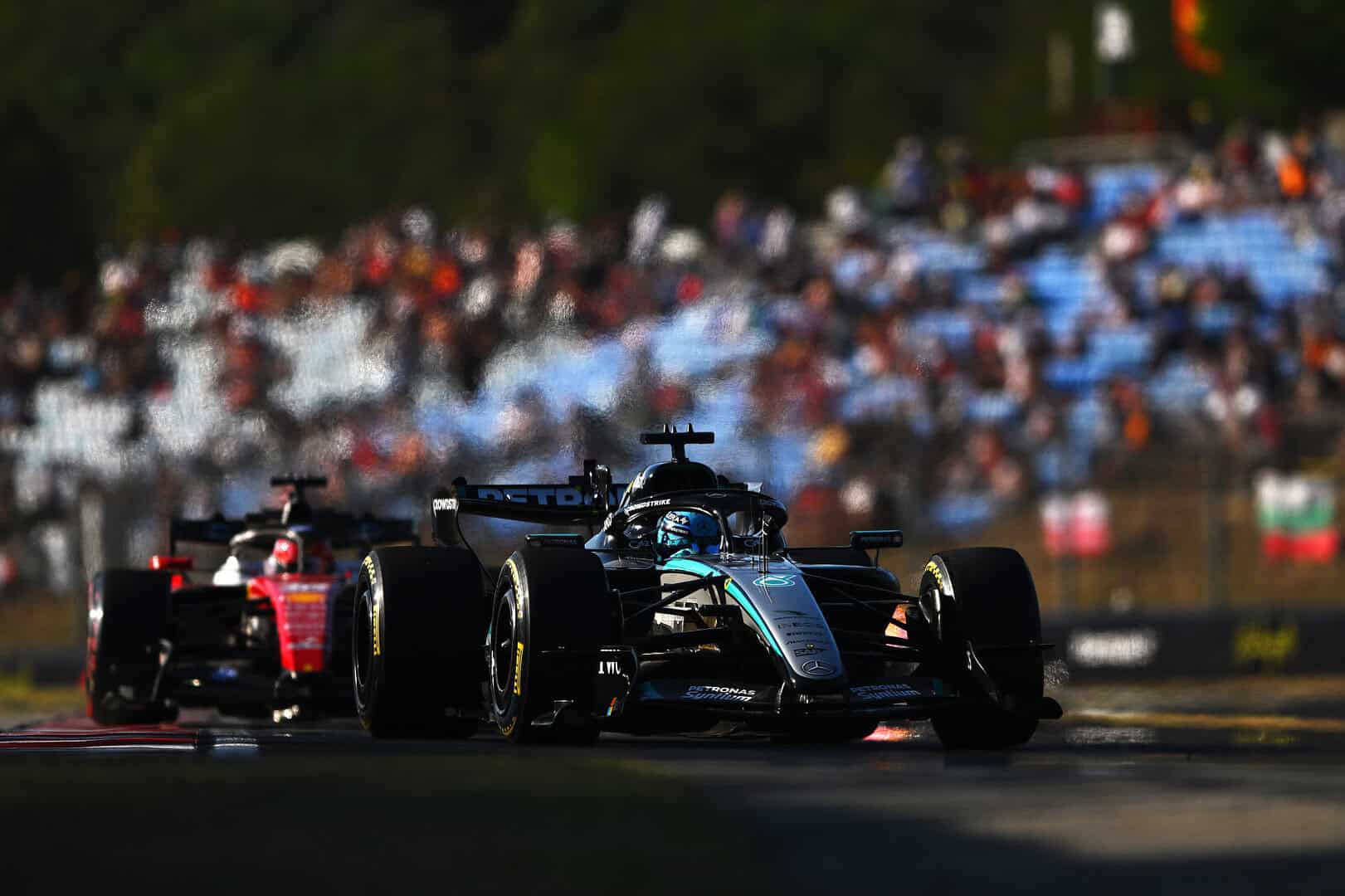
The best question to ask is whether George Russell will be lost to a mental institution or wind up herding sheep in Wales after this season because things have not gone well for the driver who started the season as the title favorite. He’s watching his teammate cruise as everything he does seems like a Sisyphean undoing. Stiff upper lip, ol chap. At least Fernando Alonso had the Spanish soccer team to pull him through his stints in the Aston Martin deathmobile.
The Hungarian GP should stand as another exercise in learning both nothing new and being surprised by expectations. At this point, there’s a good chance that the Danube floods onto the track compounded by a large boulder rolling in from the Alps. Roland Emmerich could only hope to see such cinematic wonders come to life.


As a writer and editor, Ava anchors the Formula 1 coverage for the site, while working through many of its biggest columns. Ava earned a Masters in Sports Studies at UGA and a PhD in American Studies from UH-Mānoa. Her dissertation Chased Women, NASCAR Dads, and Southern Inhospitality: How NASCAR Exports The South is in the process of becoming a book.