

“Because you never know when the last one will be.”
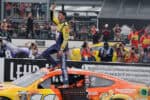
Kyle Busch’s words in victory lane last month at Dover Motor Speedway after winning the NASCAR Craftsman Truck Series race hit differently in the wake of Busch’s death just days later.
That was, of course, Busch’s final race win, and it’s one that fans will remember for a long time.
Because of their unknown nature, last times are hard to identify in the present. It’s not until later — days, weeks, years — that we know for sure that that’s a thing that will never happen again. Lasts aren’t really savored in the moment, but rather later when we understand their significance.

Sometimes we suspect it. Fans stayed in the stands long after the checkers flew and darkness fell over Martinsville Speedway on the autumn afternoon when Jeff Gordon won his 93rd and final race. Gordon was in his planned final season in 2015 (though he’d sub for an injured Dale Earnhardt Jr. in a handful of races the following year), and he hadn’t won all year. He was consistent enough to make the playoffs and get to the third round. The win cemented a Championship 4 appearance in the final race of the year.
So with three races left, Gordon could have won again. There was still a possibility. But many of the fans at Martinsville felt intuitively that they were witnessing the last time Gordon would stand in victory lane in his storied career. They took in the moment, just in case.
But Gordon’s exit was a planned one. He’s still at the track on a weekly basis in his role at Hendrick Motorsports. His final win is the exception, not the rule.
Last wins fall into a few categories. There are some like Gordon’s, a last hurrah in a farewell season. And there are some like Busch’s, that came because the driver didn’t get the chance to walk away. That kind is mercifully uncommon these days, as the cars are so much safer that we haven’t lost a driver in a crash in two decades and Busch’s sudden illness was a tragic but uncommon occurrence.
For most drivers, the last win comes without fanfare. For some, the victories get harder to come by, but they’re still happening … until they aren’t. Richard Petty’s last win in July of 1984 was his second of the year. He had won three the previous year. But he’d race eight more years after that chasing just one more.
Jimmie Johnson’s last win came the same way in 2017. He’d never had a winless season, and the defending NASCAR Cup Series champion reeled off three of them in the first half of that season. The last one came fittingly at Dover, the track where he won more races than any other driver. There was no reason at the time to think there would not be another.
Roughly 6% of drivers who have raced at the Cup Series level have won a race at all. They never had a first, let alone a last. For more than 60 of the 208 drivers who have won, the first was the last.
First wins, of course, have a whole different feeling to them. It’s not that they’re especially significant in the historical sense, at least not until you think about the fact that in nearly 80 seasons, just 208 drivers have ever broken through. But first wins are generally a feel-good story. Whether a driver goes on to win one race or a hundred, they have to start somewhere.
Fans usually embrace a first-time winner even if he’s not their favorite because it is a special moment. First wins hold promise. Anything could happen in the intervening years, but that first checkered flag leads to dreams of more. At that moment, the driver is at the top of the mountain, looking ahead at what’s to come. Sometimes, he’s a veteran who has worked toward it for years, quietly, without the fanfare of a young phenom. But as he crosses the finish line, he can imagine doing it again. Maybe winning a title, maybe sticking around in the sport a while.
First wins are about potential realized and potential for more. From a historical standpoint, they’re the start of something. After that, each subsequent win stamps the driver’s place in racing lore. Whatever that number is, it’s the number the driver will be most remembered by, and most judged by. As a statistic, race wins are the most comparable number across eras, because while points systems and racecars change over time, a win stands alone on the day it happened. Wins still aren’t a perfect measure because changes in the points system and schedule and officiating have affected entries, but they’re the purest stat across time.
And the first one only happens once. People remember their favorite driver’s first win. They can probably name the first winner in a particular race, especially if it’s a big one. Depending on the driver, they might not remember every detail of every victory — but they remember that one. They might not know who won the sixth Southern 500, but they know who won the first one.
The last win isn’t like that. Because it’s a win, it still holds promise. Until the driver hangs up his helmet for the last time, there’s always the chance for one more. The weight of the finality hits later, with a certain melancholy to it. The knowledge that you witnessed a first win is instant. The knowledge that you witnessed a last one is heavy, especially if it comes after a long successful career.
Whether the first win and the last one span a small number, even just one, or a long, legendary career, they carry special meaning. For one, it’s promise and potential. For the other, it’s a chapter well written and a chance to savor them all.


Amy is an 20-year veteran NASCAR writer and a six-time National Motorsports Press Association (NMPA) writing award winner, including first place awards for both columns and race coverage. As well as serving as Photo Editor, Amy writes The Big 6 (Mondays) after every NASCAR Cup Series race. She can also be found working on her bi-weekly columns Holding A Pretty Wheel (Tuesdays) and Only Yesterday (Wednesdays). A New Hampshire native whose heart is in North Carolina, Amy’s work credits have extended everywhere from driver Kenny Wallace’s website to Athlon Sports. She can also be heard weekly as a panelist on the Hard Left Turn podcast that can be found on AccessWDUN.com's Around the Track page.
Beautifully written story