
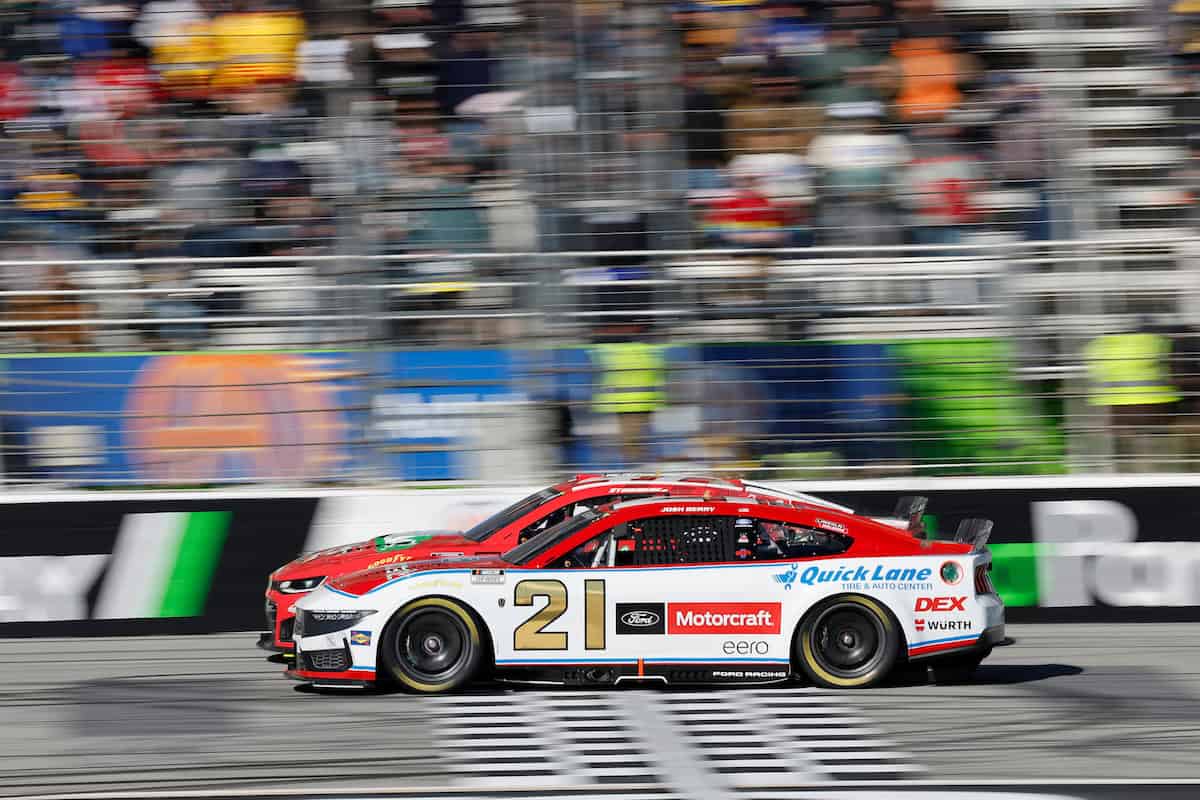
Can anyone get the Wood Brothers No. 21 back to its winning ways?
Across NASCAR history, few cars hold the same nostalgia as the Wood Brothers No. 21. It’s synonymous with the sport for those who have watched it long enough. While many drivers and sponsorship partners come and go from teams with different schemes, the timeless two-tone red-and-white No. 21 machine has stuck with what works for the majority of its life in the NASCAR Cup Series.
The only thing that hasn’t worked for it is its last few drivers.
Ever since Ryan Blaney left for Team Penske nearly a decade ago, it’s been tough to fill the Wood Bros. seat with someone who can at least keep the car in the top half of the field. First, there was Paul Menard, who finished 19th in back-to-back seasons in 2018 and 2019 after Blaney put the car ninth in the 2017 standings.
Then came Matt DiBenedetto, who started off strong in 2020 with a 13th-place finish but backslid to 18th the following year. After that, 2021-23, when Harrison Burton was, in hindsight, elevated to Cup too soon. The No. 21 finished 29th and 31st during Burton’s first two seasons before his miracle win at the Coke Zero Sugar 400 in 2024 gave him a playoff berth. Burton was the first driver eliminated and finished 16th in points.
Similarly to DiBenedetto, Josh Berry started off strong in his first year in the car. By this time last year, Berry had one win, a top-five finish and another top 10 to his credit. Now, though? Just two top 10s, and even those only just, and a slew of races where he hovered around the 30th spot.
All of these names entered their careers at Wood Bros. amid a lot of hype, for different reasons. It’s not out of the realm of possibility for fans to believe that some Etsy witch somewhere has cursed the team or the car, but that isn’t the case. In reality, all No. 21 needs to do is find a driver with the right amount of the same vintage swagger the team has draped all over it to hop into the seat.
The first step to going fast is to get a driver who seems to enjoy going fast, after all. I could see Noah Gragson going to Richard Childress Racing amid this Silly Season drama, but with the No. 21 opened up, I could also see him getting in that seat. Gragson’s talent spoke for itself, and if he can lock in a deal at WBR for multiple years, it could offer the exact kind of stability he needs to let that talent finally show through.
Do the Prime viewership numbers warrant a full season come the next media rights deal?
Despite the endless barrage of complaints I hear about how nobody will pay extra money for a streaming service most people already have access to, Prime Video evidently sure knows how to put on a race.
According to Adam Stern of the Sports Business Journal, Prime drew close to 2.1 million viewers for last weekend’s FireKeeper 400 at Michigan International Speedway.
Breaking the 2 million mark is significant, as is a 17% year-over-year rise. You could point to a wide array of reasons for the increase, from certain YouTubers in attendance to the product at Michigan simply being wicked fast, but in reality, Prime is simply handling its business and doing what they can to grow the sport.
For instance, how many specials have we seen FOX or NBC put on their own streaming platforms with the biggest drivers in the sport? Additionally, Prime doesn’t have the option to force NASCAR on FOX Sports 1 or USA, where the numbers will never be as good. It’s just on Prime.
Yet the biggest gripe I hear is that NASCAR still hops from channel to channel throughout the season and still needs one consistent home. The problem? Most of the people who make the same complaint only want the sport aired on one of two channels that have already said they have no interest in handling the full schedule.
If Prime is willing to take the full season ahead of the next media rights deal, NASCAR should jump at the chance. A consistent home has proven beneficial for the NASCAR O’Reilly Auto Parts Series. The same is true of the NASCAR Cup Series, and I have zero doubt a year-long commitment wouldn’t still turn a profit. Get NASCAR off a network that its own companies barely care about and give it to a group that wants to place it centerstage: Prime.
Are Carson Hocevar and Denny Hamlin the two most influential drivers in the sport?
You might be looking at this question sideways, but if you were to ask Time Magazine, it’d tell you that both Denny Hamlin and Carson Hocevar are the two most influential figures in NASCAR, according to the latest Time’s The 100 Most Influential People in Sport.
It’s an interesting question, really, because how do you define influence? For instance, Hamlin is listed alongside Michael Jordan, largely due to their joint legal venture against NASCAR last year, which fundamentally changed the sport’s revenue-sharing model.
Hocevar, though, is listed for his presumed future as the face of a whole new generation of fans coming into the sport, as well as his virality following his win at Talladega Superspeedway.
That said, within the NASCAR bubble, you could spin that Hamlin is the sport’s most influential driver, but not Hocevar just yet, and you couldn’t even begin to think that either has a larger fan base than some of their competitors. But then again, a large fan base doesn’t automatically equal influence, does it?
Speaking from a cultural standpoint, Time got it right. These two figures (and Jordan) hold more of the keys to the sport’s future than many within it care to admit. Between what Hamlin and Jordan can do from a team perspective, along with what Hocevar and the other drivers of his age can bring to the table from a social capital standpoint, there aren’t two more influential people in NASCAR right now.
Who else could join them?
While it is a list of the 100 most influential people in all of sports, I must say I was surprised not to see a few other NASCAR drivers make it, especially the likes of Chase Elliott or Kyle Larson, both of whom deserve their share of the spotlight for different reasons.
Elliott is a shoo-in for Most Popular Driver just about every season. Meanwhile, Larson is not only making an impact on the racing community by driving on Sundays but his ventures into Sprint Car racing across America are also building a grassroots racing fandom in the 21st century, a feat many thought was impossible.
Then there’s the current media darling of NASCAR, Ryan Blaney, who is in more shows right now than some A-list Hollywood actors. Where does he fit into the equation? It’s obvious NASCAR wants to put him in front of as many people as possible, but again, that doesn’t equal influence, does it?
Of all these names, I see Larson and Blaney doing the most in the future to join Hamlin and Hocevar. Once Elliott retires from NASCAR, we may never hear from him again, and that is both completely fine and his prerogative. If Blaney keeps working on his acting chops, movies might be in his future, similarly to some other incredibly popular drivers of the past.
For Larson, his impact on racing in general is going to be felt long after he retires, and, in fact, it wouldn’t shock me if his greatest contributions to motorsport as a whole are yet to come. All three of these figures deserve to be mentioned in the same breath as Hamlin and Hocevar, but in terms of their global impact within sport as a whole, we still don’t have their full stories.


Tanner Marlar is a staff writer for Sports Illustrated’s OnSI Network, a contributor for multiple automotive news outlets, an award-winning sports columnist and talk show host, and a PhD. student at a premier college of media and mass communication. Tanner began working with Frontstretch in 2022, covering the O'Reilly Auto Parts Series.
Almost 65 years old here, attended my 1st GN race at age 7 i 1968, & I’d love to have Prime cover the entire season. NBC has always had lousy coverage, both times they’ve coverec NASCAR, & adding Leigh Diffey to yell at the top of his lungs every lap of every race has made their coverage even worse. FOX is little better.