
Track limits? Penalties for just giving a guy a love tap?
What is this, Europe?
It has been an interesting week of conversation and debate following NASCAR’s recent announcements.
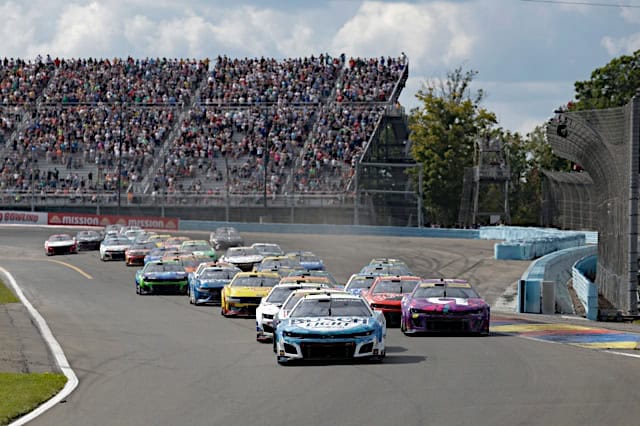
On May 5, NASCAR revealed that Watkins Glen International will add additional tire barriers closer to the racing surfaces of turns 1 and the carousel.
The same day, NASCAR released its weekly penalty report that revealed Ryan Preece was fined $50,000 and docked 25 points in points for his on-track contact with Ty Gibbs at Texas Motor Speedway.

And I have to say, both of these actions seem very … open wheel.
Track limits aren’t a new thing when it comes to NASCAR. At Circuit of the Americas in recent years, the esses section of the track has been the bane of NASCAR officials’ and drivers’ existence alike. For a multitude of races, drivers and fans complained about unfair track limits being imposed on the Formula 1-purpose-built circuit in NASCAR races.
The problem was the line for infraction was simply too gray for stock cars and frustrating for a sport that has never had use for them. Some drivers were penalized for going over the penalty line while others weren’t. As racecar drivers do, they were forced to try to put their cars as close to the line of infraction as possible lap after lap. However, that’s a lot easier said than done when you’re side-by-side with other drivers who don’t have the ability to see their own quarter panels — a problem open wheel racers don’t have.
How was this fixed? By putting stationary tire packs at the border of the racing surface. They helped with line-infraction penalties, sure, but traded them for the risk of drivers slamming into big obstacles at speed.
Now, it’s been brought to Watkins Glen, a track that has never had an issue with track limits for NASCAR races in its over 70 years of racing history.
Why? Well, according to NASCAR’s communications team on its recent Hauler Talk podcast, it’s for reducing the risk of the high-impact crashes we’ve seen at the road course in the past.
I will never condemn NASCAR for trying to make the sport safer, and I do applaud the attempt. However, I find the idea that putting big stationary obelisks in the middle of a high-traffic, high-braking corner that sees cars fan out three- to four-wide on restarts won’t cause more dangerous crashes to be a little far-fetched.
It’s not all bad. For the carousel exit, at least, a connected tire pack is being added, so instead of relying on drivers to avoid venturing too far into the runoff, the track runoff has been eliminated entirely. For that part of the track, I approve the change.
NASCAR racing as a whole has been more fun to watch when cars can fan out wide into turn 1. It also gives drivers more options for which lanes to take in that corner rather than just follow the same line each time. That made stock-car racing stand out from your typical open-wheel circuit racing. Yes, crashes do happen sometimes as a result, but then again, they will surely still happen this weekend, too. In the past, some of that crashing might have even been on purpose, but with Preece’s penalty, maybe not anymore.

In the motorsport world, NASCAR also stood out in its laissez-faire approach to on-track contact and rivalries. It has always famously been a self-policing sport. If one driver rubbed you the wrong way one week, it was your responsibility to return the favor the next. It’s not a policy open-wheel racing series can afford to have considering the fragility of their cars and the danger at the speeds they operate at.
But that’s gone, too. Preece’s actions at Texas were the result of his feeling disrespected by Gibbs. In fact, Preece told Frontstretch his wreck wasn’t even intentional.
However, since NASCAR has stepped in, there likely will never be any retaliation from Gibbs. In fact, there may not be any retaliation from anybody. Keep in mind, Preece didn’t hook Gibbs’ Toyota at Texas. From the looks of it, it was a nudge from behind that moved the Joe Gibbs Racing car.
With that, NASCAR set the precedent that even making contact with someone may warrant a penalty, or at least a look into it. Mike Forde, NASCAR managing director of communications, explained on Hauler Talk that it was because Preece said he was going to wreck Gibbs beforehand.
In 2011, seven-time champion Jimmie Johnson demanded his team fix his car after a crash involving Kurt Busch despite his crew chief, Chad Knaus, telling him there was no point. The reason? So Johnson could return to the track and get his revenge on the Team Penske driver, to which he and his team admitted to on the radio.
No fine was given to Johnson as a result.
It’s a slippery slope that NASCAR has placed itself on. Where does the line truly become crossed? How far are we from the point that every piece of racing contact will be under investigation? Are these tire stands the answer to any track where NASCAR wants to enforce limits?
Realistically, it’ll likely never truly be on par with the likes of F1. However, we are at least closer than we have ever been, and that’s a big detraction from what makes NASCAR stand out from everything else.


Dalton Hopkins began writing for Frontstretch in April 2021. Currently, he is the lead writer for the weekly Thinkin' Out Loud column, co-host of the Frontstretch Happy Hour podcast, and one of our lead reporters. Beforehand, he wrote for IMSA shortly after graduating from Embry-Riddle Aeronautical University in 2019. Simultaneously, he also serves as a Captain in the US Army.
Follow Dalton on Twitter @PitLaneCPT
Completely understand why some are upset NASCAR is no longer allowing “boys have at it”, but I think something needed to be done.
Back in the day, allowing drivers to self-police somewhat worked, as most teams didn’t have the resources to put a nearly equal car on the track if a primary was destroyed. Famously, Cale Yarborough wrecked in Daytona qualifying, and the team had to grab a show car on display at a local Hardee’s. (Amazingly, they won the race.)
We’ve seen a slow but steady increase in aggression over the decades. Part of this is likely due to stage racing packing fields close together. Part of this was “win and your in” (which thankfully is now gone). And again, the largest factor is teams have many spares, just in need of some minor adjustments and a sponsor wrap. It has reached a point where many if not most NASCAR races have drivers intentionally moving or wrecking one another. This rarely happened in NASCAR’s glory years, other than Bristol and Martinsville. With the exception of an extended feud with Geoff Bodine, even Dale Earnhardt Sr. rarely punted anyone, other than on short tracks.
There’s a reason we remember the Yarborough/Allison fight. There’s a reason we remember the Keselowski/Edwards feud. There’s a reason we remember Kurt Busch/Jimmy Spencer. It’s because these events were remarkable and unusual. Now? It’s just another week of rock ’em sock ’em race cars.
I don’t like F1 and IMSA’s somewhat arbitrary time penalties for on track contact, that was often just a result of hard racing. But I don’t really have a problem when an organization penalizes a driver for deliberately wrecking another. My problem with how NASCAR does it is that it’s very inconsistent…Preece gets fined and Busch walks away free for very similar incidents. The writer makes it sound like NASCAR’s never used to penalize drivers, but I remember over 20 years ago Harvick being held out of a Cup race in 2002 for wrecking Coy Gibbs in a truck race (of course this was surrounded by special circumstances, it was a Gibbs).
I’m also not a big fan of arbitrary track limits. If there’s blacktop there, a driver should be able to use it. The Glen isn’t the first time NASCAR’s had track limits. They tried it (very unsuccessfully) at the Indy road course, and of course they’ve had the “yellow line” limit at Daytona and Talladega for years. I don’t agree with the changes to Watkins Glen’s Turn 1, but I’m not against what they’re doing at the exit of the Carousel. I’ve been going to The Glen since 1969 and have been involved in racing since 1980. NASCAR is the only race group that has ever allowed cars to run past the curbing at the exit of the Carousel entering the short course.
As I said above, I believe if there’s pavement there a driver should be allowed to use it. If a track or organization don’t want it used then they should either put up oversize curbing, guardrails or tear it out and put a gravel trap in. Then any driver who ventures beyond the track has to pay an immediate price, instead of paying an arbitrary penalty many maps later, that was decided by some anonymous official in a booth.
Bad memories of that Harvick deal, though he too needed to be toned down back then. I was a Harvick fan, and attended the Martinsville race he was parked for. Brutal not seeing my favorite driver, especially at a track he was generally competitive on, even in his RCR days. Kenny Wallace filled in, and was slow all day.
The tough part with Busch this week is common sense says he dumped Nemechek. But the SMT data was inconclusive, as it showed Busch was turning left at the time of him wiping out Nemechek. Busch was just smart enough not to admit intent. Knowing his history, and what the video showed, it’s near certain Busch waited then intentionally gassed up enough to slide up into Nemechek, but it’s not 100% certain.
Busch driving a damaged car and not admitting intent (unlike Preece) makes me think NASCAR did the right thing. They’ve been known to make decisions based on “maybe” in the past, and I never cared for it. Stick to what we know. That said, I can totally see why many disagree. It’s a grey area, and I wouldn’t have felt strongly about it if NASCAR had opted to penalize him based upon his history.
If you’re going to The Glen Sunday, have fun, and it looks like NASCAR got somewhat lucky with the weather. Hopefully when it moves to September next year, it’ll be early in the month, with warm weather hanging on.