
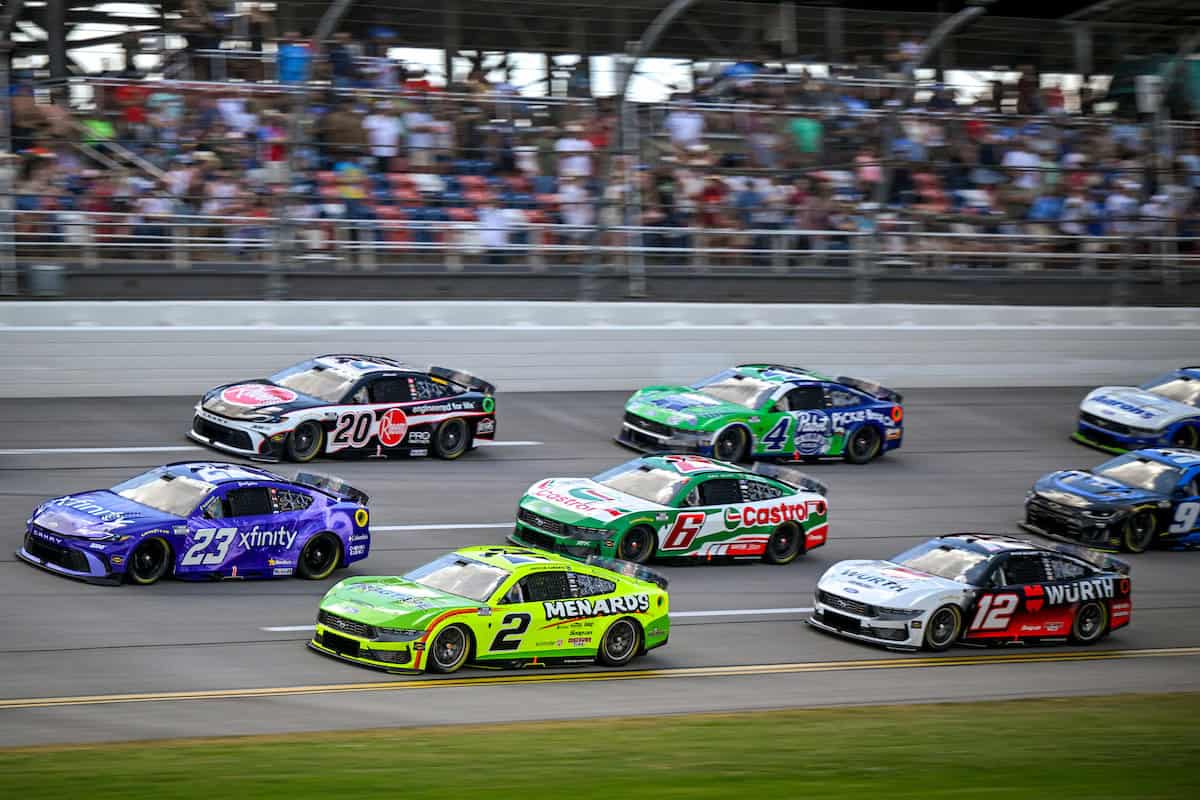
With each succeeding superspeedway race that passes in the Next Gen era, fans grow ever more tired at the mix of fuel saving and gridlock that takes shape in the pack. During Sunday’s (April 26) Jack Link’s 500 at Talladega Superspeedway, FOX Sports showcased Kyle Larson‘s telemetry, where Larson was getting close to running half throttle on lap 3.
The NASCAR O’Reilly Auto Parts Series has also had some warts when it comes to pack racing over the years, namely turning into the Richard Childress Racing invitational as Austin Hill and Jesse Love school the field. But Saturday’s (April 25) NOAPS race that featured a first-time winner in Corey Day and Sunday’s Cup race that also showcased the same in Carson Hocevar had two vastly different avenues of getting there.
O’Reilly illustrated the chaos of drafting-style racing while Cup became more of a procession until the tri-oval on the final lap. Has it gotten to the point where O’Reilly’s superspeedway product is ostensibly better than Cup’s? Thomas Dunn and Christopher Hansen break that down on this week’s 2-Headed Monster.

The O’Reilly Series Has the Superior Superspeedway Package
Ask any fan on the street to describe a NASCAR race at a superspeedway. Words like chaos, treacherous and unpredictable come to mind.
Ever since Talladega first hosted NASCAR in 1969, the 2.66-mile track has played host to wild crashes and unforgettable moments throughout its history.
With the launch of the Gen-7 car at the beginning of 2022, you still had to expect the unexpected when NASCAR competed at Daytona International Speedway and Talladega with a tight pack of cars turning laps in excess of 180-plus miles per hour in the draft. One bad block on track can result in the Big One, a massive crash that, at times, has collected more than 20 cars in Talladega races.
The one variable in superspeedway racing that has changed with the Gen-7 car? Fuel saving.
Cup teams have placed a greater emphasis on fuel mileage during superspeedway races in recent seasons. What’s the reasoning for this trend? To save extra seconds for their driver on pit road, giving them track position in the closing laps.
In order to ensure fuel isn’t an issue, drivers will run approximately 50% on the throttle in an effort to save as much fuel as they can. This practice often leads to four-wide racing except the entire field is in fuel conservation mode.
This is NOT the superspeedway racing that I became accustomed to watching when I first got into NASCAR racing. In my early years of watching NASCAR, superspeedway racing always produced the most stressful moments. Drivers would race inches apart for 500 miles in a big pack, going as hard as they could, lap after lap.
Most fans feel the same way in which the stars of NASCAR shouldn’t be worried about whether or not they’ll have to save a few seconds on a pit stop. Just that alone leaves the NASCAR O’Reilly Auto Parts Series superior in terms of providing fans the best superspeedway racing.
The second-tier NASCAR series cars suit the high-speed chess match of drafting tracks, as drivers are able to manufacture massive runs inside the tightly-formed packs throughout the race.
Multiple times between the NOAPS Saturday and Cup race Sunday, several occurrences of four-wide racing broke out throughout the field with drivers jockeying for track position.
To the casual fan, they watched this same practice unfold between the two races. However, the one glaring difference is that the Cup cars spent the entirety of the 98-lap first stage saving fuel without necessarily going 100%.
In the O’Reilly Series race, fuel-saving strategies were hard to come by as the field continuously wrestled for a better position within the pack, setting themselves up for a good finish as the laps wound down. Traditional, white-knuckle superspeedway racing without fuel mileage strategy is more common in the NOAPS than in the Cup Series.
Aside from EchoPark Speedway in Atlanta, you don’t see the Cup cars skating all over the track as tires start to wear out. As soon as the pack begins running four-wide, it becomes next to impossible for anyone to break out of line and attempt to make a move in the closing laps.
That’s not the case with the O’Reilly Series cars, where drivers can take massive runs courtesy of the draft and make split-second moves that come at the risk of being the catalyst for a multi-car pileup.
With the current body of the O’Reilly car, the drivers are more in control when racing in a big pack where they have the capability to make massive runs on one another, while not having to worry about any sort of strategy except for going 100% each lap.
Until something is done to take fuel saving out of the equation for the Cup Series, the O’Reilly Series will be the superior superspeedway product for the foreseeable future. – Christopher Hansen

We’re Not Exactly Picking From Treasure
Don’t get me wrong, the Cup Series product on superspeedways absolutely stinks outside of EchoPark Speedway.
From fuel saving to gridlock and what eventually becomes all or nothing propositions, there’s no room to accomplish anything over the course of these long races. Fans feel hoodwinked, TV has to scramble into the depths to tell stories, then the drivers climb out of the car and act displeased with the way it all shakes out.
But as was mentioned earlier, NOAPS is looking to turn the tide itself when it comes to superspeedway racing.
RCR has won each of the last five spring Daytona races, two of the last four spring Talladega races and are the defending champions at fall Daytona. A common theme from some of the events becomes the lack of fight from the field in trying to usurp RCR.
Compare that to Cup, where Hocevar became the 12th different winner in the last 12 Talladega races. His exciting post-race celebration had fans on their feet, cheering as he drove the car with his foot while the rest of his body was firmly planted above the window. Crashing the car into the outside wall to a roar from the grandstands, Hocevar delivered in a way the domination of RCR in NOAPS, well, doesn’t.
Of course, with NOAPS, you can’t ignore the momentum cars get inside the pack. You just aren’t getting this ability to move within the field with the current Cup package.
Truthfully, it’s difficult to take a hard stand with either of these packages, but the trends are pointing in the right direction for O’Reilly and heading into a dark cave for Cup.
New NASCAR CEO Steve O’Donnell has acknowledged the reality of wanting the series’ premier product to be better all around, and he’s got a currently herculean task to turn around how the Next Gen car is viewed.
O’Reilly has become a series that’s consistently been on the rise the last few seasons, it hasn’t necessarily come as a shock when it outperforms Cup on track. Superspeedway racing had been one area where it didn’t hold a candle to the guys on Sundays, but that gap has become as close as ever in today’s age. But I’m not ready to crown them yet.
The way things are continuing, O’Reilly could feasibly be the show period by the time this season ends. Cup’s TV ratings have been reeling, and if this superspeedway package doesn’t show a pulse of turning the corner, then we may not be too far out of the realm where O’Reilly outduels Cup in the ratings. But that’s going to require a larger sample size that we just haven’t seen yet. – Thomas Dunn

Thomas is in his second year covering NASCAR at Frontstretch. A Bay Area NASCAR fan for over 15+ years, he found his love for the sport through Jeff Gordon. He helps manage the 2-Headed Monster Column.
Thomas has enjoyed several trips to Sonoma Raceway in his time and currently covers college athletics in the Bay Area, writing about the California Golden Bears and doing play by play broadcasting.

It’s not if it’s a better series. We know it is. It’s not why it’s a better series. We know that. The question is why does NASCAR keep pushing that Gen. 7 crap wagon on race fans?
How long will it take for the NA$CAR brain trust to screw with the lower series like when they made the cars similar to Cup cars? After all, the Cup fiasco is their number one concern and they won’t like the current view comparing the two.
Why aren’t the NOAPS drivers saving fuel during their race?