
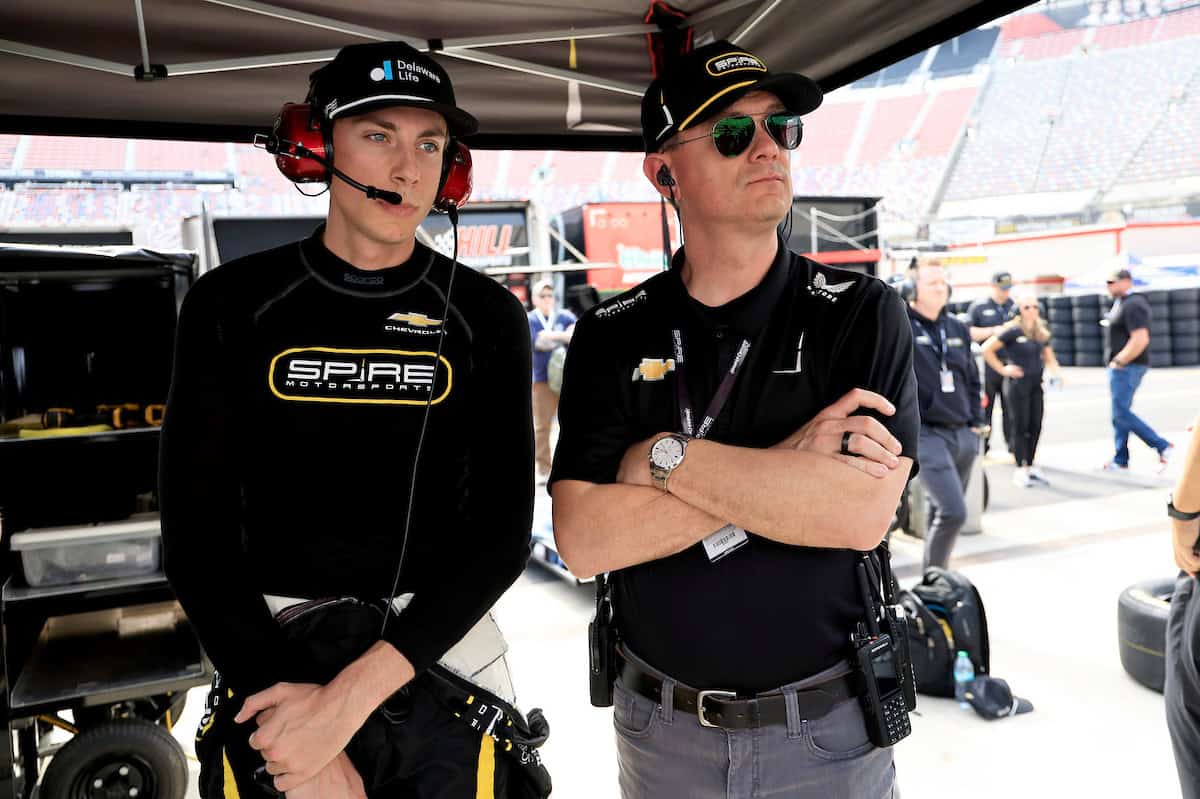
Nearly a month after a hearing for Joe Gibbs Racing’s motion for preliminary injunction against its ex-competition director Chris Gabehart was heard in the Western District of North Carolina, Judge Susan C. Rodriguez issued a ruling on a preliminary injunction as the trial continues to steam ahead.
JGR is alleging that Gabehart misappropriated its trade secrets by taking multiple photos before the two sides parted ways in November 2025, then proceeded to share the confidential information in his possession with Spire Motorsports. Ultimately, JGR is seeking $8 million in damages.
Judge Rodriguez converted a temporary restraining order that Gabehart has been under since March into a preliminary injunction that requires him to return any JGR trade secrets he may have in his possession. The order also prohibits Gabehart from operating in a similar role to his former one at JGR for 18 months, though he may continue with Spire.
Additionally this week, Gabehart’s counsel and Spire filed responses to a motion by JGR for expedited trial that would set a trial date for November 16, 2026.
Need to catch up on everything that went down? Frontstretch has you covered with the key information you need to know from this past week’s events.
Read all of Frontstretch’s content covering the JGR vs. Gabehart/Spire lawsuit here
- After a hearing on March 26 for JGR’s motion for preliminary injunction, Judge Rodriguez issued her ruling in the waning hours of Thursday night (April 24).
- Of note in its history of events and proceedings in the case, Judge Rodriguez stated, “While the forensic analysis could not rule out the possibility, at this time, JGR has not produced evidence that Gabehart sent this information to other outside third parties, such as Spire.”
- Judge Rodriguez also noted that some of Gabehart’s responsibilities at Spire overlap with his previous role as competition director at JGR, but included that “not all” of his duties overlapped.
- The court moved to convert Gabehart’s temporary restraining order into a preliminary injunction, though there is little difference in how it restricts Gabehart.
- The preliminary injunction requires Gabehart to “immediately cease and desist from ‘retaining, transferring, using or copying’ any confidential Joe Gibbs Racing trade secrets and “disclosing JGR’s trade secrets.” Gabehart is also required to return any trade secrets in his possession and not work in any capacity that is similar to his role at JGR for 18 months.
- Judge Rodriguez ruled that “JGR has shown a likelihood of success on the merits with respect to its misappropriation claims against Defendant Gabehart,” citing that Gabehart admitted to taking photos of JGR’s trade secrets and possessing them on his cell phone and personal storage drives.
- However, Judge Rodriguez also ruled that “JGR has not clearly shown that Spire acquired, used, or disclosed any of the JGR trade secrets resulting in actual or threatened misappropriation.”
- Included in the files that Gabehart misappropriated were “comprehensive post-race audit and analyses of team and driver performance for the entire 2025 NASCAR season; complete team payroll details including job titles, contract length, annual compensation, incentive compensation, and compensation plans for prior years; an employee compensation calculator used to project and plan pay for key JGR positions; driver pay for the 2025 and 2026 NASCAR seasons; revenues from sponsors, partners, and other business arrangements for the 2024, 2025, and 2026 NASCAR seasons; JGR’s pit crew analytics for the 2024 NASCAR season; and detailed analytics of racecar tires used to assess impact on race results,” among several other files about JGR’s performance, setups, and data analysis.
- The court went on to say that North Carolina courts have discussed adopting the doctrine of “inevitable disclosure” where an employee is expected to share trade secrets with a new employer.
- Though JGR has acknowledged that the doctrine has not been adopted, Judge Rodriguez pointed out that it continues to ask the court to apply it. “Therein lies the problem. JGR has not specifically identified which trade secrets that Spire has misappropriated or threatened to misappropriate other than information taken by Defendant Gabehart, which at its core is based on the theory that Defendant Gabehart will inevitably disclose such information to Spire,” the ruling read.
- Judge Rodriguez also noted that Spire has cooperated by searching its company files for JGR information and locking Gabehart out of its systems. Spire has also confirmed it previously assisted JGR with identifying sponsor information, but none of its contact with JGR sponsors were a result of Gabehart’s misappropriation.
- Regarding the deleted texts between Gabehart and Spire co-owner Jeff Dickerson, Judge Rodriguez stated she needed a “more fulsome record” and that JGR’s accusations did not have enough to infer intent to tamper with their organization.
- The order also revealed that concerning Gabehart’s non-compete clause, “all bets were off” when Gabehart misappropriated JGR’s confidential information. As a result, Judge Rodriguez ruled that JGR’s 18-month non-compete covenant against Gabhart is “operative” and that his termination was demonstrated to be “for cause.”
- On Monday (April 20), both Gabehart’s counsel and Spire filed a response to JGR’s motion for an expedited trial from earlier in the month that asked the court to schedule the trial for Nov. 16.
- Both Spire and Gabehart requested that JGR’s motion be denied on the basis that the request is “neither reasonable nor necessary,” with Spire calling it “wholly unnecessary.” Both argued that JGR’s proposed trial would give Gabehart little to no chance of defending himself without proper discovery and research.
- Instead, the Defendants requested a trial date for May 3, 2027.
- Spire supported this date by stating that it would have no effect on the 2027 NASCAR Cup Series season, while holding a 2026 trial date would greatly confine itself and Gabehart during the season.
- In their filing, Gabehart’s counsel stated that JGR’s requested date “is an aggressive and unrealistic timeline that would prejudice Mr. Gabehart’s ability to defend himself and assert meritorious counterclaims,” citing that the case is still young and that the Defendants have not yet responded to JGR’s amended complaint.
- Gabehart’s counsel also brought attention to the fact that an ongoing forensic examination of Gabehart’s devices and accounts has not concluded yet.
- The counsel argued that JGR’s proposed trial date “would compress fact discovery, expert discovery, dispositive motions, and trial preparations into a mere seven months,” the brief stated.
- Gabehart’s counsel also contested that while JGR has pointed to deleted texts and files from Gabehart, it hasn’t proven that he shared any confidential information with Spire.
- Additionally, the counsel brought to question why JGR would need an expedited trial after waiting four months to file suit. JGR accused Gabehart of misappropriating its trade secrets in November 2025 but didn’t file the suit until February 19, 2026.
- Gabehart’s counsel argued that JGR’s motion is premature because there are several outstanding items that have yet to be satisfied, such as the sides’ pleadings not closing, the fact that regular discovery has not begun, nor have the parties held a 26(f) conference, where each sides’ counsel meet to discuss potential settlements, discovery plans, information preservation and scheduling.
- The counsel argued that the May 2027 date gave more time to resolve outstanding issues, and that it was still within a quicker window at 15 months.
- Furthermore, Gabehart’s counsel argued that JGR has not shown “good cause” for an expedited trial because its case rests on speculation rather than proven evidence. Both parties demonstrated that a temporary restraining order has already been placed on Gabehart, and that he has been locked out of Spire’s systems.
- Responding to several claims of “irreparable harm” by JGR, Spire contended that JGR has not proven Spire has used any of JGR’s car set-ups, and pointed out that JGR’s performance during the 2026 season has exceeded that of 2025 thus far.
- Similar to Gabehart’s counsel disclosing steps taken to protect him from further allegations, Spire argued it has implemented several safeguards, such as enacting an electronic litigation hold, locking Gabehart out of its system and enlisting a forensic examiner to review Dickerson’s devices and Gabehart’s Spire-issued laptop.
- Spire also maintained that JGR hasn’t presented “good cause,” though, like Gabehart’s counsel, expressed its desire for an expeditious resolution to the case. Spire said that JGR’s forensic examiner deleted information about trade secrets from Gabehart’s devices “after confirming there was no evidence of dissemination.”
- Gabehart asserted that JGR’s proposed trial would cause him to “suffer substantial prejudice” and that he would face “particularized burdens” from the seven-month duration between the suit and proposed trial. He contended that this would cause him to have to “participate in witness discovery, expert witness development, and trial preparation” while simultaneously performing his role at Spire.
- Gabehart’s counsel and Spire argued that the motion should be denied because it doesn’t comply with Local Rule 7.1(b) that “the parties have properly conferred or attempted to confer,” the rule states.
- In its filing, Spire claimed JGR emailed it a proposed Case Management Plan, but Spire offered a counterproposal for a May 2027 trial after discovering JGR’s proposed trial would commence discovery before the forensic investigation of Gabehart’s devices and accounts was completed.
- Furthermore, Spire’s filing stated, “JGR also proposes closing fact discovery on July 16, which would give the parties less than three months to propound and respond to written discovery, collect, review, and produce what will likely be thousands of documents, identify third-party witnesses and pursue third-party discovery, and schedule, prepare for, and take numerous depositions.”
- After sending its counterproposal, in its filing Spire said JGR filed its motion for expedited trial “without responding to or otherwise acknowledging Defendants’ counterproposal.”
- Spire criticized the proposed deadlines submitted by JGR, such as Requests of Production and Rule 26 Disclosures before Spire’s April 27 deadline to respond to the amended complaint, calling those “not just impracticable — it is impossible,” and “untenable.”
- Additionally, Spire accused JGR of contradicting itself through the proposal because the trial would be after the season ends, meaning “the harm it claims to prevent would not be averted.” It also recalled that Gabehart is under a temporary restraining order, while claiming there is “no potential harm to JGR” as the case is pending.
- Spire argued that it and Gabehart are “separate parties with separate defenses,” giving JGR no reason to blend the two parties and limit how much discovery Spire can obtain through a limited timeframe.
- A decision on the motion has not been made at this time.


Luken Glover joined the Frontstretch team in 2020 as a news writer before elevating to a columnist, where he served as the longtime writer for The Underdog House. Currently, he is an editor for the site and conducts feature interviews. Glover has covered several forms of racing for the site including NASCAR, CARS Tour, and SRX events.
A 2023 graduate of the University of the Cumberlands, Glover is a promotional writer, elementary athletic director, and basketball coach. He is passionate about serving in his church, playing/coaching a wide variety of sports, and researching motorsports history.