
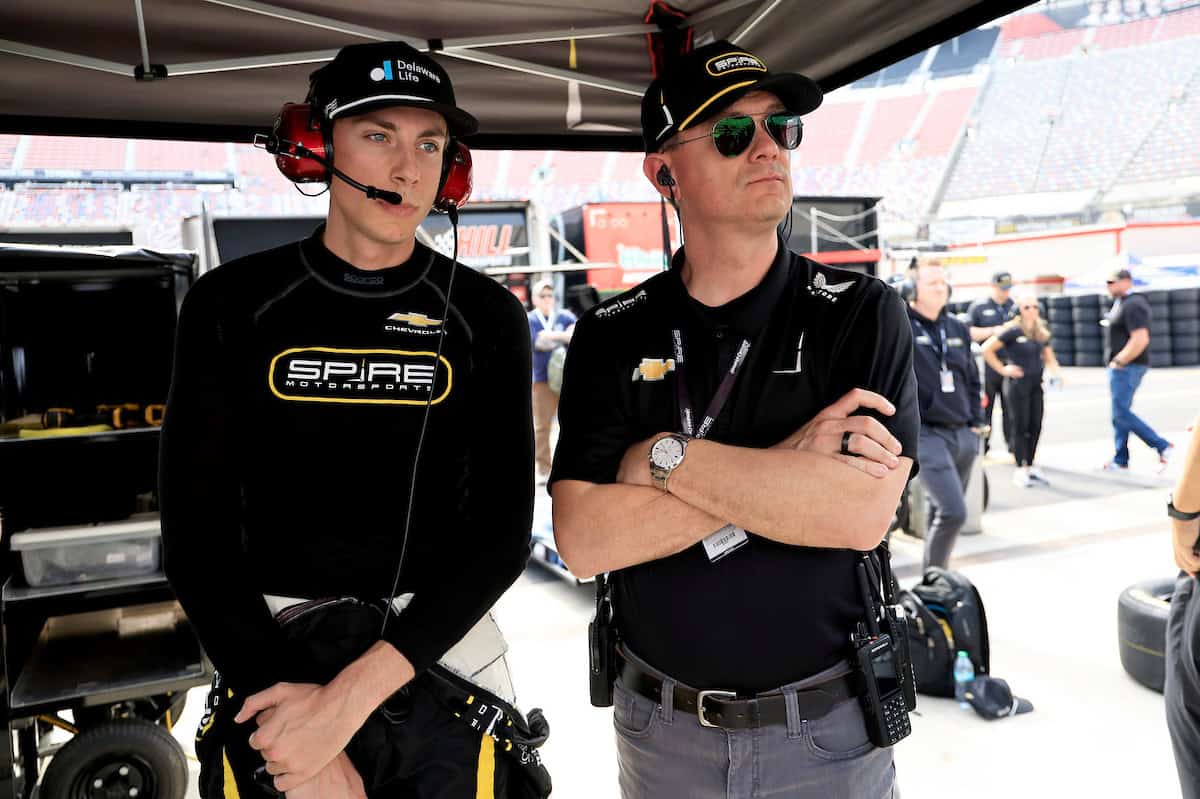
As the case between Joe Gibbs Racing versus its ex-competition director Chris Gabehart and Spire Motorsports approaches its second month, this past weekend’s race at Bristol Motor Speedway became the center of attention in the case.
JGR is seeking $8 million in damages for Gabehart allegedly misappropriating its confidential information and trade secrets, then transferring it to Spire to benefit the team’s performance in the NASCAR Cup Series.
At the center of this week’s battle were photos of Gabehart at Bristol, with JGR using those to argue he was performing in a competition-related role for Spire. Both Gabehart and Spire objected to the claims, spelling out what his involvement with the team was at the track.

With that, let’s take you through what unraveled in the case this week.
Read all of Frontstretch’s content covering the JGR vs. Gabehart/Spire lawsuit here
- On Monday (April 13), JGR filed a notice of supplemental legal authority accusing Gabehart of violating a temporary restraining order placed on him by Judge Rodriguez in March that prohibits him from performing similar duties at Spire to his former role at JGR.
- Gabehart was present for the NASCAR Cup Series weekend at Bristol Motor Speedway last week, with JGR alleging that he performed duties relevant to the competition director role.
- JGR’s filed a declaration from Wally Brown, the competition director at the team, as well as photos of Gabehart at Bristol in Spire attire.
- Brown stated that Gabehart was present for the Cup Series practice and qualifying on Saturday, April 11, noting that practice sessions are “the time when race teams test their race cars on the track to evaluate and refine their car setups through mechanical adjustments in preparation for the race,” the declaration stated. Brown also noted how qualifying has similar objectives in order to impact race strategy.
- The declaration stated that “engaged attendees are typically limited to competition personnel-such as crew chiefs, engineers, competition directors, and other team members with input into car performance. Executives who do not have input into competition typically are not actively engaged in Practice or Qualifying sessions.”
- While Brown revealed he was not at the track that day, other personnel took note of, or photographed Gabehart at the track.
- A photo of Gabehart showed that he was wearing two radios with earpieces at Bristol. Brown stated “Based on my experience, the photographs appear to suggest Chris Gabehart may be engaging in the kind of activities I would expect from someone performing Competition Director-related duties for a NASCAR Cup event.”
- Brown also mentioned that pit road is typically a workstation for team members during practice and qualifying to monitor data, receive feedback from drivers, crew chiefs and engineers, and monitor SMT data from other teams.
- Another photo showed Gabehart under the workstation of one of Spire’s teams during practice, with Brown contesting that in his experience, “the workstation is typically limited to competition personnel with direct input into a Cup team’s on-track performance.”
- A third photo was used by Brown to allege that Gabehart was conversing with Carson Hocevar at the end of qualifying, which Brown argued is evidence that Gabehart was working in a competition leadership role by reflecting on drivers’ qualifying performance and their cars’ handling.
- An additional declaration was filed by David Biro, the content creator and social media manager for Ty Gibbs who took the photos of Gabehart, which showed several photos of Gabehart at the track.
- In addition to its declarations, JGR filed an additional motion in support of a second expedited discovery on Dickerson’s devices, his communication with Gabehart, and both of their cellular providers.
- JGR argued that Gabehart admitted to deleting texts with Dickerson without giving any evidence for why he deleted the texts.
- A motion made by Spire last week contested that JGR was trying to relitigate a motion that had already been denied in its effort for expedited discovery. JGR responded that it sought initial expedited discovery without knowledge of the deleted texts, nor that Gabehart disclosed that information in the initial hearing on March 16.

- In its filing, JGR stated that “the risk of destroying evidence of the transmission of JGR’s trade secrets is just as dire, and the risk of additional destroyed evidence is apparent because Gabehart has already demonstrated his willingness to deliberately delete relevant evidence.”
- JGR alleged that the timeline of Gabehart’s deletion of the texts should be of concern. Gabehart deleted the texts on Nov. 15, eight days after he took photos of of JGR’s trade secrets, two days after receiving an offer from Spire and on the same day he accessed a folder labeled “Spire” on his Google Drive, which JGR’s alleged that it contains its confidential information and trade secrets.
- JGR re-iterated its claims that if Gabehart had nothing to hide, there would have been no reason for deleting the texts. Additionally, JGR stated that Gabehart’s “failure to disable cloud-based syncing” were the reasons his access logs were discovered.
- Contrary to Gabehart’s and Dickerson’s claims that the texts were deleted with no anticipation of litigation, JGR contested that Gabehart’s conduct through the alleged misappropriation of trade secrets is merit for anticipated litigation, as well as his role in investigating a former JGR employee who was accused of stealing confidential information.
- JGR supported its belief that Gabehart should have anticipated litigation based on discovered texts with Dickerson that mentioned “lawsuit” and “settlement talks.”
- Due to the deleted texts, JGR argued that it has been “deprived of […] evidence” in investigating whether Gabehart transmitted confidential information with Spire and if it was shared in other ways as well.
- In support of its third-party expedited discovery on Gabehart’s and Dickerson’s cellular providers, Dickerson’s devices and subpoenas of five other team executives — Joe Custer, Justin Marks, Todd Meredith, Rick Ware and Tommy Baldwin — JGR said those sources are the only avenues to recover communications between Gabehart and Dickerson.
- JGR contested that a litigation hold imposed by Spire to preserve communications and relevant documents does not hold enough weight to overcome the deletion of texts between Gabehart and Dickerson.
- JGR argued that even if Spire didn’t have a role in the deleted texts, it should have anticipated litigation after JGR Chief Commercial Officer Eric Schaffer warned Spire’s president Bill Anthony about hiring Gabehart on Dec. 3, 2025.
- The requests by JGR for third-party subpoenas were recounted, with JGR stating it “seeks to recover what can be recovered and to determine when the autodelete feature was activated—information directly relevant to investigating the deletion,” referring to discovery on Dickerson’s devices.
- The second request related to Spire’s retention policies to see if deleted data can be retrieved, as well as if it can discover when Dickerson activated the autodelete feature on his devices.
- JGR revealed both parties agreed to subpoena Gabehart’s cell phone provider for text messages between Gabehart and Dickerson from Oct. 1, to Nov. 15, 2025, limited from JGR’s initial request that would have spanned from Oct. 1, 2025, through March 13, 2026.
- JGR argued that its subpoenas to other Chevrolet team executives is relevant because those teams may posses evidence that Spire transferred information about JGR’s trade secrets.
- “Even Dickerson acknowledged that Spire shares ‘certain of its own trade secrets and confidential information with its technical alliance partner, Hendrick Motorsports,'” the filing stated.
- The last request asked the court to allow an independent forensic review of Dickerson’s devices to be conducted to see if any texts are recoverable and when he activated the autodelete function.
- Lastly, JGR opposed both Gabehart’s and Spire’s requests for reciprocal discovery on the devices of several key leadership figures at JGR, stating that those should be denied “for violating the Local Rule prohibiting motions in responsive briefing.” JGR said it has exhibited “good cause” for discovery, while Gabehart and Spire have not done so because “the facts are not reciprocal.”
- On Thursday (April 16), Gabehart filed his response to JGR’s notice of supplemental legal authority that contained the photos of him at Bristol.
- Gabehart stated “JGR has resorted to stalking” him and then tried to twist “routine behavior into suggested misconduct.”
- Gabehart denounced JGR’s filing, counteracting it by arguing that evidence was not presented within the briefing schedule and that “JGR has not cited a single case, statute, or piece of legal authority,” the filing stated.
- In response to the photos, Gabehart contested that his duties at Bristol aligned with his position as Spire’s chief motorsports officer, maintaining that Matt McCall serves as Spire’s competition director for the Cup Series. Additionally, Gabehart called Brown’s declaration “speculation,” citing the fact that Brown used “appears” when alleging Gabehart performed competition director-related duties.
- In a third declaration, Gabehart stated “Race weekend attendance is an essential and expected part of any motorsports executive’s role—it enables direct observation of team operations and real-time engagement with personnel.”
- Gabehart argued that in addition to the roughly 15 rostered personnel each participant is allowed to have, “‘Admin level’ personnel are allowed to be on property with the proper credentials.” These include team owners, presidents and executives. Gabehart noted that in addition to himself, JGR owner Joe Gibbs and JGR President Dave Alpern, Legacy Motor Club President Michael Guttilla, 23XI Racing President Steve Lauletta and Hendrick Motorsports Vice Chairman Jeff Gordon were at practice and qualifying.
- Referencing the photo of himself wearing radios, Gabehart maintained that hundreds of personnel across multiple levels of leadership wear radios to monitor team performance.
- Gabehart said that the driver, crew chief and spotter communicate competitions matters, but that since he did not have a microphone, he could only listen to the radio.
- Lastly, Gabehart claimed that in two of the photos taken by Biro, he was looking at the Jumbotron in one and in the other, he was watching monitors with the live TV broadcast of practice, as well as a monitor with the ranking order of drivers in practice and their lap times.
- Spire also filed a response to JGR’s notice of supplemental authority, immediately stating, “It’s déjà vu all over again.”
- Spire said JGR has constantly approached the court with “a new accusation, a newly concocted fake emergency, a new demand, or a new piece of ‘evidence,'” but that each of the demands “rest on speculation.”
- Spire accused JGR of believing that former employees should be “prohibited from so much as showing his face at a NASCAR Cup Series event,” the statement read.
- Furthermore, Spire called JGR’s non-compete term “overbroad,” and claimed it violates North Carolina law.
- Spire then contested that none of the photos show Gabehart sharing or distributing trade secrets.
- Spire asked the court to dismiss Brown’s declaration because his conclusion of the photographs come from an event he was not at, which Spire made a point to note considering Brown is JGR’s competition director.
- The words and phrases Brown used in his declaration such as “appear to suggest,” “may be engaging in,” “likely,” and an “apparent interaction” were scrutinized by Spire, using those to affirm its belief that JGR is presenting the alleged evidence on the basis of speculation.
- “JGR’s entire theory rests on the logical fallacy that attendance at Practice and Qualifying is equivalent to acting as a Competition Director. That is demonstrably false,” the filing read.
- The filing also contained a declaration by Dickerson, who addressed Gabehart’s presence at Bristol and the photos taken of him.
- Dickerson presented that Gabehart was hired as the team’s chief motorsports officer and that he is expected to be at the track across multiple racing series.
- Dickerson re-iterated that McCall is Spire’s competition director, and that Gabehart’s role requires him to be a leader who builds and maintains relationships with team members.
- Like Spire’s response, Dickerson noted how Brown was not present for practice or qualifying while stating that McCall attends every race weekend.
- Dickerson outlined McCall’s duties at the track and that he was “actively engaged in two-way communications with drivers and members of the team.” Dickerson also stated, “This is what it looks like when a Competition Director is locked in and doing their job.”
- Photos of McCall operating at the team’s workstation on pit road and wearing a two-way headset with a microphone were included in the filing.
- Similar to Gabehart, Dickerson listed several team executives were present for practice and qualifying at Bristol who do not perform competition-related duties, including Biro, who Dickerson said was “in close proximity to Spire’s activities that day,” but does not have “competition-related functions.”

Luken Glover joined the Frontstretch team in 2020 as a news writer before elevating to a columnist, where he served as the longtime writer for The Underdog House. Currently, he is an editor for the site and conducts feature interviews. Glover has covered several forms of racing for the site including NASCAR, CARS Tour, and SRX events.
A 2023 graduate of the University of the Cumberlands, Glover is a promotional writer, elementary athletic director, and basketball coach. He is passionate about serving in his church, playing/coaching a wide variety of sports, and researching motorsports history.