
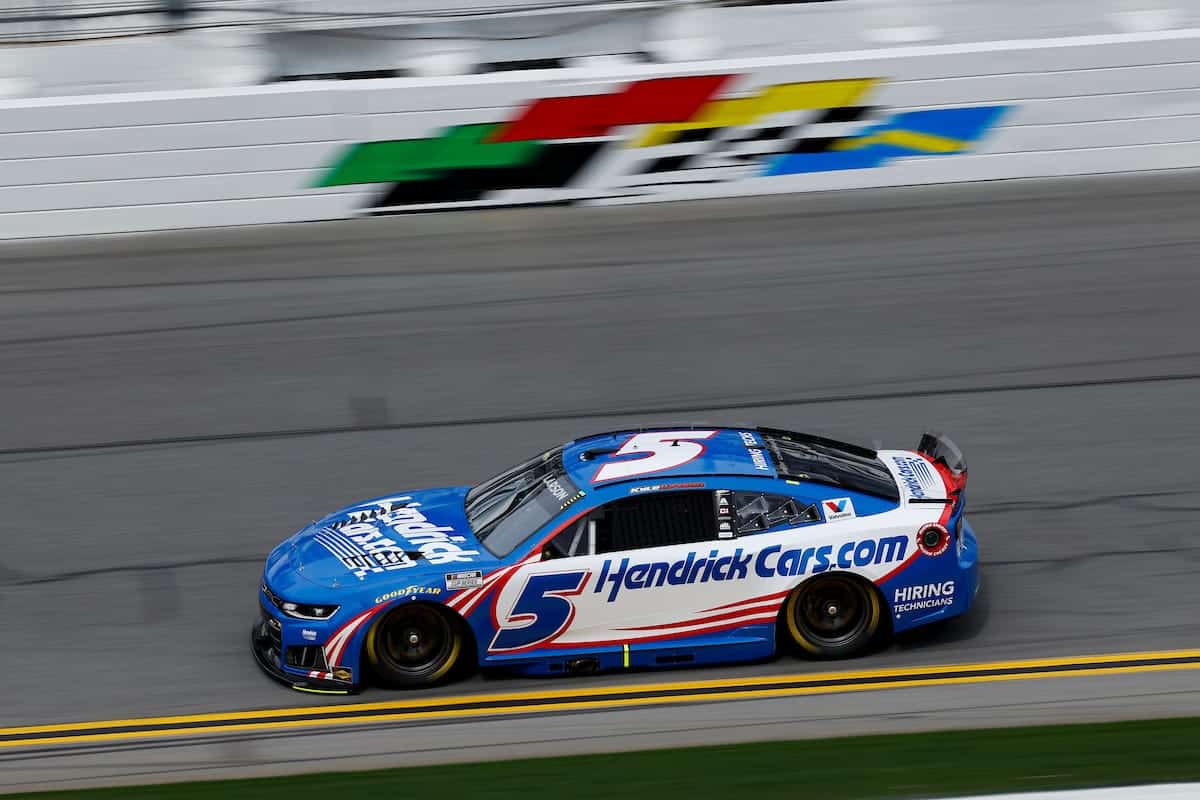
One of the most-discussed storylines so far in the 2026 NASCAR Cup Series season revolves around Kyle Larson and his now-32-race winless streak.
Larson’s last win came at the track the NASCAR Cup Series will head to this weekend, Kansas Speedway, back on May 11 of last year. Despite winning his second Cup championship during this winless streak and currently ranking sixth in points this season, many have described the last 11 months for Larson and the No. 5 team as a slump.
A slump is defined as a “sudden, heavy fall or sharp decline in performance,” and this does not fit Larson’s last 32 races. I want to start off by stating the obvious: It is very difficult to win a Cup race, and it is really difficult to win one in the Next Gen era. This is a time in the sport when the cars are so similar that it is harder for the powerhouse teams to firmly pull away from one another.
The most wins for a driver in a season since 2022 is six. William Byron did it in 2023, Larson in 2024 and Denny Hamlin last year. Larson blew this number out of the water in his first season at Hendrick Motorsports back in 2021, the last year of the Gen-6 car, as he won 10 times. That spectacular season set an unfair expectation for NASCAR fans about what to expect from Larson every season.
Larson has won 16 races since moving to the Next Gen car, the most of any Cup driver during this time. That’s why it’s so surprising that he has not found victory lane in almost one full calendar year, but this is by no means a sharp decline.

Since his last win, Larson has an average finish of 14.5, which is eighth best in the series, and has led 710 laps, good enough for fifth in the series. Those numbers are not otherworldly, but he is still an elite driver in the series who contends for wins more often than not. Larson’s aggressive driving style has also taken him out of races in the past, so he has never posted a series-best average finish since his 2021 championship season.
Over the past 32 races, Larson has a better average finish than teammate Byron by a full position, but since Byron has won two races in that span, no one is talking about him slumping, even after his team’s rough performance at Bristol Motor Speedway last weekend.
A driver that I consider to be slumping shouldn’t surprise anyone, because since his last win in 2023, Kyle Busch has had a very frustrating time at Richard Childress Racing. However, it is common for some legendary drivers in the backside of their careers to experience a sharp decline. It happened to Richard Petty, Jimmie Johnson, Tony Stewart and others, but when a slump comes in the middle of a driver’s prime, it comes as a shock.
So,let’s take a look at some stretches by notable drivers in their primes that are actual slumps.
Jeff Gordon‘s 2008 season saw him go winless for the first time since his rookie year in 1993. Gordon had a hard crash at Las Vegas Motor Speedway in the third race of the season, which is said to have contributed to his disappointing numbers, but he still made The Chase. However, his average finish dropped seven positions after his very consistent, six-win 2007 season.
After his win at Charlotte Motor Speedway in fall 2007, Gordon only won one race until the spring Phoenix Raceway race in 2011. Gordon was still running up front during this time, qualified for The Chase every season and led over 2,000 laps in that span, but his one win over a 114-race span was out of character.
However, Gordon’s biggest slump during his prime came in a season when he won four races, including the Daytona 500. Gordon’s 2005 season saw him miss The Chase for the only time in his career as he ended that campaign 11th in points with an average finish of 17.8 and nine DNFs.
After the 10th race of the season, Gordon was second in the standings, but over the next 21 races, Gordon plummeted down to 17th in points before his end-of-season rally to get up to 11th. That 21-race span was indeed a slump. Gordon had seven race-ending crashes, including three in a row, to go with no wins, 10 finishes of 30th or lower and an average finish of 23.3.

Kevin Harvick also had some tough slumps in the 2000s while driving the No. 29 for Richard Childress Racing. Harvick endured the dreaded sophomore slump in 2002, finishing the season 21st in points, the lowest position of his career. Then he missed The Chase in 2004 and 2005 and only nabbed one win over those two seasons. After winning the 2007 Daytona 500, he did not win again until 2010 at the spring Talladega race, going winless in 2008 and 2009. In that ’09 campaign, Harvick finished 19th in points during RCR’s organizational disaster of a season.
Matt Kenseth‘s biggest slump in his career came at RFK Racing in 2008 and 2009, where he missed The Chase in back-to-back seasons. He went winless in 2008 before winning the first two races of 2009 but did not return to victory lane for the rest of the season and finished 14th in the standings. He also went winless in 2010, leading only 108 laps that year, but made The Chase, finishing fifth in points.
Other notable slumps in the middle of a driver’s prime include Mark Martin in 2001 and 2003, Kurt Busch in 2008 and Carl Edwards in 2009. Dale Earnhardt Jr. had multiple slumps in the middle of his career. His first came in both 2005 and 2007 at Dale Earnhardt Inc., which was part of the reason why he left DEI for Hendrick Motorsports. At Hendrick, he started strong in 2008, then had two miserable seasons in 2009 and 2010 before returning to The Chase in 2011 but remained on his long winless drought until summer 2012.
Using a present-day example, a driver currently going through a slump in the middle of his prime years is Ross Chastain. Trackhouse as a whole has not looked strong thus far in 2026, aside from Shane van Gisbergen at Circuit of the Americas and his steady improvement on the ovals, but Chastain’s No. 1 team has especially taken a step back in performance.
Chastain’s last win came at the Coca-Cola 600 last year, which was the next points race after Larson’s last win at Kansas. Since that victory in Charlotte, Chastain is winless over the last 31 races, and part of why this stretch can be called a slump is the fact that he has only led 55 laps since that win.
His average finish is 17.9 during this span, and he currently sits in 21st place in points, 24 behind van Gisbergen for the final Chase spot. There is still plenty of time for Chastain to turn his season around, but so far, he has been invisible outside of his third-place finish at EchoPark Speedway.
Unlike Chastain, Larson has shown race-winning speed despite his dry spell in the win column, as he proved last weekend at Bristol by sweeping both stages. It is very possible for Larson, Cliff Daniels and the No. 5 team to once again win at Kansas on Sunday and finally put this winless drought to bed.
Although this has been the longest time Larson has gone without a win in a Hendrick car, this should absolutely not be regarded as a slump.


Michael Bellifemini joined Frontstretch in February 2026 as a contributor. Bellifemini was born and raised in New Jersey and graduated from Seton Hall University. He called Seton Hall men's and women's basketball games for their college radio station, 89.5 FM WSOU, and continues to broadcast in the area. Outside of covering NASCAR, Bellifemini is also an avid baseball, football, basketball, and hockey fan and enjoys watching different sports leagues on a daily basis.
1000% agree. I’m no Larson fan, but to me, the narrative he’s in a slump has no basis in fact. But for a late caution, he likely would have won just this week.