
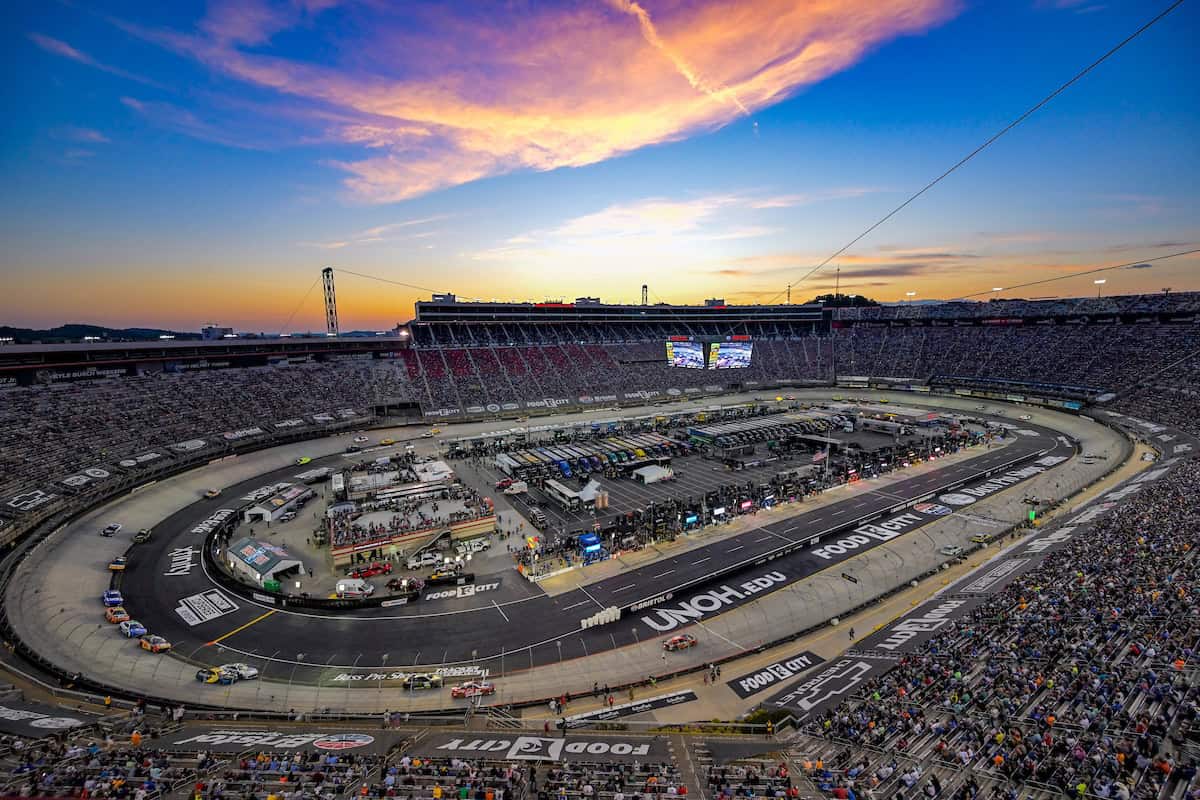
Did You Notice? … Bristol Motor Speedway likes to coin itself as The Last Great Colosseum. For decades, NASCAR gladiators wrote a chapter book on how to grow stock car racing, their front bumpers busting through traffic and glimmering under the summer lights in front of a cheering crowd of 160,000-plus. The hype for Bristol races wrote itself, history happening so naturally here you could build a Hall of Fame around its finishes alone.
But if NASCAR is serious about fixing itself, it must face a hard truth: The World’s Fastest Half-Mile has lost a step. A racetrack that was once a must-see event for any serious stock car fan hosted a race Sunday (April 12) in which there were tens of thousands of empty seats. The sport stopped releasing attendance figures long ago, outside of sellouts, but it was hard to miss the gaps between the crowd on TV: giant sponsored seat tarps covered the rest.
The ratings for this year’s Food City 500, released this week, were hard for the industry to swallow: they dipped below two million in viewership for the first time since NASCAR’s national TV contract came into effect in 2001. As recently as two years ago, the race pulled in a total of 3.8 million viewers on FOX; this time around, the total was cut in half (1.945 million).

Some will say the Masters golf tournament, a crown jewel all its own, siphoned away a large part of the audience on CBS. It’s also true the race was televised on cable (FOX Sports 1); being on the national networks of Fox, NBC, ABC, etc. still make a big difference.
But during Bristol’s heyday, competing sporting events and audience reach were never a problem. Back in 2006, my first year of working NASCAR television, the race was a hit: the Bristol spring race posted a 6.2 Nielsen rating (as opposed to 1.09 in 2026) and viewership that was just shy of 10 million. Its main competition that weekend? None other than the NCAA Men’s Basketball Tournament, an audience that also drew some 10 million viewers in its own right.
This downturn happened in the midst of a race that, on paper, had everything you could ask for: a first-time winner (Ty Gibbs) and an overtime, side-by-side finish. The margin of victory between Gibbs and Ryan Blaney? 0.055 seconds, one of the closest in track history.
But even in the best of endings, you could see the cracks in Bristol’s facade. A track whose reputation was built on contact didn’t have a hint of one out front during a flurry of late cautions, including the one that forced overtime. In Bristol terms, you could have fit an entire continent (Australia?) between Blaney and Gibbs. Some might call that respect.
It just used to work differently in the Last Great Colosseum. Dale Earnhardt pioneered some of the most famous endings, like this one in 1995…
Or 1999…
The final score was Earnhardt, one win, Terry Labonte, one win, and memories for the crowd that lasted a lifetime. These were just two of the many moments that Bristol produced in the 1990s and early 2000s; Jeff Gordon’s bump-and-run on Rusty Wallace in 1997 also comes to mind.
Back then, Bristol was a one-groove oval where passing proved next-to-impossible without contact. The only way to get by a guy when you were just a little faster wasn’t to find a different spot on the track; it was to find a spot on his rear bumper and slam the ever-living crap out of it. It was a bullring of bumper cars that produced action at every turn and frustrated those who couldn’t use contact to their advantage.
And when that contact reached out and bit you? It was easy for the tempers to boil over, leading to the type of on-track antics and famous sound bites that made the office rounds Monday morning.
But in 2007, everything changed. Not only did the Car of Tomorrow chassis enter the Cup Series, Bristol underwent a renovation designed to give the drivers more room to race. Multiple grooves turned the track into a mini-Kansas Speedway, drivers able to race the top or the bottom as if they were running a 1.5-mile intermediate.
Here’s the problem: Bristol was never sold as a 1.5-mile intermediate. Gladiators don’t try and give each other room to work. So, after an initial honeymoon period for some (me included!) people began to miss the one-groove bullet train Bristol left behind. Gone were the tempers and the crashes; in its place was a whitewashed racetrack with more room to pass than your local highway.
These days, watching passes at Bristol aren’t exhilarating; they’re exhausting. You can get alongside a guy but it takes 15 or 20 laps to inch past as you both battle two separate grooves. It’s minutes of watching a yo-yo where the faster driver, if they’re lucky, will clear the competition as long as his tires don’t wear out first.

Every once in a while, lapped cars will enter the fray and make the racing that much more interesting. But using contact to bump guys out of the way, at least on the Cup side, isn’t something you see at Bristol all that often anymore. NASCAR’s newest Next Gen chassis is part of the problem, cars that grip so tightly to the track you might put a bulldozer behind them in the middle of a turn and they won’t spin around.
Damage from contact is also harder to spot, a more indestructible chassis that’s good for safety but bad for fans looking to see these race cars look race worn by the end of Bristol. You’re not supposed to leave here with a car that could get sold in a showroom; the allure of this track was seeing cars slam themselves straight to the junkyard.
Maybe fans were channeling their own inner road rage through seeing others duke it out. The frustration you can’t release stuck in traffic on your daily commute, that guy on his cell phone not paying attention who just cut you off? Bristol was the place you watch people spin each other out for such a mistake, then get out and yell or do something silly that made you forget why either one was mad in the first place. It was entertainment at its finest, a Bristol brand that took decades to complete.
A brand that now may take decades to rebuild. It’s clear the Next Gen chassis needs work on the short tracks but Bristol itself may need another renovation. They’ve tried it as a dirt track for a bit with mixed reviews; you also can’t just switch it back to the past configuration. Martinsville Speedway, another short track suffering these days, has more of a single-groove feel and it’s impossible with these cars to root someone out of the way. Reach out for Bristol circa 1995 and you may get 500 laps of a freight train, 40 cars just running in place.
Solutions aren’t going to come easy. But the first step needs to be admitting you have a problem. Are NASCAR, track owners Speedway Motorsports, Inc. and team owners willing to do that?
We’ll soon find out.
Follow Tom Bowles on X at @NASCARBowles


The author of Did You Notice? (Wednesdays) Tom spends his time overseeing Frontstretch’s 50+ staff members as its majority owner and Editor-in-Chief. Based outside Philadelphia, Bowles is a two-time Emmy winner in NASCAR television and has worked in racing production with FOX, TNT, and ESPN while appearing on-air for SIRIUS XM Radio and FOX Sports 1's former show, the Crowd Goes Wild. He most recently consulted with SRX Racing, helping manage cutting-edge technology and graphics that appeared on their CBS broadcasts during 2021 and 2022.
You can find Tom’s writing here, at CBSSports.com and Athlonsports.com, where he’s been an editorial consultant for the annual racing magazine for 15 years.
The repave ruined Bristol. Full stop. Other factors have exacerbated Bristol’s waning popularity, but the repave is the culprit.
What made Bristol great was the single low groove. Because it was low groove only, you could bump someone and move them up the track, without wrecking them. Because it was low groove only, bump and run was often needed to make a pass, whereas now, you’d just drive around them in whichever groove they’re not using. Bristol’s magic was forced aggression, if you wanted any chance of succeeding. The repave has turned it into just another track. If they don’t fix the track, nothing else will matter.
Secondary issues:
Stage racing is stupid. No strategy, no risers and fallers based upon tire management, and roughly 2/3 of every race is nothing more than qualifying for the final 1/3 of the race.
I hear so much about the bump and run being dead, but we saw a bit of it Sunday, before the top groove came in and returned us to current Bristol racing. I agree the current car is far too planted, but Bristol’s problems predate this car. Still, a car with less downforce and more suspension travel would make for a better show.
Of course, time slot matters as well. Given NASCAR’s waning popularity and aging fan base, it seems silly to put Bristol directly up against The Masters. I fully understand why the average race starts later than it did when NASCAR was predominantly a southeastern sport.
Still, I’d have to think this week, of all weeks, should have been an exception. Green flag at 1pm would have had the race winding down well before any major drama was occurring in Augusta, Georgia. It may surprise some, but there is some overlap between golf fans and auto racing fans. I’d think even some of our friends on the west coast would have been happy to be able to watch both events.
Again though, fix the track. Otherwise, enjoy your empty stands, no matter how much glorified pine tar you put on the bottom groove.
I believe Tom Bowles covered all of the bases, he really did his homework! As for NASCAR I would think they would have a lot of sleepless nights. Their popularity shows the answer is they have no answer!
I don’t watch to see drivers wrecking each other out of the way. Multiple cautions for spins does not make a good race to me.
But I do see the point of less Bristol excitement since the repave. Rather than three grooves with 2* banking between each section, make it two grooves with 2* banking each. The top lane has too much banking (4* more) and makes the top too equal to the bottom. We saw how much drive off Ty Gibbs had compared to Ryan Blaney at the end.
Having said that, I would like to see the outside grooves at Martinsville and New Hampshire raised 1* at their next repave. Being on the outside at those tracks is almost a death sentence.
Amen Tom.
Unfortunately I think it’s beyond NASCAR’s ability to fix.
Worst thing Nascar could do is take a race away from this place, despite the doom and gloom of this article. Its a unique track on the schedule and Nascar could use plenty of them. We certainly don’t want it replaced with another road course or mile and a half track.
And if I’m not mistaken Bristol’s capacity about 200k. Other than maybe Daytona, Nascar is not getting that kind of attendance for any race so its not a surprise the place looked empty. But I did hear a 70k attendance estimate. Not too bad if you ask me since typically Nascar gets less than that most Sunday’s .
Here’s a definite factor, Bristol is in Tennessee, right? Not that many blue haired nose ring wearing people go to NASCAR races.
The empty stands and poor viewership numbers on television tell you what the fans think.
The stage breaks and endless TV commercials ruin the show. Restarts are good for a few laps, but I lose interest rather quickly these days. I find other things to do around the house and check on the race from time to time. I’ll watch the last 30 laps of most races because IMO they’re the best we’re going to get anyhow.
NASCAR is making money, but it’s not from selling tickets.
I really wanted to comment on the ;lack of starpower; article, but there’s no ‘post comment’ box at the end of the article…so I guess I’ll post it here. Back when Nascar had stars loke Petty and Earnhardt and Martin, coverage of the sport in print and on TV was fairly extensive. Television in particular had several shows that featured racing, interviewed lots of drivers, and gave fans a way to get to see the various personalities. Drivers also used to sign autographs at their souvenir trailers, another chance for fans to have a personal contact with drivers, even if they didn’t have pit road passes. I had no idea that Austin Cindric had such a great sense of humor and quick wit until he had to fill in during a rain delay while working pit road on a ‘drivers only’ race. There are, I’m sure, plenty of drivers that would benefit from more exposure that isn’t just based on ‘what does your car need and how did it feel’ sort of interviews. Winning isn’t everything for a driver being popular. look at Ken Schrader and Kenny Wallace. Neither were the winningest drivers, but their personalities made them very popular. So, before you bemoan the lack of ‘stars’, look to the opportunities for fans to get to know drivers.
Noticed the same about Cindric, on one of last week’s broadcasts.
He caused me to laugh out loud more than once. His comment about noticing the car Mikey destroyed at Bristol years ago was sponsored by Kool-Aid was hilarious. It never occurred to me the Kool-Aid man almost knocked the wall down. OH YEAH!!!
Was also funny when Mikey prompted him about a car with a tire rub. He replied something to the effect of “yeah, you generally need all four of those”, referring to the tires.
Bristol’s attendance is not unique. Many other tracks increased their seating capacity only to tear down half their grandstands when the attendance boom tanked.
The “colleseum” style of Bristol’s grandstands make it near impossible for the owners to reduce the number of seats. So they are left with expanses of empty seats.
Maybe the age of the automobile is coming to an end and Motorsport with it …