
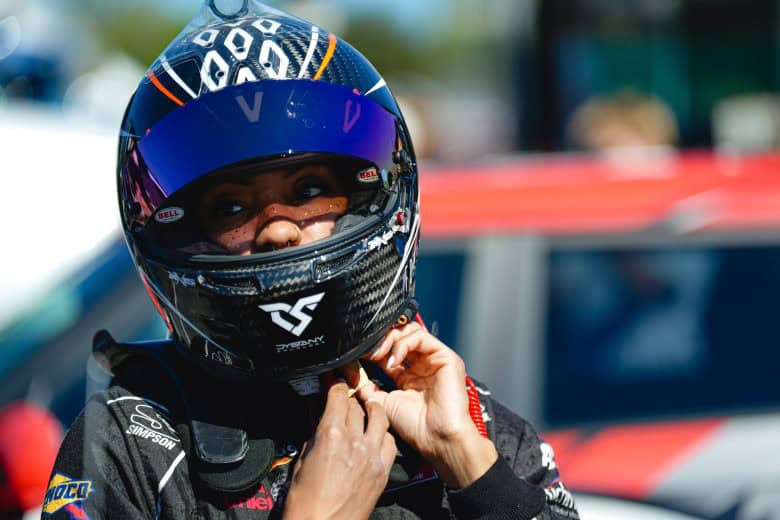
It’s something that would make any sports fan grow up happy: hearing the clanking of bats in your front yard from Wrigley Field, the shaking and roar of the crowd at Lumen Field in Seattle or living front and center near Lambeau Field. Being able to hear iconic moments or smell the air on game day is the peak for any sports fan. For Dystany Spurlock, she had just that, but in another way.
The drag racer turned stock car driver grew up in Richmond, Virginia, just outside of Richmond International Raceway. And on those night races around the Virginia short track, she could hear it out her front door.
“NASCAR has always been my heart,” she said to Frontstretch. “My grandfather is the one who showed me NASCAR on TV, so we would watch. He would open up the doors so we could hear the cars outside while we were watching it.”

While she had a love for NASCAR, her path into the sport was a bit unique — and delayed. Spurlock cut her teeth drag racing motorcycles from just riding with her parents as a kid.
“I used to ride on the back of the motorcycle with them when I was little,” she said. “I went to the dragstrip when I was 12 because my godfather was drag racing. I was like ‘Mom, I want to do this!'”
Most kids at 16 get their first car. She, however, got a motorcycle.
During her time racing bikes, her eye was always on the goal of making it into NASCAR at some point, which led her to racing other cars. Some deals did not work out.
“This has been a journey since I started drag racing — I had some deals that fell through,” she said. “For two years in Richmond, I did some Arena Car racing, fast-forward some and did some stuff with Skip Barber, and I raced Formula 4 for one year. In 2013, I had an opportunity to race late models, but it fell through.”
If the natural order of the racing business wasn’t enough, the pandemic caused by the COVID-19 virus in 2020 set her back even more.
“This isn’t something new that just came out of nowhere,” Spurlock said. “It has always been the thing I’m working towards, trying to get the right team, the right people, the right backing, and now we have it with Foxxtecca — so we’re here!”
It’s no secret that going in a straight line on a motorcycle is not the same as taking some laps on an oval in a heavy stock car. Due to her experience in Formula 4, it was more about the techniques rather than driving something different.
“I can’t really say it’s crazy because I’ve raced these cars in Formula 4, it’s just about learning the tracks and different car styles,” she said. “At a dead stop, we’re going super fast down the drag strip, about 200 mph in six seconds. The speed aspect of it, it’s kind of the same.”
It takes a special, strong person to withstand the trials and defeat when the plans laid out do not come to fruition or are ripped from under their feet. For Spurlock, it was for a bigger purpose and she has a supportive village.
“My family, it’s always been bigger than me,” she said. “I love to race motorcycles and cars, but I’ve always wanted to be that example where other little boys and girls can look at me and see I never gave up, I never stopped. That’s why I kept going.”
Spurlock became the first black woman to race in a NASCAR series on March 28 in the ARCA Menards East series. MBM Motorsports’ Garage 66 team was who she raced for and was credited with being instrumental in her career.
“My team at Foxxtecca, the Carls [Long], Jason Smiths … like when you get people around you who really love you, care, and know what it is that you want, and they believe in you, that’s all you need.”
Spurlock finished seventh in her debut at Hickory Motor Speedway, with her next races coming up at Rockingham Speedway and Kansas Speedway.
“We’re going to stay focused, keep learning, keep digging, and who knows where we’ll be by the end of the year?”